Apple Macintosh Classic
[Vin65]
The Apple Macintosh Classic, released in 1990, was notable for being the first Macintosh to sell for under $1,000, making the Macintosh experience accessible to a much wider audience. Its most distinctive features included a compact all-in-one design with a 9-inch monochrome display, an 8 MHz Motorola 68000 processor, and the inclusion of the Apple SuperDrive, which could read and write multiple disk formats. The Macintosh Classic played a crucial role in expanding Apple’s market share during a time when inexpensive IBM PC clones were flooding the market, and it set the stage for Apple’s ongoing emphasis on design simplicity and accessibility.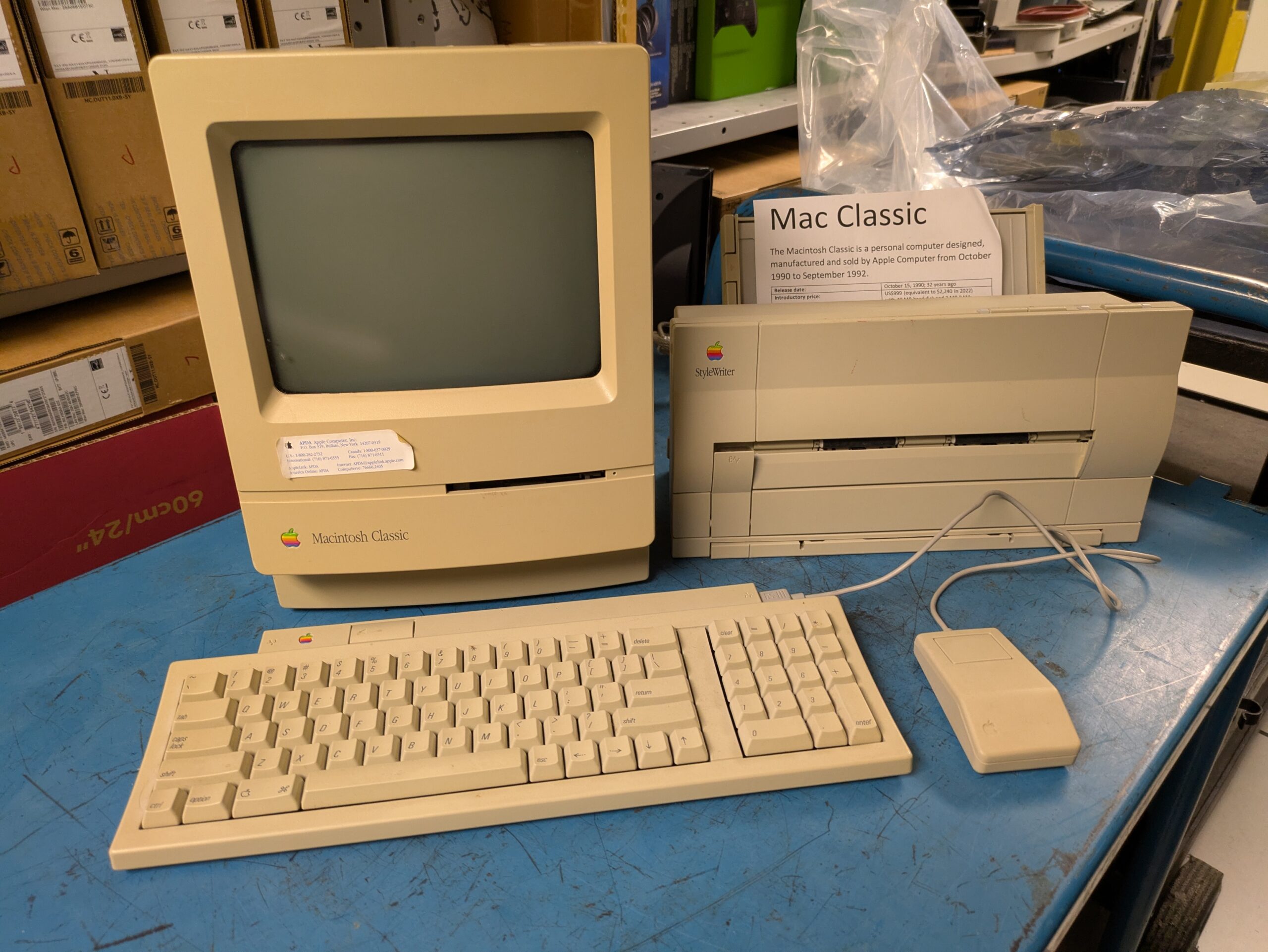
- Manufacturer: Apple Computer Inc.
- Released: 1990
- Type: Personal Desktop Computer
- Cost at release: USD $999 (CAD ~$2,400 adjusted for inflation)
- MIPS: 0.7 (700 KIPS)
Hardware Specifications
- CPU: Motorola 68000, 8 MHz
- RAM: 1 MB standard, expandable up to 4 MB using 30-pin SIMMs and a memory expansion card
- ROM: 512 KB
- Display: 9-inch monochrome CRT, 512 × 342 pixel resolution
- Storage:
- 1.44 MB SuperDrive floppy disk (standard)
- Optional 40 MB SCSI hard disk drive
- Ports:
- 1 × ADB (keyboard/mouse)
- 2 × mini-DIN-8 RS-422 serial ports (printer, modem, AppleTalk)
- 1 × DB-19 (external floppy)
- 1 × DB-25 SCSI (external hard drive, scanner)
- 1 × 3.5 mm headphone jack
- Audio: 8-bit mono, 22 kHz output
- Expansion: No internal expansion slots except for RAM
- Power Supply: 76 watts
- Weight: 16 lbs (7.26 kg)
Operating System & Programming Languages
- O/S: System 6.0.7 and supported all versions up to System 7.5.5. It also included a hidden System 6.0.3 in ROM, which could be accessed with a specific key combination during boot
- Programming Languages:
- Pascal (the standard language for early Mac development; Apple’s APIs and documentation were written for Pascal, and tools like Think Pascal and MPW Pascal were widely used).
- C and C++ (became increasingly popular in the 1990s, with environments like Think C and MPW supporting them).
- Assembly language (68k assembler was used for performance-critical code and low-level programming).
- BASIC (such as MacBASIC, though Apple discontinued official support in the mid-1980s, and third-party BASIC interpreters were available).
- Other languages: Free Pascal and other Pascal dialects could be used, and scripting or interpreted languages like HyperTalk (for HyperCard) were also available.
Notables
- The Macintosh Classic was the first Macintosh to sell for under $1,000, making it Apple’s most affordable Mac at the time and broadening access to the Macintosh ecosystem. it is remembered as a pivotal model that democratized Macintosh ownership, making Apple computers accessible to students, educators, and home users.
- It featured a secret internal ROM disk: by holding Command–Option–O–X at startup, users could boot from a hidden 357 KB System 6.0.3 disk in ROM—unique among Macs.
- The Classic was essentially a slightly faster, rebranded Mac Plus, with only modest improvements, prompting some criticism for its outdated specs even at launch.
- It lacked expansion slots, a cost-saving measure that returned to the sealed, simple design philosophy of the original Macintosh.
- The brightness knob was eliminated; screen brightness was controlled by software instead.
- Its industrial design was the final adaptation of Jerry Manock and Terry Oyama’s original Macintosh 128K case, with a more curved front bezel that influenced Apple’s 1990s product aesthetics.
- The Classic was widely adopted in schools and education due to its low price and robust library of educational software
Donated by: Doron Nussbaum