[Vin67]
Released in January 1989, the Macintosh SE/30 squeezed the 32-bit Motorola 68030 CPU, 68882 FPU, and up to 32 MB of RAM into Apple’s compact 9-inch all-in-one case, making it the fastest and most expandable “classic” black-and-white Mac. Its claim to fame was delivering Macintosh II-class performance, including a hard drive, high-density SuperDrive and a Processor-Direct Slot for network or colour-video cards, in a portable footprint beloved by publishers and as small office servers; three prominent Mac commentators later crowned it “the best Mac ever”. The model sold well for a niche machine (Apple kept it in the line until 1991 despite newer Classics) and was popular enough that logic-board upgrades let thousands of earlier SE owners convert their units
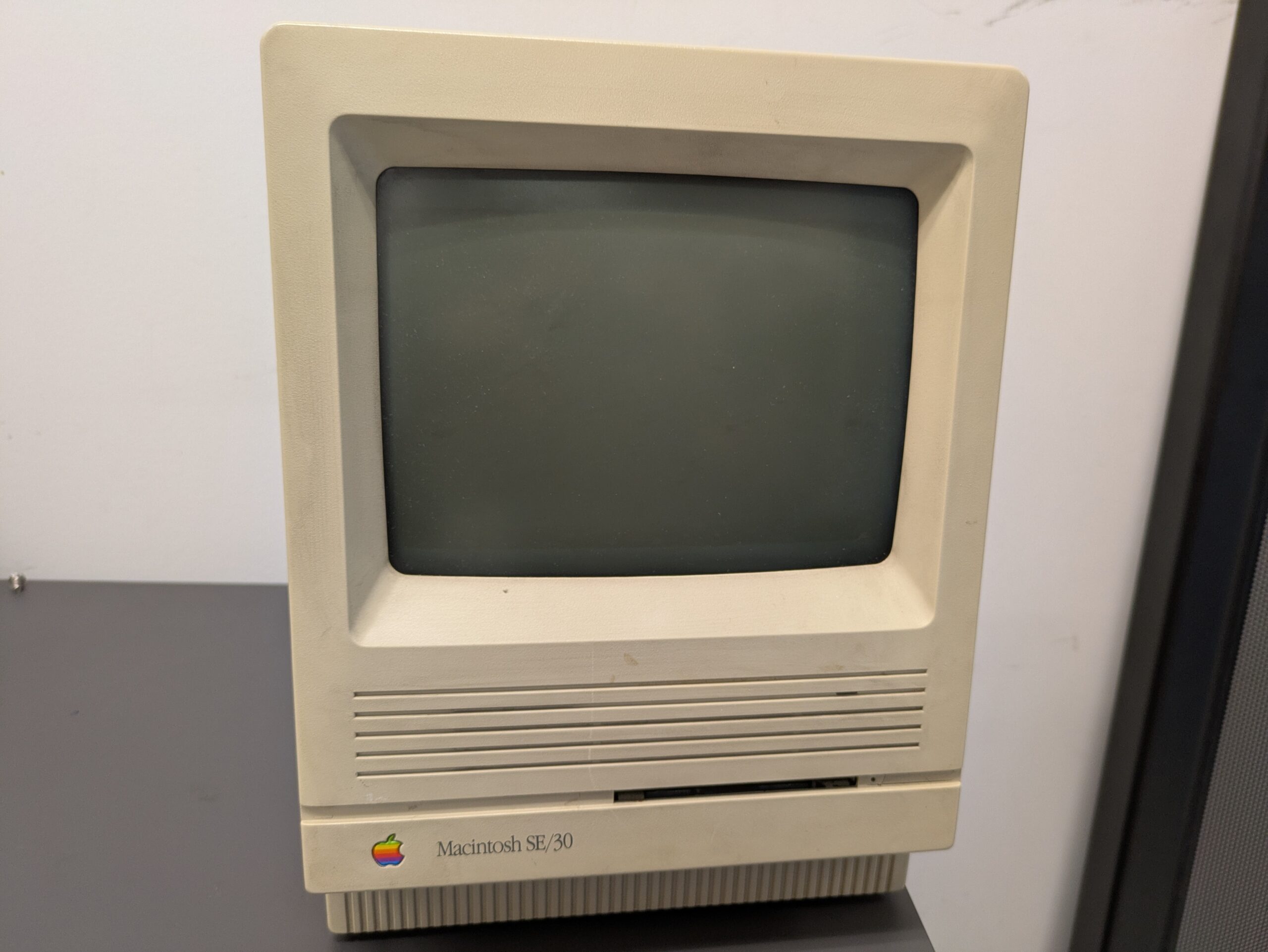
- Manufacturer: Apple Computer Inc.
- Released: 1989
- Type: Personal Desktop Computer
- Cost at release: USD $4,369 (CAD ~$11,000 adjusted for inflation)
- MIPS: 2.5
Hardware Specifications
- CPU: Motorola 68030, 16 MHz (32-bit CPU)
- Floating-Point Unit: Motorola 68882, 16 MHz
- RAM: 1 MB standard, expandable up to 32 MB (8 slots for 30-pin SIMMs, 120 ns)
- ROM: 256 KB
- Display: 9-inch built-in monochrome CRT, 512 x 342 pixels resolution
- Video Memory: 64 KB VRAM
- Storage: 40 MB or 80 MB internal SCSI hard drive (some models shipped without a hard drive)
- Floppy Drive: 1.44 MB SuperDrive (auto-inject)
- Expansion: 1 SE/30 Processor Direct Slot (PDS)
- Ports: 2 ADB, 2 serial, 1 SCSI (DB-25), external floppy (DB-19), audio out, built-in speaker
- Weight: 19.5 lbs (8.8 kg)
Operating System & Programming Languages
- O/S: System 6.0.3 and officially supported classic Mac OS versions from System 6.0.3 up to System 7.5.5. With special modifications (such as a “32-bit clean” ROM upgrade), it could run Mac OS 7.6.1. The SE/30 was also capable of running A/UX, Apple’s Unix-based operating system, and alternative Unix variants like NetBSD
- Programming Languages:
- C (THINK C, MPW C, Metrowerks CodeWarrior)
- Pascal (Mac Pascal, Turbo Pascal, MPW Pascal)
- Assembly (Motorola 68k assembler)
- BASIC (Microsoft BASIC, True BASIC)
- Modula-2 (Metrowerks Modula-2)
- Fortran (MPW Fortran)
- HyperTalk (HyperCard scripting)
- Logo
- AppleScript (from System 7 onwards)
- Perl, AWK, Shell scripting (under A/UX or NetBSD)
- Python (early versions such as MacPython 1.5.2 on System 7)
- C++ (later via Metrowerks CodeWarrior and Symantec C++)
Notables
- Naming Quirk: Apple almost named it the “Macintosh SEx” (for 68030 CPU, following the IIx naming), but marketing wisely opted for SE/30.
- Upgradeable: Owners could upgrade a regular SE to SE/30 specs via a logic board swap, a rare official Apple upgrade path.
- RAM Ceiling: Officially supported 32 MB RAM, but with software like MODE32, could address up to 128 MB—an extraordinary amount for a compact Mac in 1989.
- Color on a B&W Mac: With a rare Micron Xceed video card, the SE/30 could display grayscale or even color on an external monitor—something not intended by Apple.
- Museum Piece: The SE/30 (and its sibling, the SE) was displayed at the Museum of Modern Art in New York, highlighting its design legacy.
- Pop Culture: Made cameo appearances in TV shows like “Seinfeld” as Jerry’s computer
- Apex of Classic Macs: Regarded as the most powerful and expandable of the original compact Mac line, blending small size with workstation performance
Donated By: Arlen Michaels