SUN Blade 150

[VIN74]
The Sun Blade 150, introduced by Sun Microsystems in 2002, was a notable entry-level 64-bit UNIX workstation designed for technical and business environments needing robust performance at an affordable price. It used the UltraSPARC IIi processor (up to 650 MHz with 512 KB L2 cache), support for up to 2 GB of ECC memory, advanced graphics options including the XVR-500 3D accelerator, and modern I/O (USB, FireWire) – all at a price point less than half that of comparable HP or SGI systems, making it a highly attractive upgrade for the vast installed base of Sun Ultra 5 and Ultra 10 workstations. The Sun Blade 150 was important in computing history because it democratised access to 64-bit UNIX workstations, delivering significant performance and graphics improvements.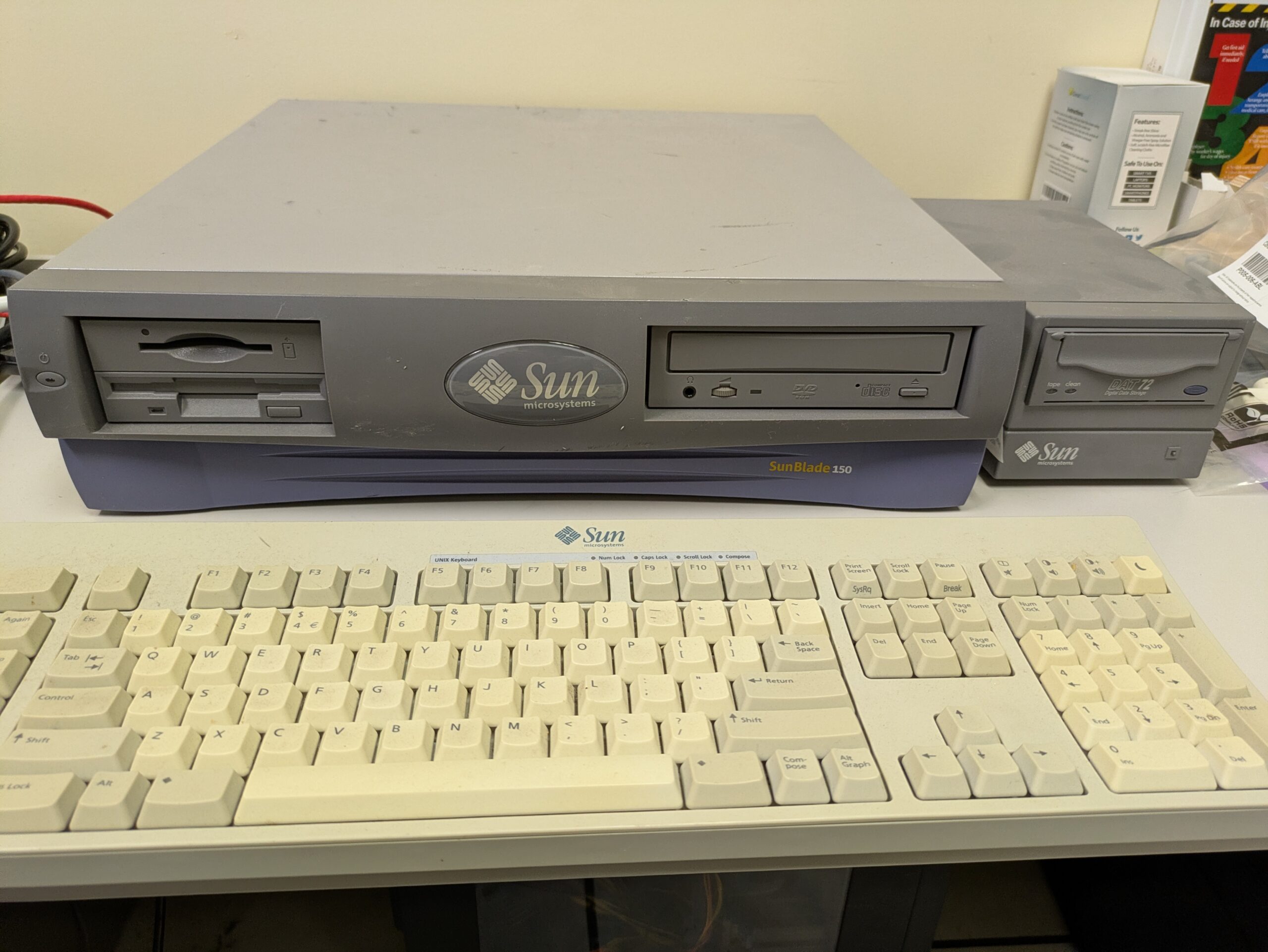
- Manufacturer: Sun Microsystems
- Model: Blade 150
- Released: 2002
- Type: Desktop
- Original Pricing (2002):
- Base model: $1,395 USD (550 MHz CPU, 128 MB RAM, 40 GB HDD, 2D graphics) (CAD $3,600 adjusted for inflation)
- Mid-tier: $1,995 USD (650 MHz CPU, 256 MB RAM) (CAD $5,100 adjusted for inflation)
- High-end: $3,395 USD (650 MHz CPU, 512 MB RAM, XVR-500 3D graphics, DVD-ROM) (CAD $8,750 adjusted for inflation)
- MIPS: ~429 (estimate)
Hardware Specifications
- Processor: UltraSPARC IIi, 550 MHz or 650 MHz, with 512 KB L2 on-die cache.
- Memory: Up to 2 GB PC133 ECC SDRAM (4 DIMM slots; later models supported up to 4 GB).
- Storage: Standard: 40 GB 7200 RPM ATA66 IDE hard drive expandable up to two internal 80 GB 7200 RPM IDE drives (max 160 GB).
- Graphics: On-board Sun PGX64 2D graphics (8 MB RAM) and optional Sun XVR-100 (2D), Sun XVR-500 (3D) graphics accelerators.
- Expansion Slots: Three 32-bit, 33 MHz PCI slots (full-size, 5V).
- Optical Drives: 48x CD-RW or 16x DVD-ROM (one bay).
- Floppy Drive: 1.44 MB, 3.5-inch manual-eject.
- Networking: 10/100 BaseT Ethernet (RJ-45).
- USB Ports: Four USB 1.1 ports.
- FireWire: Two IEEE 1394a (FireWire) ports.
- Audio: Four audio ports (line-in, line-out, mic-in, speaker-out).
- Smart Card Reader: Integrated (SCR 443).
- Power Supply: 250 watt
Operating System & Programming Languages
- O/S: Solaris Operating System, with official support for Solaris 8, Solaris 9, and later Solaris 10
- Programming Languages:
- C and C++ (via standard Solaris development tools)
- Java (Java 2 SDK and runtime were preinstalled)
- Perl (preinstalled and available as open source)
- Fortran (commonly used in technical and scientific environments on Solaris)
- Shell scripting languages (sh, csh, ksh, bash, etc.)
- Other languages such as Python and Tcl/Tk, which could be installed by users
Notables
- The Sun Blade 150 was a price leader in 64-bit UNIX workstations, the Sun Blade 100, while costing less than half of comparable HP systems.
- It featured a built-in smart card reader for enhanced security, a rare feature in desktop workstations at the time.
- The Sun Blade 150 could run both 32-bit and 64-bit applications natively on Solaris, providing full binary compatibility with Sun’s entire workstation and server line.
- It was notable for its advanced graphics options-with the XVR-500 accelerator, it delivered high-end 3D capabilities using technology from 3Dlabs’ Wildcat II, supporting demanding MCAD and GIS applications.
- The system supported USB and FireWire I/O, unusual for UNIX workstations of its era, enabling modern peripheral connectivity.
- The Sun Blade 150 was often seen as the “workhorse” or “budget powerhouse” of Sun’s workstation lineup, making high-performance UNIX computing accessible to smaller businesses and academic labs.
- Despite its name, the “Sun Blade” series had no relation to blade servers; the name predated the widespread use of the term “blade server” in the industry.
- The Sun Blade 150 was a popular upgrade path for users of the Sun Ultra 5 and Ultra 10, offering a seamless transition due to its binary compatibility and improved specs.
- Its internal design improvements included better EMI shielding and an internal Ethernet link LED for debugging, reflecting Sun’s focus on reliability and serviceability.
- The Sun Blade series was eventually supplanted by the Sun Java Workstation line in 2004
Donated by: School of Computer Science
Carleton University: Was used in a research lab at the School of Computer Science