Epson PX-8
[Vin81]
The Epson PX-8 “Geneva” was a pioneering portable computer from 1984, notable for its compact, laptop-style design, Z80-compatible processor, and use of a non-backlit 80-column by 8-line LCD display. Its claim to fame was running the CP/M operating system entirely from ROM, offering a microcassette drive for storage, and supporting modular ROM cartridges for software like WordStar and dBase II, making it one of the most flexible and advanced 8-bit portables of its era. Although it struggled commercially against competitors like the TRS-80 Model 100, the PX-8 is remembered for its innovative approach to portability and expandability, and it found a niche among enthusiasts and professionals—especially after price reductions—cementing its place in computing history.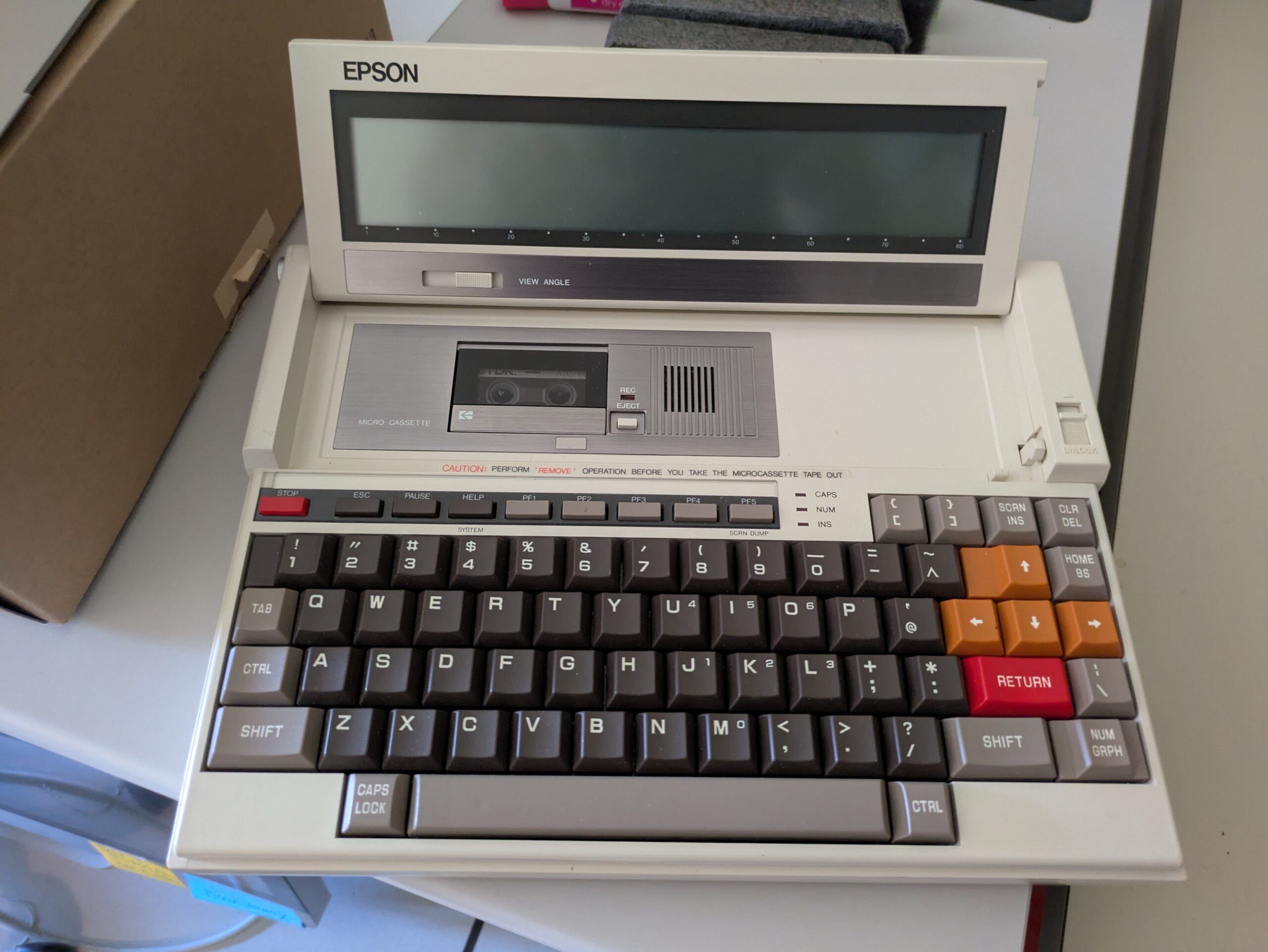
- Manufacturer: Epson Corporation (Japan)
- Type: Laptop
- Model: PX-8
- Release Date: 1984
- Cost at release: USD $995 (CAD ~$3,400 adjusted for inflation)
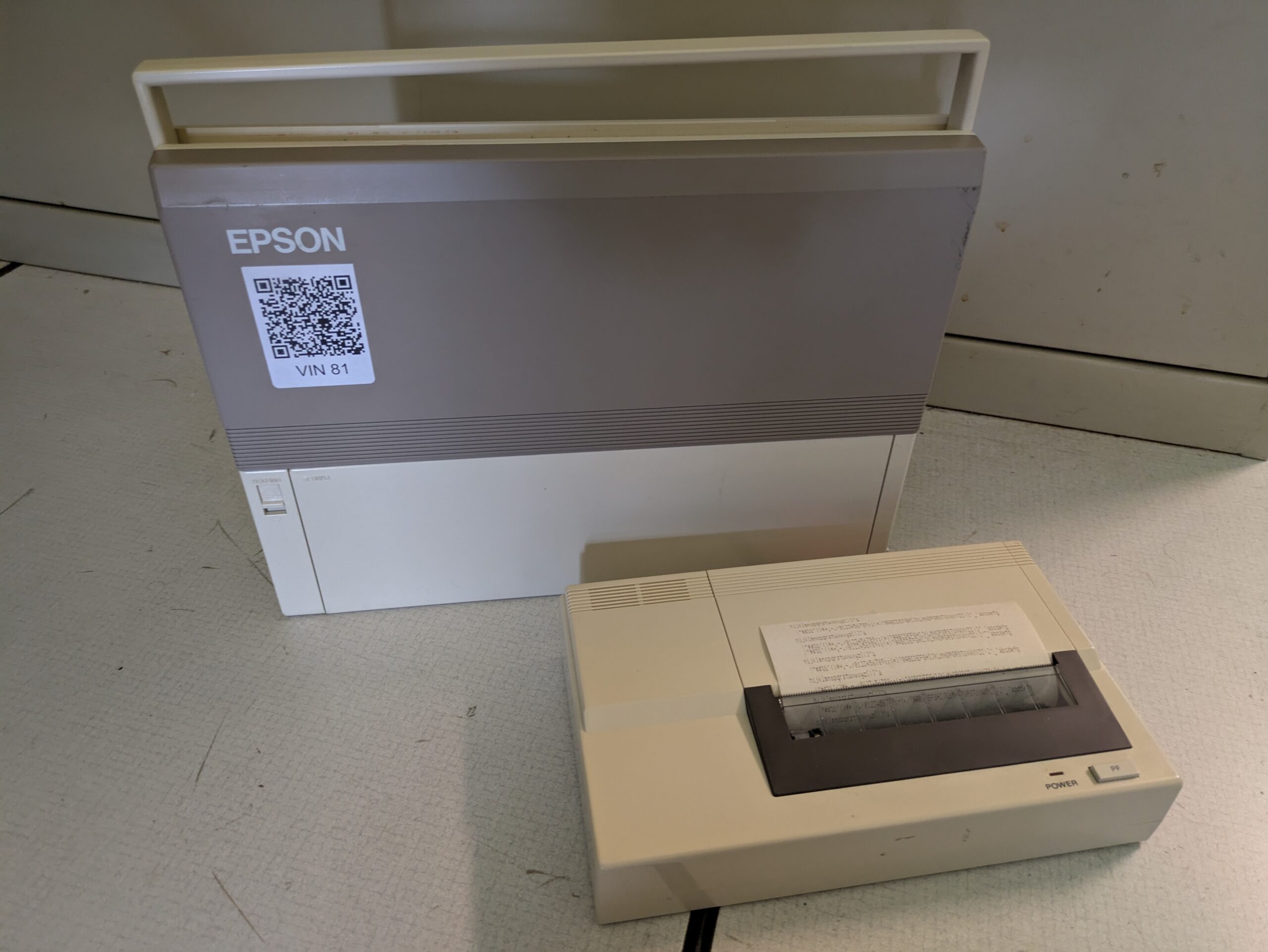
- Cost with peripherals: USD $2,484 (CAD ~$8,500 adjusted for inflation)
- MIPS: 0.3 (300 KIPS)
Hardware Specifications
- CPU: Z80-compatible microprocessor, 2.45 MHz (some sources mention up to 4 MHz).
- RAM: 64 KB standard, expandable up to 128 KB (with optional RAM disk modules).
- ROM: 32 KB (expandable via ROM cartridge slots for software like WordStar, BASIC, etc.).
- Display: 80-column by 8-line monochrome LCD (non-backlit); graphics mode 480 × 64 pixels.
- Storage: Built-in microcassette tape drive for data storage; optional external RAM disk (64 KB or 128 KB) and external floppy disk drive.
- Ports/Interfaces: RS-232 serial, proprietary serial for disk drive or printer, analog input, bar code reader interface.
- Power: Internal rechargeable nickel-cadmium battery (6–8 hours typical usage).
- Sound: Built-in speaker (beeper).
- Keyboard: Full-stroke 72-key keyboard with function and cursor keys.
- Dimensions: 29.7 cm (W) × 21.6 cm (D) × 4.6 cm (H) (A4 size).
- Weight: 2.3 kg (5 lbs)
Operating System & Programming Languages 
- Operating System: Customized version of CP/M 2.2 as its operating system, stored in ROM rather than on disk.
- Supported Languages:
- BASIC: The PX-8 included an Epson-enhanced version of Microsoft BASIC in ROM, allowing users to write and run BASIC programs directly on the machine.
- CP/M Languages: Because it ran CP/M 2.2, the PX-8 could also run a wide variety of CP/M-compatible languages and tools, such as:
- Assembler (ASM)
- FORTRAN
- COBOL
- Pascal
- C (with available CP/M compilers)
- Other interpreters and utilities available for CP/M, provided they were compatible with the PX-8’s hardware and display limitations.
- ROM Cartridges: Additional languages and applications (such as dBase II, WordStar, and others) could be loaded via ROM cartridges, further expanding the PX-8’s software capabilities
Notables
- The laptop’s nickname was “Geneva.”
- Triple Processor Design: Featured a main Z80 CPU and additional processors in its intelligent RAM disk and ROM modules, making it unusually complex for its size.
- ROM Cartridge Drives: Supported swappable ROM modules for software, which appeared as virtual disk drives, users could even create their own custom ROM’s.
- Used a built-in microcassette tape drive for data storage, a rare choice compared to floppy disks at the time.
- Its external RAM disk module included its own Z80 CPU and backup battery, making it one of the earliest battery-backed RAM storage solutions.
- Y2K Quirk: The PX-8’s date system only accepted years from 1977 to 1999, making it “Y2K-proof” in a limited sense.
- Early Notebook Pioneer: Among the first true laptop computers, following Epson’s own HX-20, and notable for its CP/M compatibility in a portable form
- One of the first portables to run CP/M entirely from ROM as well as a WordStar word processor via ROM, enabling instant boot and reliability in the field
- Audio Playback: The microcassette drive could play voice or music through the built-in speaker
Donated by: Arlen Michaels