NEC PC-8201A
[Vin83]
The NEC PC-8201A was a pioneering lightweight, battery-powered notebook computer introduced in 1983, notable for its portability, robust build, and ability to run for extended periods on four AA batteries. Its claim to fame lies in its integration of essential productivity tools; Microsoft BASIC, a text editor, and telecommunications software; permanently in ROM, making it an instant-on, highly reliable field computer for journalists and professionals before the era of modern laptops. The PC-8201A was important in computing history for demonstrating the practicality of portable computing, influencing later notebook designs.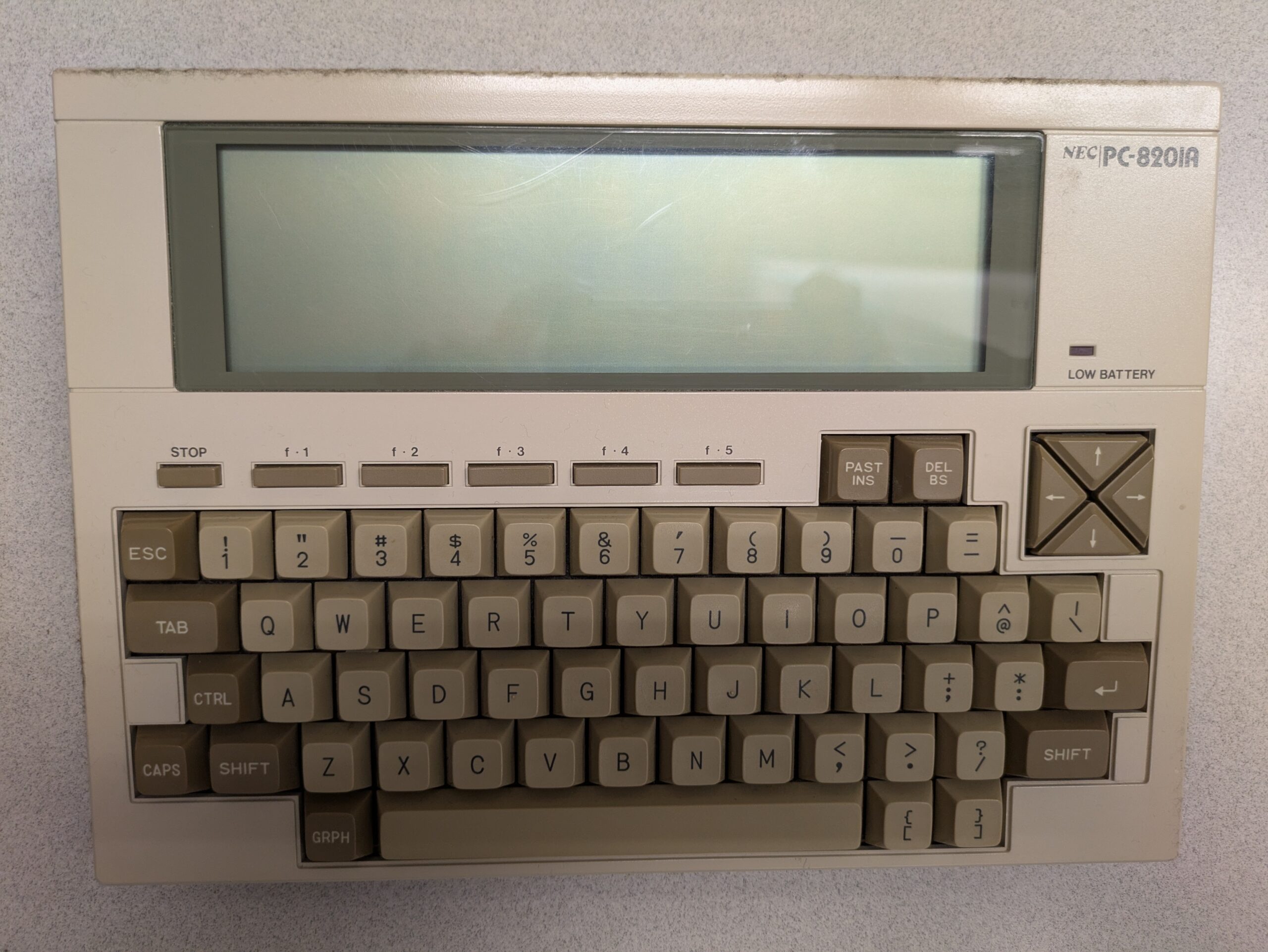
- Manufacturer: NEC Corporation
- Released: 1983
- Model: PC-8201A
- Type: Notebook Computer
- Cost at release: USD $799 (CAD ~$2,750 adjusted for inflation)
- MIPS: 0.3 (300 KIPS)
Hardware Specifications
- CPU: Intel 80C85, 2.4–2.45 MHz
- RAM: 16 KB standard (expandable up to 64 KB internally, plus up to 128 KB via cartridges)
- ROM: 32 KB (expandable to 64 KB)
- Display: 8-line by 40-character monochrome LCD (240 × 64 pixel graphics)
- Keyboard: Full-stroke, 67-key with 5 function keys and arrow keypad
- Storage: Programs and data could be saved/loaded via cassette recorder (special cable required)
- Modem: Built-in 300 baud modem
- Ports: RS-232, SIO1/SIO2 connectors, CMT socket (cassette), Centronics printer port, bar code reader socket, system slot for RAM cartridges
- Power: 4 × AA batteries, NiCad battery pack, or AC adapter (6–8.5V DC)
- Sound: 4 channels, 3.5 octaves
- Physical Dimensions: Approx. 30 cm (W) × 21.3 cm (D) × 3.3 cm (H)
- Weight: 1.7 kg (3.75 lbs)
Operating System & Programming Languages
- O/S: Did not use a traditional disk-based operating system. Instead, its system software—including the main menu, file manager, and built-in applications—was permanently stored in ROM. The system ROM, developed by Microsoft, provided an instant-on environment with a text editor, telecommunications terminal, and a BASIC interpreter as core applications
- Programming Languages:
- Microsoft BASIC (N82-BASIC): The primary programming language available on the PC-8201A was Microsoft BASIC, specifically a version called N82-BASIC, which was tailored for this computer and resided in ROM. BASIC programs could be written, saved, and executed directly on the machine.
- Machine Code (Assembly): Advanced users could write and run machine code programs (in Intel 80C85 assembly language) by loading binary files or using POKE/EXEC commands, though this required technical expertise.
- ROM Expansion: Additional software (including other languages or utilities) could be added via ROM cartridges, but Microsoft BASIC remained the only built-in programming language
Notables
- Pioneering Portable: Introduced in 1983, the NEC PC-8201A was one of the world’s first lightweight, battery-powered notebook computers, emphasizing true portability with a size comparable to an A4 book and the ability to run for hours on just four AA batteries.
- Firmware by Microsoft: Its operating system and software, Microsoft BASIC, text editor, and telecommunications program were permanently stored in ROM, with the BASIC interpreter rumoured to include some of the last firmware code written by Bill Gates himself.
- Expandable Memory: The base model came with 16 KB of RAM, expandable internally up to 64 KB and via cartridges up to 128 KB, a notable capacity for portable computers of its era.
- Unique Display: It featured an 8-line by 40-character monochrome LCD screen with 240×64 pixel graphics capability, larger than many contemporaries, though without backlighting.
- Data Retention: The PC-8201A had a tiny internal rechargeable battery that preserved RAM contents even when the main batteries were exhausted, allowing instant-on access without data loss.
- Versatile Connectivity: It supported peripherals like cassette tape recorders, printers, modems, and barcode readers, making it a versatile tool for fieldwork and mobile data entry.
- Family and Legacy: The PC-8201A shared its hardware lineage with the Kyocera Kyotronic 85 and the famous Tandy TRS-80 Model 100, which became the most popular variant, selling over 6 million units worldwide.
Donated by: Arlen Michaels