Olivetti M10
[vin85]
The Olivetti M10, released in 1983, is a historically significant vintage portable computer notable for its innovative design and strong market presence in Europe. It featured a unique tilting LCD screen for improved legibility and an excellent keyboard praised by users, particularly journalists who favored it for field use. Based on a Kyocera platform similar to the Tandy Model 100, the M10 offered long battery life (running on AA batteries), built-in software including an extended BASIC interpreter, word processor, spreadsheet, agenda, and communication program. It was widely used in Europe, especially Italy, holding a majority share of the local market and some presence internationally. The M10 is regarded as one of the earliest true notebook-form-factor computers, marking a milestone in portable computing history. Its combination of portability, usability, and built-in programming capabilities make it an important piece for tech enthusiasts and vintage computer collections. It also demonstrates Olivetti’s pioneering role in blending typewriter heritage with early computing technology.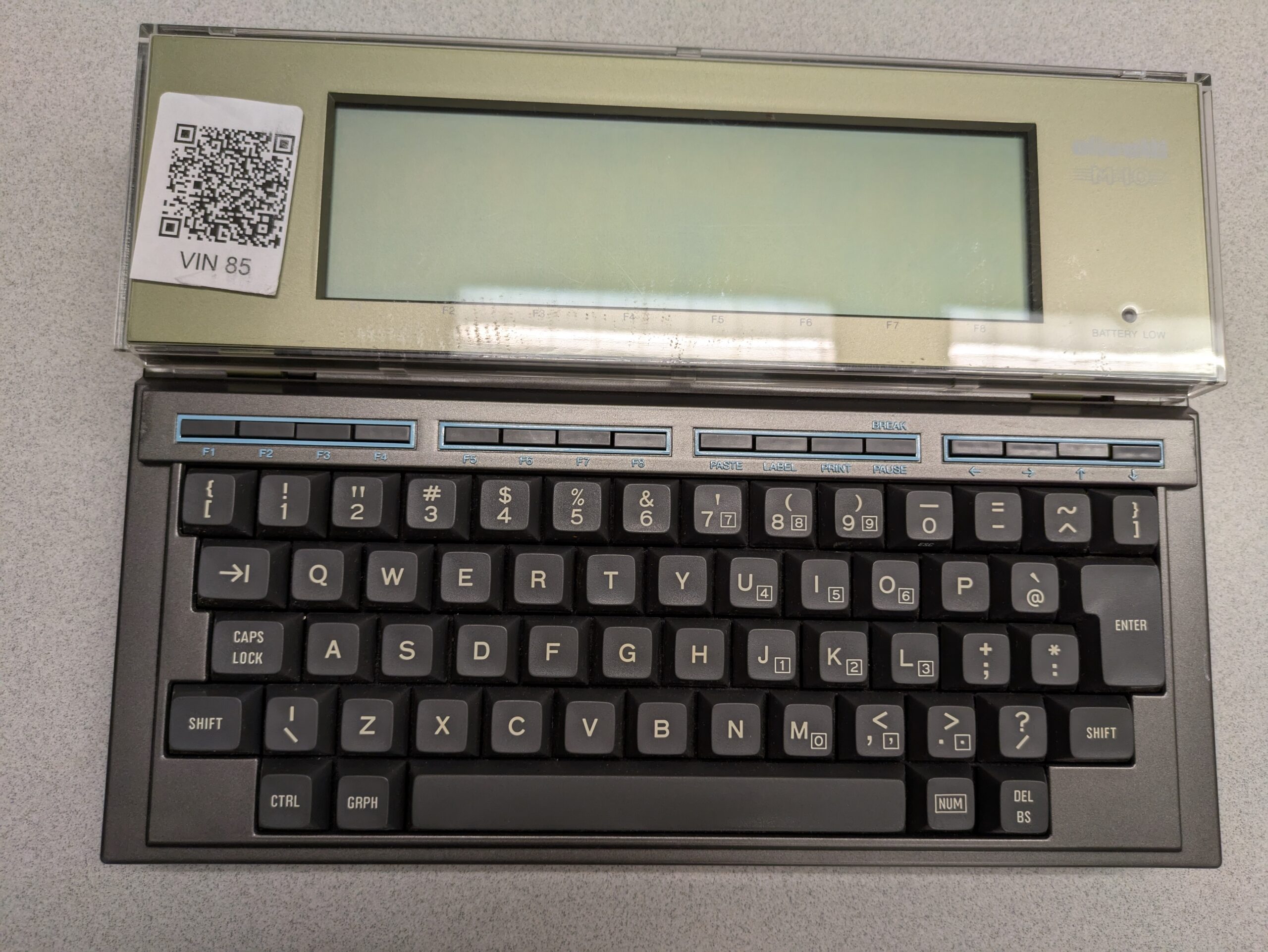
- Manufacturer: Olivetti
- Type: Laptop
- Model: M10
- Release Date: 1983
- Cost at release: USD $800 (CAD ~$2,750 adjusted for inflation)
- MIPS: 0.1 (100 KIPS)
Hardware Specifications
- CPU: OKI 80C85 8-bit CMOS microprocessor, running at 2.4 to 3 MHz
- RAM: 8 KB standard, expandable up to 32 KB
- Display: Monochrome LCD with 240 x 64 pixel resolution, tilting design for ergonomic viewing
- Storage: Volatile RAM storage backed by battery, cassette tape interface for data saving/loading
- Keyboard: Full-sized QWERTY keyboard with good tactile feedback
- Connectivity: Serial and parallel ports for modem and printer connections
- Power: Runs on 4 AA batteries, giving approximately 20 hours of operation
- Weight: Approximately 1.5 kg (3.3 pounds)
Operating System & Programming Languages
- OS: The Olivetti M10 did not have a traditional operating system but instead ran built-in firmware with an extended BASIC interpreter as its primary programming environment. This firmware provided a simple command-line interface for programming and application use.
- Programming Languages:
- Microsoft BASIC (an extended version customized for the M10)
- Machine code programming for the OKI 80C85 8-bit CPU (via assembly or direct binary input)
- Some third-party and user-developed software could also be loaded via cassette, but no widespread support for other high-level languages existed.
Notables
- Released in 1983, it was among the earliest notebook-style portable computers, predating many modern laptops.
- Known for its ergonomic tilting monochrome LCD screen, which improved readability, a feature rare for its time.
- Marketed primarily in Italy and Europe, it captured about 70% of the Italian market and 22% of the European market for portable computers in the early 1980’s.
- It was favoured by journalists and mobile professionals due to its lightweight design (~1.5 kg), long battery life (~20 hours), and excellent keyboard.
- The M10 ran an extended BASIC interpreter in firmware, enabling programming on the go, which was innovative in portability and software integration.
- Considered a pioneering machine bridging typewriter heritage and emerging personal computing technology from Olivetti, a company known for design and innovation.
- Often compared as the “Italian cousin” to the popular Tandy Model 100, it stands as a distinct alternative with unique features.
- Although it lacked flashy advertising campaigns, its quiet success in European markets cemented its place in vintage computing history.
- Its design and usability influenced later portable computing development, solidifying it as a key milestone in the evolution of notebooks.
Donated by: Arlen Michaels