Hewlett-Packard HP110 Portable Plus
[vin86]
The HP 110 Portable Plus, released in 1985, was a groundbreaking MS-DOS-compatible laptop notable for its built-in software (including Lotus 1-2-3, MemoMaker, and a terminal emulator in ROM), long battery life (up to 16–20 hours), and a tiltable, high-resolution LCD display that folded over the keyboard for portability. Its claim to fame was being Hewlett-Packard’s first true laptop, offering unprecedented portability and performance for its time, with advanced power-saving features, a robust build, and the largest memory available in a portable computer when launched.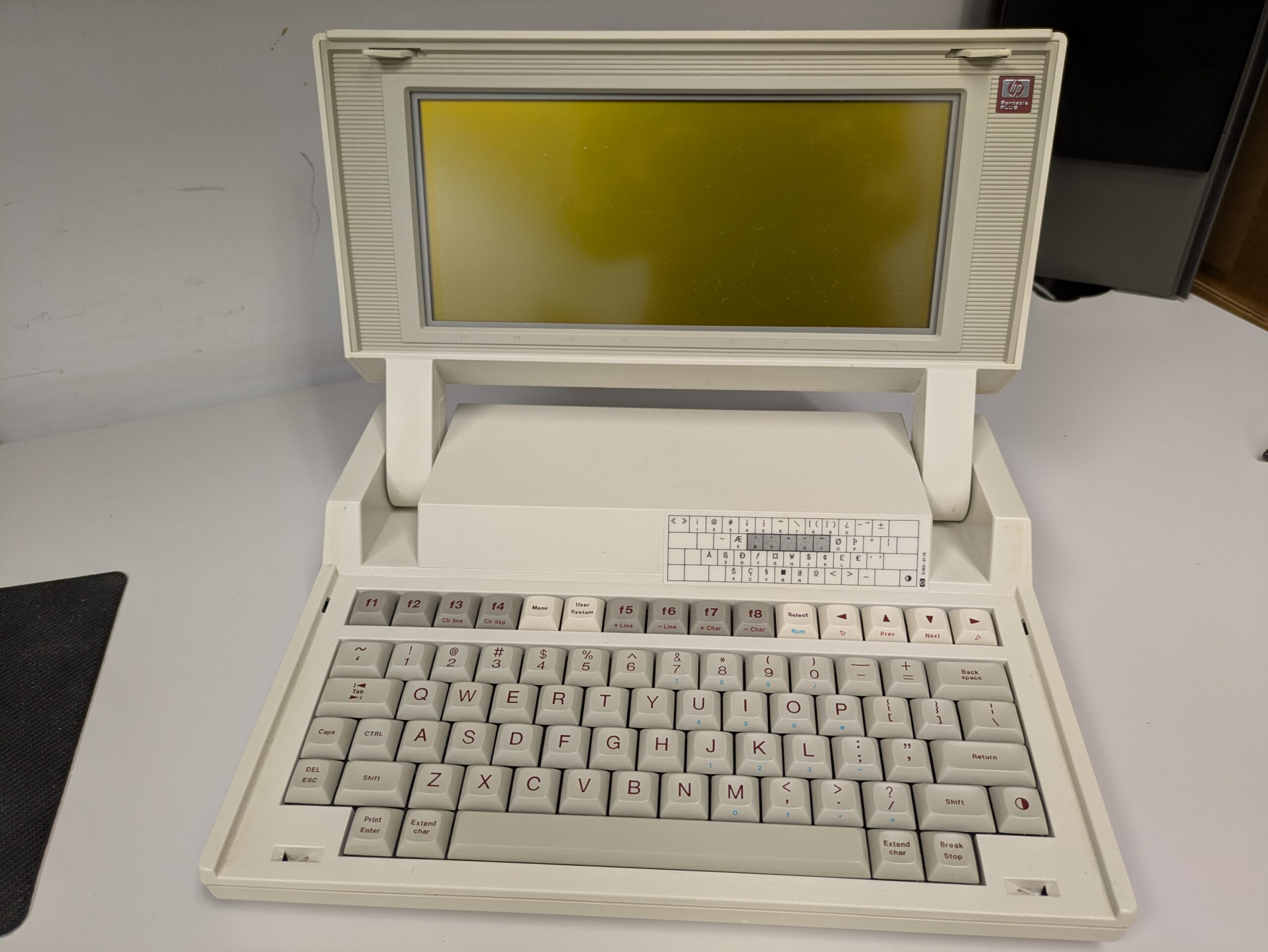
- Manufacturer: Hewlett-Packard (HP)
- Type: Laptop
- Model: HP110 Portable Plus
- Release Date: 1985
- Cost at release: USD $2,295 (CAD ~$8,000 adjusted for inflation)
- MIPS: 0.3 (300 KIPS)
Hardware Specifications
- CPU: Motorola 68030, 20 MHz (optional Motorola 68882 FPU coprocessor)
- RAM: 1 MB soldered onboard, expandable to 17 MB (4 × 30-pin SIMM slots, 100 ns)
- ROM: 512 KB
- Hard Drive: 40 MB, 80 MB, or 160 MB internal SCSI hard drive; 1.44 MB SuperDrive floppy disk
- Video: Uses system RAM as VRAM; supports up to 8-bit color at 640 × 480 resolution
- Expansion: 1 NuBus or Processor Direct Slot (PDS)
- Ports: ADB (keyboard/mouse): 1, SCSI: 1 (DB-25), Floppy: 1 (DB-19), Serial: 2 (Mini DIN-8), Audio: 8-bit stereo out, 8-bit mono in (3.5mm jacks), Printer and modem ports
- Modem: Internal 1200 bps (baud) modem
- Keyboard: Mechanical, 75 keys, 8 function keys
- Storage: No built-in floppy or hard drive; supports external 3.5″ floppy drive via HP-IL
Operating System & Programming Languages
- OS: MS-DOS 2.11 in ROM
- Programming Languages: While it did not have a built-in BASIC interpreter, users could run standard MS-DOS-compatible programming languages—including BASIC (when loaded from external storage), Pascal, C, and assembly language—by installing them via external floppy drive or RAM disk
- Built-in Applications: Lotus 1-2-3, MemoMaker, Terminal Emulator (all in ROM)
Notables
- The HP 110 Portable Plus was Hewlett-Packard’s first true laptop and was internally codenamed “Nomad”.
- At launch, it had the largest memory available in any portable computer, with 384 KB ROM and up to 1 MB RAM.
- Its suite of built-in software in ROM—including Lotus 1-2-3, MemoMaker, and a terminal emulator—was unusual and allowed instant-on productivity without loading from disk.
- The display could tilt for better visibility and folded over the keyboard, a novel design for the era.
- It boasted exceptional battery life (up to 16–20 hours), thanks to advanced power-saving features and a sealed lead-acid battery.
- The HP-IL interface allowed daisy-chaining up to 30 devices, including printers and external floppy drives, which was rare for laptops at the time.
- The RAM could be partitioned to act as a RAM disk, preserving data for months on a single charge.
- It was praised as the “almost perfect portable” and “the finest notebook computer available on the market today” by Creative Computing magazine, which annoyed some competitors’ fans.
- The HP 110 was not a mass-market hit due to its high price and business focus, but it was highly respected and influential among early mobile professionals
Donated by: Arlen Michaels