Toshiba T1000
[Vin88]
The Toshiba T1000, released in 1987, was a landmark in portable computing as one of the earliest to feature a true “laptop” form factor, lightweight (2.9 kg), and battery-powered operation with MS-DOS built directly into ROM allowing instant boot-up without floppies or hard drives. Its claim to fame was making IBM-compatible portable computing affordable (with prices often under $1,000) and practical for mass-market adoption, especially valued by writers and mobile professionals for its portability and durability. The T1000 achieved critical and commercial success, being named “Editor’s Choice” by PC Magazine and winning industry accolades, which helped cement Toshiba’s leadership in laptops.
- Manufacturer: Toshiba Corporation
- Type: Laptop
- Model: T1000
- Release Date: 1987
- Cost at release: USD $1,199 (CAD ~$3,750 adjusted for inflation)
- MIPS: 0.2 (200 KIPS)
Hardware Specifications
- CPU: Intel 80C88, 4.77 MHz
- RAM: 512 KB standard (expandable to 1.2 MB)
- ROM: MS-DOS 2.11 built into ROM (256 KB)
- Storage: 3.5-inch 720 KB floppy disk drive (no internal hard drive)
- Display: 9.1-inch monochrome LCD, CGA-compatible, 80 x 25 text, 640 x 200 graphics
- Ports: Serial port, parallel port, external floppy port, expansion connector
- Battery: Rechargeable Ni-Cd battery, offering approximately 6–8 hours of operation
- Keyboard: 77-key, full-stroke
- Weight: 2.9 kg (6.4 lbs)
Operating System & Programming Languages
- Operating System: MS-DOS 2.11 built directly into 256 KB of ROM, enabling instant boot-up even without a disk inserted.
- Supported Languages: As an IBM PC XT-compatible running MS-DOS, the Toshiba T1000 supported any programming language and environment designed for DOS systems of that era. Popular options included:
- BASIC: GW-BASIC and other DOS BASIC interpreters (such as BASICA) were widely available and compatible.
- Pascal: Turbo Pascal and similar compilers would run from floppy disk.
- C: Turbo C, Microsoft C, and other compilers designed for 8088-based systems.
- Assembly Language: MASM and similar assemblers for direct x86 programming.
- Other Languages: Early FORTRAN, COBOL, and interpreted languages like dBASE could be run, provided you had the appropriate software disks
Notables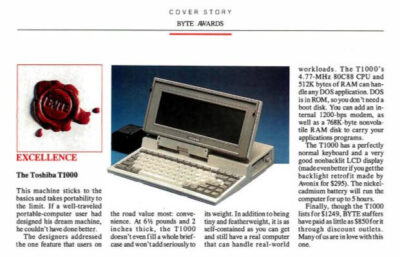
- ROM-Based MS-DOS: One of the first IBM PC compatibles to include MS-DOS 2.11 built directly into ROM, allowing for instant boot-up—no floppy necessary.
- Portable Revolution: At 2.9 kg (6.4 lbs), it was the lightest IBM-compatible laptop at its release, making true mobility practical for the first time for many professionals and journalists.
- Affordability Breakthrough: With a launch price under $1,200 USD, it dramatically lowered the entry cost to portable computing, earning headlines as “the closest thing yet to the perfect laptop” in period reviews.
- Popular with Writers: Noted for its durability, portability, and ease of use—it became a cult favorite among traveling writers and editors, with some logging 60,000+ miles of use.
- RAM Disk Innovation: Its optional battery-backed RAM expansion doubled as a fast, power-efficient internal storage, a unique feature at the time.
- Self-Contained ‘PC’: Thanks to external monitor and floppy options, it could serve as a “modular desktop” anywhere—hotel, office, or train.
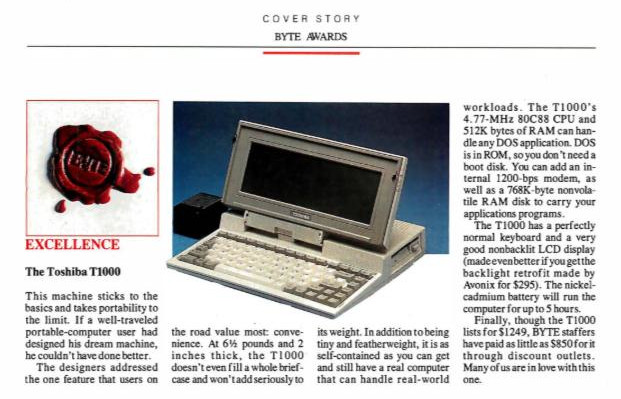
- Critical Acclaim: Won PC Magazine’s “Editor’s Choice” and a BYTE Magazine “Excellence” award, with reviewers calling it a “little gem” and marveling at its “incredible bargain” price.
- Amusing ‘Diskless Wonder’: Some vintage enthusiasts dubbed it the “diskless wonder” for its reliance on a single 3.5” floppy drive and no hard disk.
- Battery Woes: If the battery (and optional RAM disk battery) died completely, all RAM-resident files would vanish—a risk unique to this design.
- Notable Advertisement: Early ads (like those in PC Magazine, 1987) pitched it as the only light, affordable IBM-compatible laptop, with superlative praise from journalists and values often undercutting competitors
Donated by: Dr. Arlen Michaels