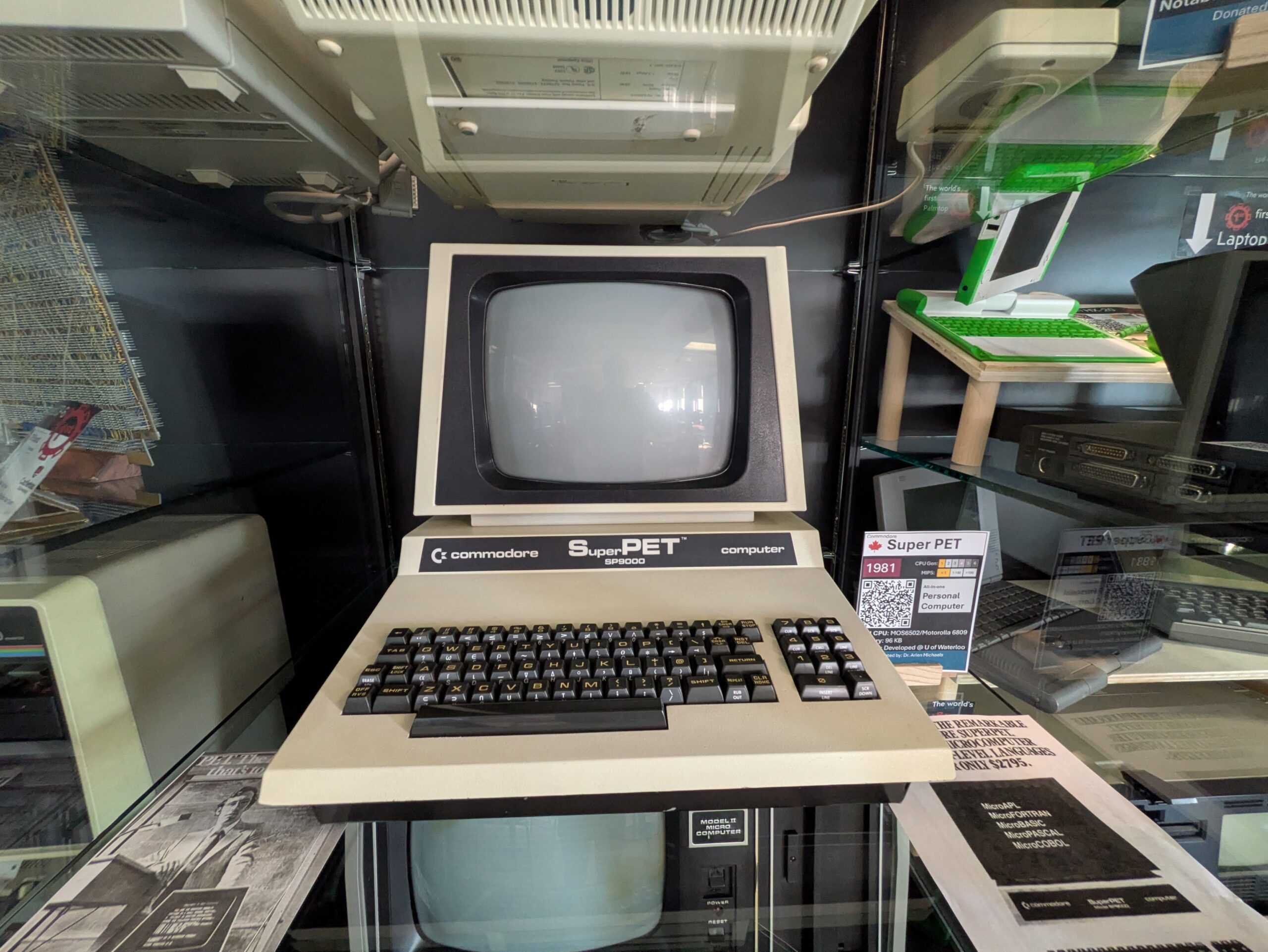
Commodore SuperPET SP9000
[Vin9]
The Commodore SuperPET SP9000, also known as the MicroMainframe, was a unique dual-processor microcomputer introduced in 1981 and developed in collaboration with the University of Waterloo in Ontario, Canada. Designed specifically for the educational and professional programming markets, it stood out both technically and visually. The machine is instantly recognizable for its distinctive angular, wedge-shaped “all-in-one” chassis, which integrates a 12-inch monochrome monitor, full-sized keyboard, and system unit into a single enclosure. Its most notable hardware feature was its dual-CPU architecture, combining a MOS Technology 6502 with a Motorola 6809, supported by an impressive 96 KB of RAM. This configuration allowed the SuperPET to operate either as a standard PET in 6502 mode or as a more advanced development system using the 6809.
What truly set the SuperPET apart was its sophisticated software environment. It shipped with a suite of advanced “Waterloo” programming languages including: BASIC, APL, FORTRAN, Pascal, and COBOL, making it an exceptionally powerful development platform for students and professionals alike. Its RS-232 interface enabled it to function as a versatile programming workstation or “smart terminal,” allowing users to develop software offline and then upload it directly to mainframes, a significant innovation at the time. Despite its technical ambition and importance as an advanced educational tool, as well as its pioneering use of co-processor architecture, the SuperPET remained a niche product. Approximately 7,000 units were sold before the rapid rise of the IBM Personal Computer and its compatibles reshaped the market, leaving the SuperPET as a rare and respected chapter in computing history.
- Manufacturer: Commodore
- Partnership: software development by the University of Waterloo and manufacturing contracted to BMB CompuScience of Milton, Ontario, Canada

- Released: 1981
- Cost at release: USD $2,000 (CAD ~$7,800 adjusted for inflation)
- MIPS: 0.42 – 0.5 (420 – 500 KIPS)
- Hardware Specifications
-
- Processor: Dual processors: MOS Technology 6502 and Motorola 6809, both running at 1 MHz
- Memory: 96 KB total (including 64 KB on a bank-switched RAM board)
- ROM: 48 KB, containing Waterloo KERNAL, CBM BASIC 4.0, and additional programming languages
- Storage: External storage options 5.25-inch floppy, 8-inch floppy, hard drives and cassette (Datassette) drives
- Ports: IEEE-488 port, two Commodore Datasette ports, expansion port, RS-232 serial port, CBM parallel programmable user port
- Display: MOS Technology 6545 CRTC, 12-inch monochrome display, 80 columns × 25 rows, three character sets
- Sound: Piezo electronic speaker
- Operating System & Programming Languages
-
- In 6502 mode, it ran Commodore BASIC 4.0, functioning like a standard Commodore PET 8032
- In 6809 mode, it launched the Waterloo-developed menu system, providing access to a suite of advanced programming tools and languages.
- With an optional add-on MMU board, it could also run the OS-9 operating system, a Unix-like multitasking OS, thanks to an expansion developed by the Toronto PET Users Group (TPUG)
- Waterloo: microBASIC, microAPL (A Programming Language), microFORTRAN, microPASCAL, microCOBOL
- Assembler (for 6809 machine language)
- Commodore BASIC 4.0 (in 6502 mode)
- Notables
-
- The Commodore SuperPET SP9000 was nicknamed the “SuperPET,” “SP9000,” and “MicroMainframe”.
- The Commodore SuperPET SP9000 is instantly recognizable for its distinctive, angular “all-in-one” chassis, which integrates a 12-inch monochrome monitor, a full-sized keyboard, and the computer’s main unit into a single, wedge-shaped enclosure
- It featured a rare dual-processor design (MOS 6502 and Motorola 6809), enabling it to run both standard PET software and advanced programming tools.
- Developed in close collaboration with the University of Waterloo, it was tailored for education and programming, especially for teaching multiple languages and remote mainframe development.
- The SuperPET could act as a “smart terminal,” allowing users to develop software locally and upload it to mainframes via its RS-232 interface-an unusual capability for early 1980s microcomputers.
- It supported a wide range of programming languages (BASIC, APL, FORTRAN, Pascal, COBOL, assembler), making it a versatile academic tool.
- A unique add-on MMU board from the Toronto PET Users Group allowed it to run the OS-9 operating system, bringing Unix-like multitasking to an 8-bit platform.
- Despite its technical strengths, it was released just as the IBM PC debuted, leading to poor commercial uptake-only about 7,000 units were sold, making it a rare collector’s item today.
- Its place in computing history is as a pioneering educational and development platform, notable for its Canadian roots and its advanced, multi-language capabilities for its time
Canadian: software development by the University of Waterloo and manufacturing contracted to BMB CompuScience of Milton, Ontario, Canada
Share: Twitter, Facebook
Short URL:
https://carleton.ca/scs/?p=19891