Heathkit H-120
[Vin90]
The Heath/Zenith H-120 (Z-100 series) was notable for its unusual dual-processor design, combining an 8-bit Intel 8085 (for CP/M) and a 16-bit 8088 (for MS-DOS), allowing it to bridge two major computing eras and software ecosystems in one machine.
It was this flexibility and its advanced features for the time (including relatively high-resolution graphics and S-100 expandability), making it a powerful but non-IBM-compatible business system that competed in the early 1980’s PC market.
While not as commercially dominant as the IBM PC, it was widely used in education, government, and enthusiast circles, and stands out historically as one of the most sophisticated transitional systems between CP/M and MS-DOS computing, highlighting the experimentation and diversity of early personal computer design.
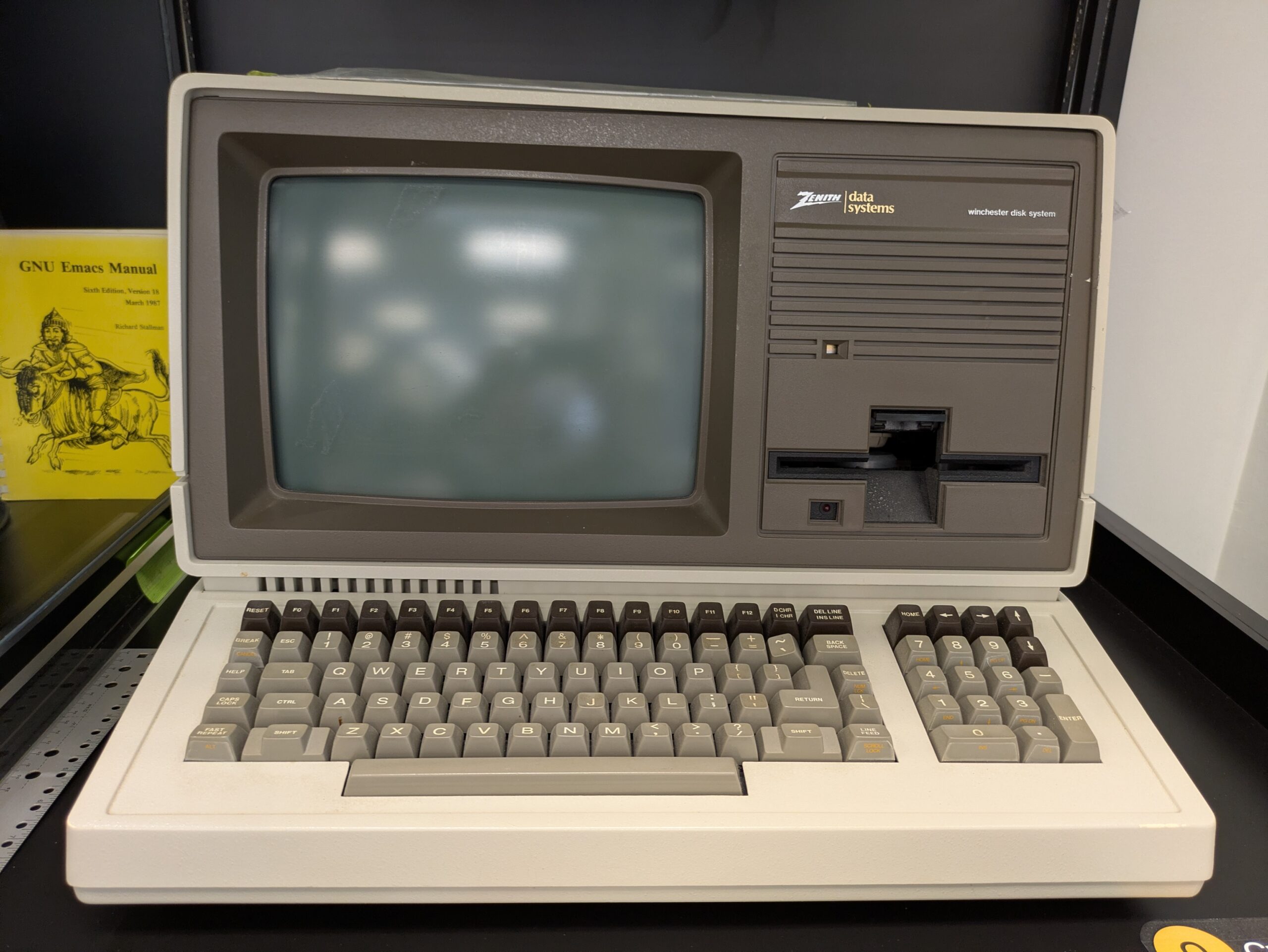
- Manufacturer: Zenith Data Systems
- Type: Personal Computer
- Model: H-120-I (Kit of the Z-100 series)
- Release Date: 1982
- Cost at release: USD $2,995 (CAD ~$11,750 adjusted for inflation)
- MIPS: 0.37-0.8 (370-800 KIPS) – depending which processor is used
Hardware Specifications
- CPU: Dual CPUs – Intel 8085 (8-bit) and Intel 8088 (16-bit), switchable depending on software needs.
- RAM:
- Standard: 128 KB, expandable to 192 KB on-board.
- Maximum: Up to 768 KB with S-100 expansion cards.
- Expansion: Five S-100 (IEEE-696) slots for expansion boards and peripherals.
- Storage:
- Two 320 KB (40-track, double-sided) 5.25-inch floppy disk drives (internal).
- Support for external 8-inch floppy disk drives.
- Some configurations supported hard drive expansion.
- Display:
- Built-in monochrome CRT (12-inch).
- Monochrome display upgradable to 8 greyscales.
- High-resolution bitmap graphics: up to 640×225 pixels; color systems could display 8 colors (RGB).
- Ports:
- Two serial ports (RS-232).
- One parallel port (Centronics-compatible).
- Keyboard: Built-in, based on IBM Selectric layout.
- Weight: Approximately 55 pounds (packed shipping weight)
Operating System & Programming Languages
- Operating System:
- Z-DOS (Zenith MS-DOS-compatible): A non-IBM compatible version of MS-DOS, often referred to as Z-DOS, was the primary 16-bit operating system. It allowed the machine to run a variety of business and productivity software developed for early MS-DOS environments.
- CP/M-85: Leveraging the 8-bit 8085 CPU, CP/M-85 was available for running a rich catalog of 8-bit business and development software.
- CP/M-86 and Concurrent CP/M-86: Supported as alternative 16-bit operating systems for more advanced or multitasking needs.
- H-DOS, UCSD Pascal, and others: The system also ran Heath’s own HDOS and niche operating environments such as UCSD Pascal, popular with universities for structured programming instruction.
- Supported Languages:
- Microsoft BASIC (BASIC-80 for CP/M-80, Z-BASIC for Z-DOS)
- Microsoft FORTRAN-86 (for Z-DOS)
- Microsoft COBOL-86 (for Z-DOS)
- Microsoft Pascal (for both CP/M and Z-DOS)
- Microsoft BASCOM-86 (for Z-DOS)
- Assembly language (with available assemblers and editors for CP/M and Z-DOS environments)
- UCSD Pascal and other languages available for CP/M systems
Notables
- Dual-Processor Hybrid: One of the first personal computers with both 8-bit (8085) and 16-bit (8088) CPUs, letting users run both CP/M and MS-DOS software—bridging two computing generations.
- S-100 Bus Expansion: Unusually, it offered S-100 bus slots, supporting robust hardware upgrades and hobbyist modifications even as the industry shifted to different bus architectures.
- Superior Graphics: Had advanced graphics for its era, supporting high-resolution bitmap and more colors/greyscales than many early IBM-compatible PCs; early versions of AutoCAD were developed for it for this reason.
- All-in-One, Robust Build: The Z-120 “all-in-one” design included an integrated monitor and rugged construction; known for its reliability in universities and demanding military environments.
- In 1983, Clarkson University became the first U.S. college to provide a personal computer to each incoming freshman—the model was the Z-100 family (including the Z-120).
- Widely adopted by the U.S. military for training and office use due to its solid build and flexibility.
- Partial Compatibility: Dubbed a “near-compatible” with IBM PC—generic MS-DOS software typically worked, but popular programs that used IBM-specific BIOS extensions often did not, resulting in a unique niche and loyal user base.
- Kit & Ready-Built Versions: Available as a Heathkit for enthusiasts to assemble themselves, or fully pre-built by Zenith Data Systems for institutions and businesses.
- Among the first all-in-one systems to blend 8-bit and 16-bit computing in a single package
Donated by: Dr. Arlen Michaels