Grid GRiDCASE 2
[Vin92]
The Grid GridCase 2 was an early, rugged portable computer released in 1985 as the successor to the pioneering GRiD Compass, which introduced the “clamshell” laptop design. Its most notable features included a robust 8086 processor, up to 640 KB of RAM, a 9.5-inch LCD display with CGA graphics, and a design engineered for durability and field use, traits that made it valuable for professionals in demanding environments such as engineering, defense and industry.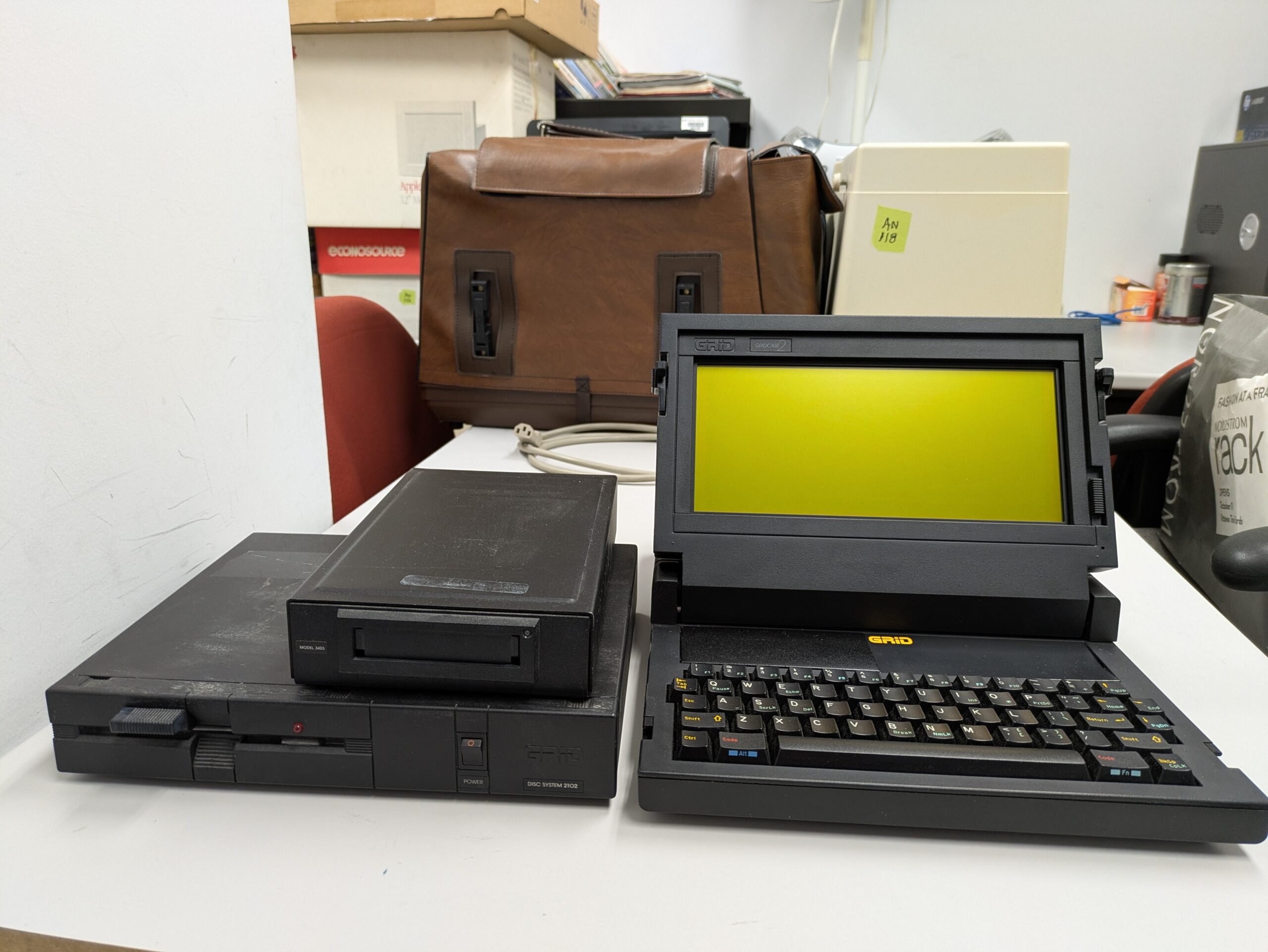
- Manufacturer: Grid Systems Corporation
- Type: Laptop
- Model: GRiDCASE 2
- Release Date: 1986
- Cost at release: ~$15,000 (adjusted for inflation)
- MIPS: 0.33 (330 KIPS)
Hardware Specifications
- CPU: Intel 8086 at 4.77 MHz
- RAM: 128 KB standard (expandable to 640 KB)
- Display: 9.5-inch LCD, 640 x 200 pixel resolution, yellow monochrome (no backlight), CGA compatible
- Storage: 3.5-inch floppy disk drive (720 KB capacity). Optional 10 MB hard disk drive in place of floppy
- ROM: Supports up to 1024 KB (8 DIP sockets for EPROMs/MASK ROMs, 128 KB each)
- Video Output: RGB video port for external monitors
- Ports: 1 x DB25 serial, 1 x parallel, DIN5 keyboard, RGB video, Ext. floppy, 50-pin expansion bus
- Battery: 16V NiCad rechargeable (field-swappable)
- Keyboard: 57 keys integral keyboard
- Case: Rugged, portable “clamshell” design
- Weight: 5.4 kg (12 lbs)
Operating System & Programming Languages
- Operating System: MS-DOS 2.11, which was stored in ROM and served as the main interface for users
- Supported Languages: The GridCase 2 could run a variety of programming languages compatible with the IBM PC and MS-DOS environment.
- GW-BASIC: A key language provided via ROM chips or on disk, allowing for easy BASIC programming directly on the device.
- Microsoft BASIC: Variants such as BASICA or GW-BASIC were standard on MS-DOS computers of this era and readily usable.
- Other DOS-Compatible Languages: Any language that could run on MS-DOS 2.11 could, in principle, be used—including:
- Pascal (Turbo Pascal)
- FORTRAN
- C (Microsoft C, Turbo C)
- Assembler (MASM, TASM)
- COBOL, dBASE, and other language/interpreter tools released for early DOS platforms
- Application ROMs: The design allowed certain productivity or language tools to be embedded in ROM chips for instant access.
Notables
- Often called “GRiDCASE” (stylized with a lowercase ‘i’), the line has also been referred to as “Portable Sagem” in France.
- Among the earliest semi-rugged portable computers, designed as the successor to the legendary GRiD Compass, the first clamshell laptop.
- Featured one of the first improved LCDs in a rugged portable system, readable by more than one person at a time (unusual for the era).
- Could run software and apps directly from ROM chips installed in user-accessible sockets, a rarity among laptops then.
- Built with a robust magnesium case, making it highly durable for fieldwork, ideal for demanding professional environments.
- A unique design feature: interchangeable power modules allowed for field-swappable battery or AC transformer packs.
- Its keyboard used the same layout as the IBM PCjr, noted for its tactile feedback, but not widely liked by all users.
- Each battery pack provided 4–5 hours of runtime, significant for a mid-1980s portable machine.
- Part of GRiD’s legacy as the first company to bring the “clamshell” laptop format to the mass market
- The original GRiD Compass was the first laptop flown in space, beginning with the Space Shuttle missions in the early 1980s. NASA used the Compass for in-flight navigation, tracking, and mission-critical calculations, and astronauts relied on its robust and portable “clamshell” design.
Donated by: Dr. Arlen Michaels
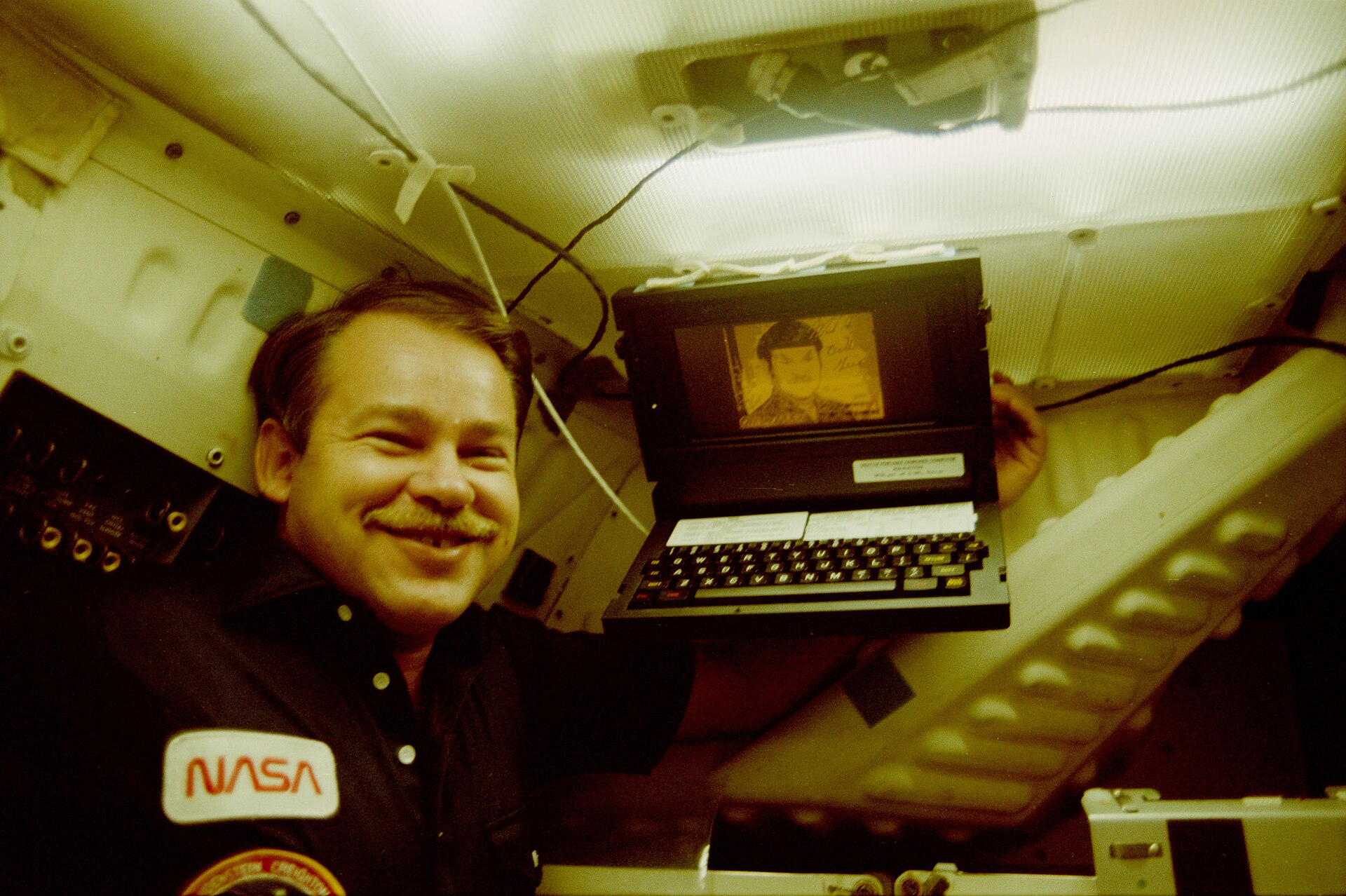
Astronaut John Creighton posing with a Grid Compass aboard a Space Shuttle Discovery mission in 1985