Tandy Color Computer 3 (CoCo 3)
[Vin93]
The Tandy Color Computer 3 (CoCo 3), released in 1986, was a significant home computer in North America, known for its backward compatibility, upgraded memory (128KB expandable to 512KB), and enhanced graphics via the custom GIME chip. Its claim to fame was offering advanced color graphics and multitasking capabilities on the Motorola 6809E processor at a time when 8-bit machines were becoming obsolete, carving a devoted niche among enthusiasts and educational users. While never rivalling sales of giants like Commodore or Apple, the CoCo 3 enjoyed moderate popularity in north America.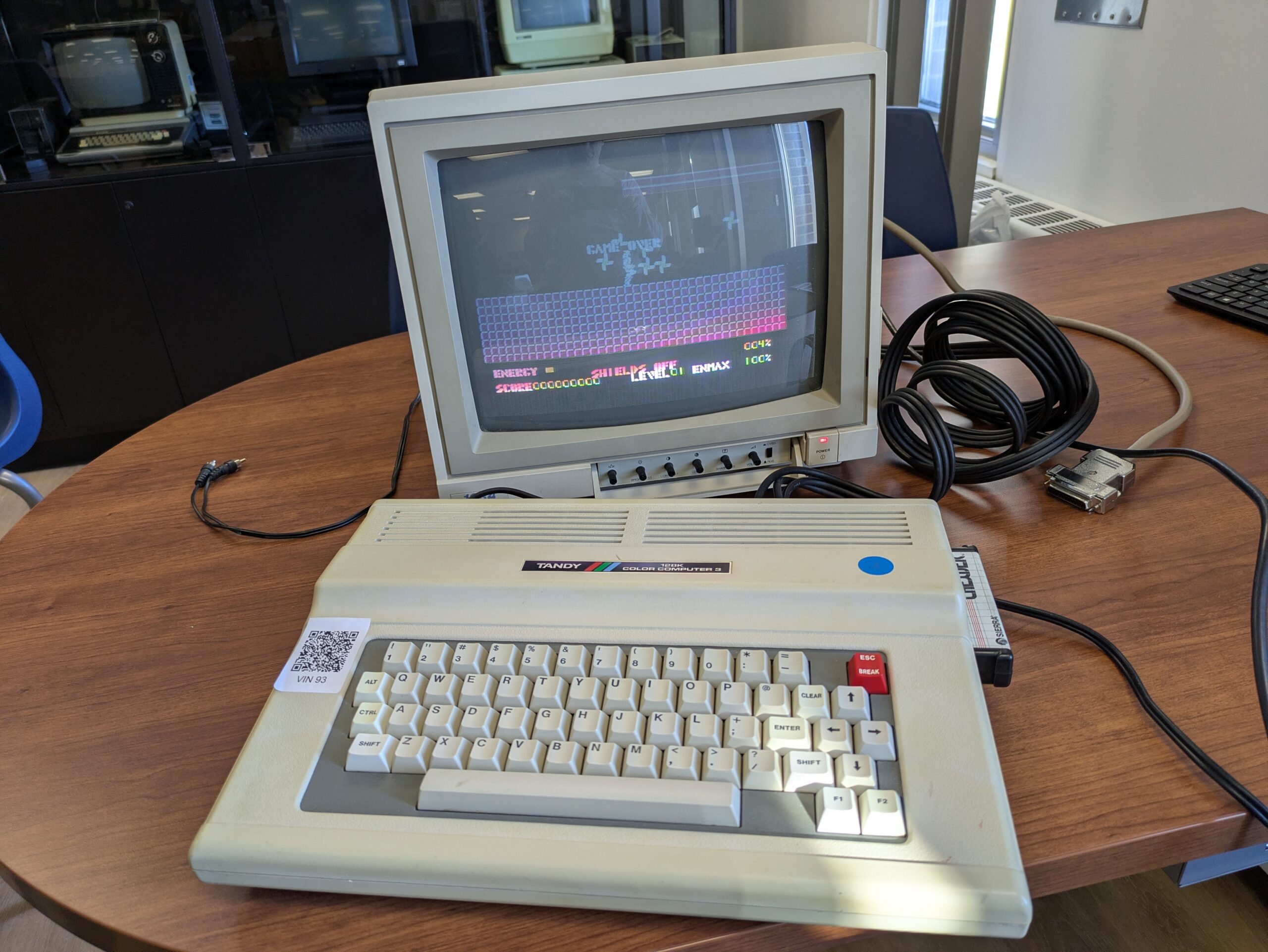
- Manufacturer: Tandy Corporation (Radio Shack)
- Type: Home computer
- Released: 1986
- Cost at release: USD $219 (CAD ~$750 adjusted for inflation)
- Cost of a full system: USD $665 (CAD ~$2,250 adjusted for inflation
- MIPS: 0.5 (500 KIPS)
Hardware Specifications
- CPU: Motorola 68B09E, 1.79MHz (switchable between 0.89MHz and 1.79MHz)
- RAM: 128KB standard, expandable to 512KB (third-party upgrades up to 2MB)
- ROM: 32KB, featuring Microsoft Extended Color BASIC with enhancements by Microware
- Graphics: Custom GIME (Graphics Interrupt Memory Enhancement) chip. Resolutions up to 640×225 pixels (machine code). Up to 16 simultaneous colors from a 64-color palette
- Text Modes: Up to 80×28 characters per screen
- Sound: 1-channel (6-bit DAC), output through television
- Storage: Cassette interface and support for floppy disk drives (using ‘Program Pak’ cartridges)
- Input/Outputs: 2 joystick ports, Analog RGB, composite, and TV outputs, RS-232 serial port, Cartridge expansion slot
- Keyboard: Full-stroke, 53-key keyboard with added arrow keys, CTRL, ALT, F1, and F2
- Weight: About 2.8kg (6.2lbs)
Operating System & Programming Languages
- O/S: Microsoft Extended Color BASIC (with Microware Super Extended Color BASIC enhancements). Optional: OS-9 Level II, a multitasking and multiuser operating system, was widely used for more advanced applications such as programming, word processing, and database management.
- Programming Languages:
- BASIC:
- Color BASIC (built-in)
- Extended Color BASIC (built-in)
- Super Extended Color BASIC (Microware extension, built-in)
- Assembly Language (Machine Code): Supported directly via the Motorola 6809E processor
- C: Available under OS-9 and other development environments
- Pascal: Third-party Pascal implementations were available, especially under OS-9
- FORTRAN: Available for the system when using OS-9
- Logo (educational)
- Forth
- BASIC09 (under OS-9)
- BASIC:
Notables
- Widely known as “CoCo 3” among enthusiasts.
- One of the few home computers using the Motorola 6809E, considered one of the most advanced 8-bit CPUs for its time.
- Introduced the proprietary GIME (Graphics Interrupt Memory Enhancement) chip for improved graphics and memory management.
- Could run almost all software and use most peripherals from the earlier CoCo 1 and 2, making it a standout for upgradeability in the home computer era.
- OS-9 Level II brought full preemptive multitasking and multiuser support; this was rare for affordable home computers in the 1980s.
- All RAM Mode: Used an “all RAM” technique to sidestep software licensing constraints, copying ROM routines to RAM and patching in new features—unusual for its era.
Donated by: Dr. Arlen Michaels