Comdyna GP-6
[Vin99]
The Comdyna GP-6 is a compact, general-purpose analog computer introduced in 1968 and produced through 2004, known for its use in simulating dynamic systems and solving differential equations by means of patchable electronic circuits. Its claim to fame lies in its wide adoption as an educational and research tool, especially for teaching control systems in universities and enabling hands-on learning in classical systems engineering over 2,000 units were installed in more than 400 laboratories globally, making it one of the most accessible and enduring analog computers ever built. While its capacity was modest, its portability, ease of use, and quick setup made it a mainstay in teaching, control labs, and experimental music, earning it a unique legacy in the transition from analog to digital computing technologies.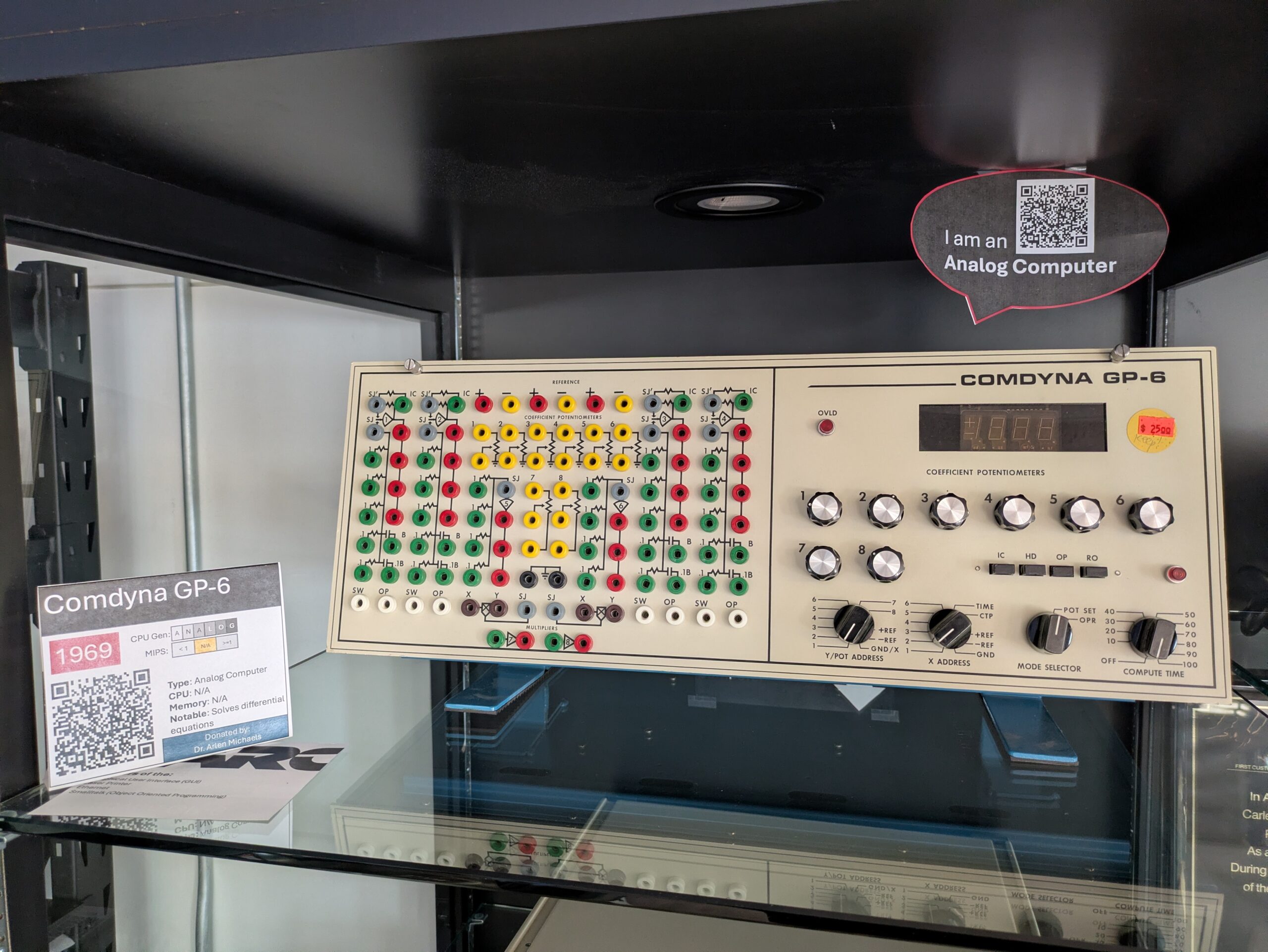
- Manufacturer: Comdyna, Inc.
- Type: Analog Computer
- Model: GP-6
- Release Date: 1968
- Cost at release: USD $1,095 (CAD ~$10,000 adjusted for inflation)
- MIPS: Not Applicable
Hardware Specifications
- Type: General-purpose analog computer (patch-panel based)
- 8 DC operational amplifiers for computations
- Potentiometers: 8 multiturn potentiometers (used for analog coefficient settings)
- Switches: 4 rotary switches and 4 mode selector buttons for configuration and operation
- Output Display: 3.5-digit LED digital voltmeter for measuring voltages and settings
- Overload Indicator: Built-in overload light to signal amplifier saturation
- Input/Output Connectivity: Complete banana plug access for all connections; rear binding posts and interface connector for external instruments
- Time Base: Internal, calibrated to match integrator time scales, for driving XY plotters or oscilloscopes
- Shorting Capability: Capacitor shorting for zeroing integrators
- Power Supply: Built-in power supply unit with ±10V and ±15V regulated outputs
- Current Limiting: Built-in circuitry to protect against overloads
- Physical Dimensions/Weight: Approximately 25kg (55lbs)
Operating System & Programming Languages
- OS: The Comdyna GP-6 did not use a conventional operating system. As an analog computer, it operated entirely through electrical components such as operational amplifiers, potentiometers, and switches configured on a patch panel. All computational tasks were achieved by physically wiring circuits to simulate mathematical operations and systems, with no digital logic or stored-program computing involved.
- Programming Languages:
- The GP-6 was not programmed using traditional computer languages (such as BASIC, FORTRAN, or assembly).
- “Programming” on the GP-6 involved devising mathematical models using differential equations and representing these with a configuration of patch cables, knobs, and switches, known as analog or patch programming.
- Users would model systems by translating equations into specific configurations of physical connections between hardware components on the patch panel.
- No compiled or interpreted software of any language type ran natively on this machine, as it lacked any microprocessor or digital memory.
Notables
- Released in 1968 and manufactured through 2004, the GP-6 had one of the longest production runs for an analog computer, remaining relevant for over 35 years.
- Analog “Programming”: Users “programmed” the GP-6 by physically patching banana cables, not by typing code—resulting in highly hands-on computational experiences typical of classic analog computers.
- It featured innovative gear-less, planetary reduction potentiometers for fine adjustments, increasing accuracy and smoothness—an unusual mechanical refinement for its era.
- Over 2,000 Units Sold: The GP-6 found its way into over 400 university, industry, and government labs worldwide, making it one of the most evenly distributed teaching analog computers ever made.
- It became a classic in control systems labs, celebrated for its rapid setup and for providing real-time, high-speed continuous simulation, critical for teaching dynamic systems engineering
- Advertisements stressed its “self-contained operation,” ease of use, and ability to “simulate up to four state variables,” with brochures often showing the GP-6 on a lab bench surrounded by patch cables and oscilloscopes to appeal to both educators and engineers
- This unit has a red $25.00 sticker on it. Arlen must have bought that at a garage sale for 25 bucks! What a bargain!
- Comdyna GP-6 Literature (pdf)
Donated by: Dr. Arlen Michaels