The Making of Rosemount Library
When Hintonburg needed a public library in 1917, Ottawa asked the rich to step up. They declined.
By Peter Coffman
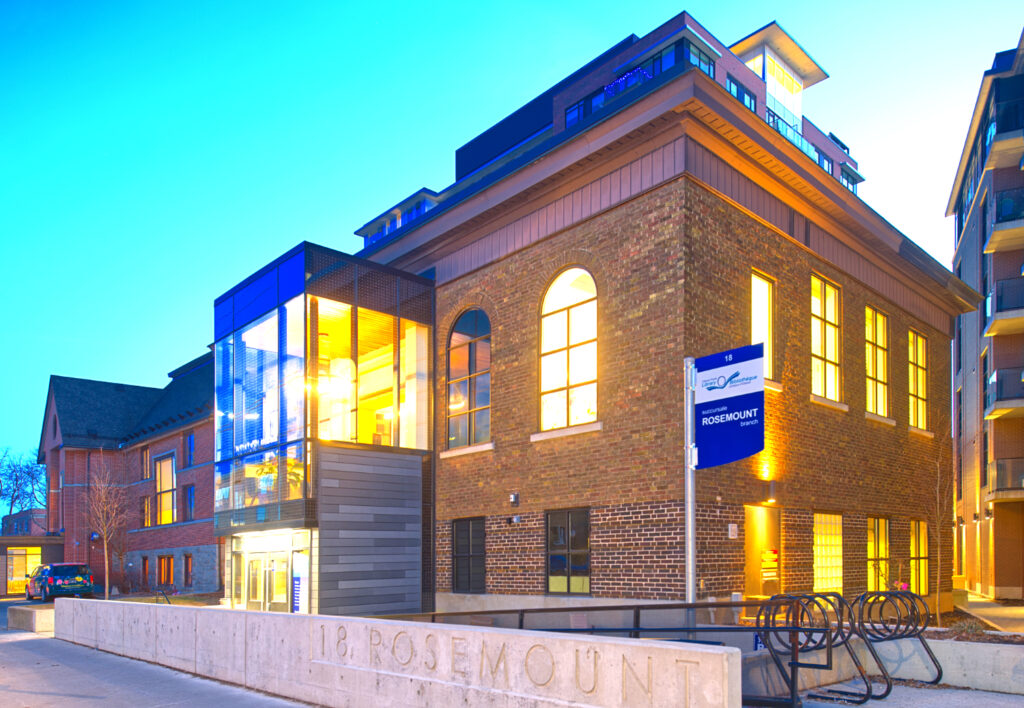
October is Canadian Library Month, which is a good time to celebrate my own neighbourhood’s branch of the Ottawa Public Library: Rosemount Library, in Hintonburg. Rosemount is one of the most loved – and most heavily used – public libraries in the city. Like thousands of other Hintonburgers, I’m grateful to have such a fine community resource.
But to whom should we be grateful? The answer may not be what you’d assume.
Hintonburg was incorporated as a village in 1891, and became part of Ottawa in 1907. A small library operated first from a room in the Rosemount Avenue Public School in 1907, then in rented retail premises on Wellington Street from 1910. But the burgeoning community needed a purpose-built public library, so City Hall got to work. Letters were written to thirty Rich Men of Ottawa in the hope that the $15,000 needed to build the library could be raised. After all, if each of them donated just $500, the project would be fully funded.
So, what came of this appeal to the philanthropy of Ottawa’s privileged? Not much:
Number of letters written: 30
Number of replies received: 0
Total funds donated to the project: $0.00
Disappointed but undeterred, the Ottawa Public Library Board asked the mayor to apply to the Carnegie Foundation for a grant of $15,000.
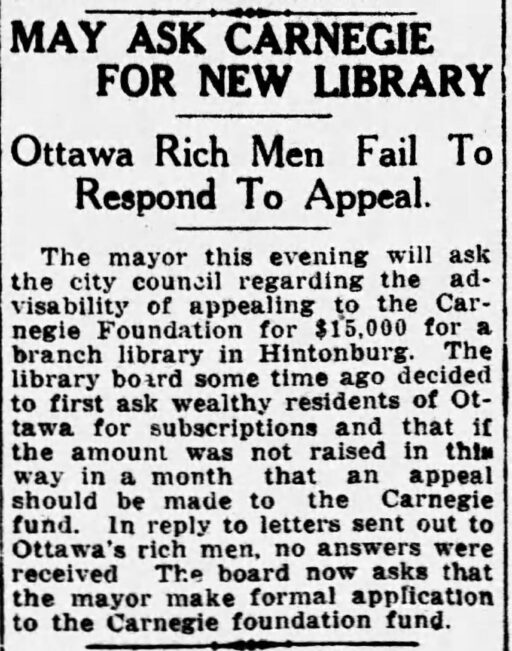
What?! An American philanthropic foundation being asked to pay for a library in Canada? In Canada’s capital, no less? The Ottawa Citizen shared your dismay:
At this time when advertisements in the street cars seek to impress everybody with red letter statements about Canada being prosperous, it might seem remarkable that the capital of Canada has to appeal to the Carnegie Corporation for the paltry sum of $15,000 to build a branch library.
Ottawa’s mayor, Harold Fisher, was no more excited by the prospect than the Citizen. The Ottawa Journal reported:
His worship holds that the city would be lowering its dignity in making such a request.
The Journal continued:
It is estimated that there are about fifty millionaires among Ottawa’s citizens. A contribution of $300 from each would provide the necessary $15,000.
Despite his misgivings, Fisher had little choice but to swallow his pride and pass the hat to the Americans. The fact that there was plenty of precedent for this may have softened the blow to civic pride. Rosemount Library turned out to be the last of 125 Canadian libraries funded by Carnegie. Many of these were in communities that could never have afforded one otherwise. Others, like Rosemount, were in communities that could have afforded one, but weren’t willing to pay.
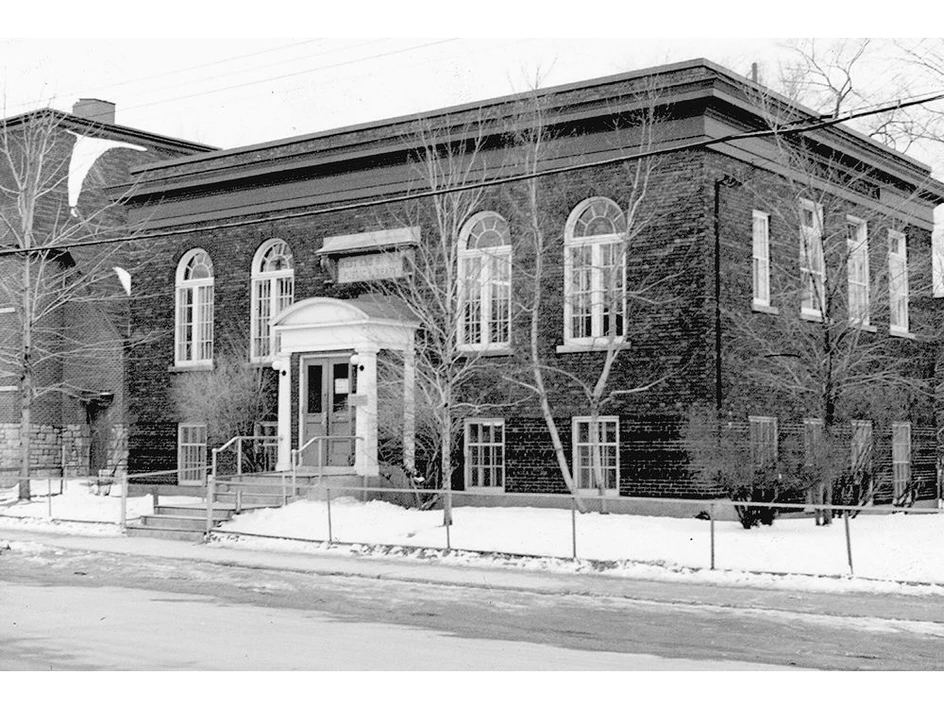
Architect J. P. Pritchard designed a small, dignified, Classically-inspired building with echoes of a Renaissance villa. The original entrance portico had smooth columns supporting a segmental arch pediment – a very sweet feature unfortunately demolished in 1982. In 1932, Pritchard designed a harmonious addition that significantly enlarged the building, and gave the city one of its most quietly elegant Classical interiors.
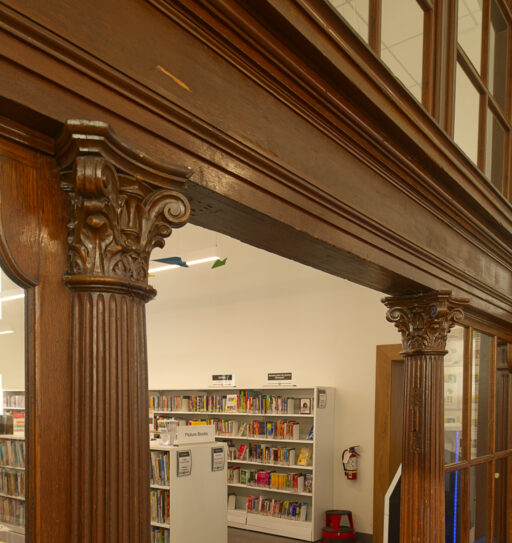
Rosemount Library officially opened on the evening of November 29th, 1918, before “a large gathering of west end residents”. Whether any of Ottawa’s Rich Men attended the ceremony is not recorded. Despite its rocky start, Rosemount Library was, and remains, an outstanding success. According to Ottawa Public Libraries, it “has the highest circulation of materials per square foot of all OPL branches.”
By its centenary in 2018, Rosemount was bursting at the seams, and the time had come for renovation and enlargement. The architectural firm +VG Architects was hired to do the job.
Those who know me well can tell you that modern additions to historic buildings is a topic on which I have some views. So it was with keen interest that I watched the design unfold. I’ll save that discussion for a future blog. Spoiler alert: They did a good job, and Rosemount Library remains the community treasure that it has been since the day it opened.
Peter Coffman, History & Theory of Architecture program
peter.coffman@carleton.ca
@petercoffman.bsky.social