The Great Indoors: Heritage and Histories of Interiors in Canada
Table of Contents
The Project
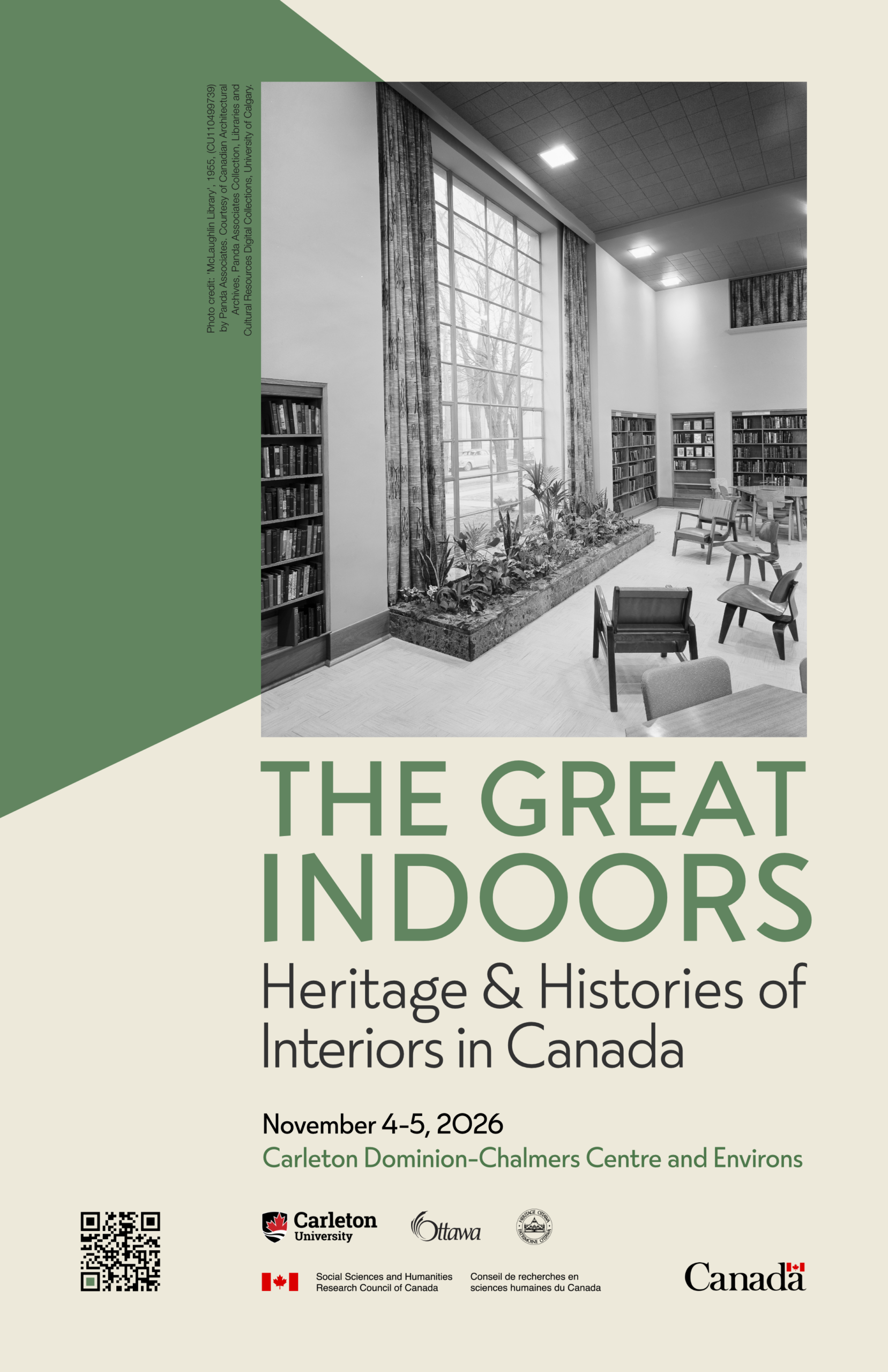
Canadians spend the majority of their time indoors, whether at home or in public spaces. Interior environments frame everyday lives, become potent sites of memory production, and hold traces of lived experiences. Because of their mutability, interiors pose particular challenges for historians, curators, and heritage conservationists alike, yet hold great promise for narrating diverse histories. Despite their significance in everyday life, research on the history of interiors in Canada is underdeveloped.
The Great Indoors: Heritage and Histories of Interiors in Canada seeks to advance research on this overlooked area by bringing together historians, practitioners, students, and interested members of the public to consider interiors as sites of historical inquiry, cultural memory, and diverse heritage practices in Canada. The aims of the project are to share academic research associated with interiors in Canada and best practices in the heritage field; foster future research through ongoing conversations and dissemination of findings, student training, and public appreciation of interiors histories; and lay the foundations for a new network of experts and emerging scholars working across fields mutually interested in interiors, from art and architectural history and heritage studies to museology, curatorial studies, and interior design.
The Symposium
The project includes a two-day symposium hosted at the Carleton Dominion-Chalmers Centre (CDCC) in Ottawa capped with public lectures hosted by Heritage Ottawa and publication of the inaugural issue of Design Studies in Canada in 2027. Click here to register for the public lecture.
If you would like more information about the event, please contact Michael Windover (michael.windover@carleton.ca)
PROGRAM AT A GLANCE
Wednesday – Nov. 4
8:30 – Arrival (coffee, light refreshments)
9:00 – 10:15 – “Interior Designers and Creators of Space”
10:15 – 10:30 – Break
10:30 – 12:15 – “Interiors as Evidence and Sites of Memory”
12:15 – 13: 30 – Lunch
13:30 – 14:00 – Travel to Fairfields Heritage House
14:00 – 16:30 – Tour Fairfields Heritage House followed by curatorial discussion
16:30 – 17:00 – Return to CDCC
Thursday – Nov. 5
8:30 – Arrival (coffee, light refreshments)
9:00 – 10:40 – “The Longer (and mediated) Lives of Interiors”
10:40-11:00 – Break
11:00 – 12:00 – Roundtable/Conclusions
12:00 – 13:15 – Lunch
13:15 – 15:45 – Downtown walking tours
18:30 – arrival to Ottawa Public Library Main Branch
19:00 – 20:30 – Public lectures
SESSIONS
Interior Designers and Creators of Space
Staging Modernity: René Cera, Eaton’s, and the ‘House of To-Day’
MARIE-MAXIME DE ANDRADE
In 1928, T. Eaton & Co., through its Paris buying office, was actively seeking a leading French authority in modern art. After some time, and on the advice of the French architect Jacques Carlu, they selected René Cera. In 1929, after only five months in Canada, Cera completed the model display home House of To-Day, following an assessment of the national market for modern decoration. This paper examines the decorator and the narrative constructed by Eaton around his French career through this model home—reproduced twice, in Calgary and Toronto—in relation to both local and international artistic scenes, asserting its ambition as Canada’s leading institution in modern art.
Marie-Maxime de Andrade is a doctoral candidate in Art History pursuing a joint degree between the Université du Québec à Montréal and Paris –Panthéon-Sorbonne.
Pending: The Case of Custom Furniture for MacMillan Bloedel
KATRIN ZAVGORODNY-FREEDMAN
In 1970, client MacMillan Bloedel accused Erickson/Massey (E/M) of copying the custom interior design from their recently completed headquarters in Vancouver on another project. In response, E/M and its architect in charge of the project, James Strasman, wrote point-by-point explanations of the differences between the two projects. Their detailed replies paralleled a simultaneous patent application taken out in the context of a royalty argument between the architecture firm and furniture manufacturers Royalmetal. This presentation queries the stakes of expertise and ownership of mid-century interior furniture designs in Canada among the overlapping and competing jurisdictions between architects, clients, and manufacturers in this tangled tale.
Katrin Zavgorodny-Freedman is a doctoral candidate at the Peter Guo-hua Fu School of Architecture at McGill University.
Designing an Impression: The Changing Position of Interior Design in Toronto’s Maturing Design Culture in the Early 1980s
KAREN R. WHITE
During the 1960s in Toronto, the emerging discipline of interior design in Canada was supported by dedicated educational pathways, professional associations, and trade magazines. Two decades later, by the early 1980s, a second generation of interior designers emerged to re-shape the development of the discipline. In response to the proliferation of broadcast and print media concerned with interiors, designers changed how they positioned themselves and their work. The demand for design-forward boutiques, clubs, and hotels called for creative environments by young mavericks with fresh approaches. Recognizing a lack of historical analysis of this dynamic period in the history of Canadian interior design, this research project seeks to develop new insights by studying overlooked examples.
Karen R. White is an independent design historian with nearly two decades of experience in Canadian post-secondary Interior Design and Industrial Design education.
Interiors as Evidence and Sites of Memory
Voices from Home: Oral History, Material Culture, and the Role of Interiors in Spatial Storytelling
DOROTHY STERN
This paper discusses the methodology and outcomes of “Voices from Home,” an ongoing oral history project (which began in 2023) at and for the residents of Hillel Lodge Long Term Care Facility in Ottawa. The interviewed residents live in a limited interior space that contains curated evidence of the rich and textures narratives/memories of their lives. Through audio-visual recorded, informal interviews, the project illustrates how the interior design of a resident’s room can give expression to often unheard voices and thereby give meaning to often neglected lives. It offers an example of a community-led initiative based on respect, recollection, and the role of interiors in framing and remembering narratives.
Dorothy Stern is an interior designer and educator. Now retired from her role as professor of interior design, she continues to work as a Student Support Services Coach at Algonquin College.
Gardens in the Backwoods: Floral Prints and Cultivation in Old Ontario
VANESSA NICOLAS
This paper argues that the florals that adorned the interiors of Old Ontario homes helped moderate the nostalgia experienced by early British settlers confronting Canada’s formidable flora and aestheticized the settler-colonial imperative to domesticate North America’s wilderness. Taking a particular interest in the nineteenth century fabrics and wallpapers that survive in regional collections and heritage parks, this paper shows that floral patterns within the homes of British settlers related to the increasing complexity of their gardens, reflecting the parallel and interconnected development of interior decoration and cultivated landscapes.
Dr. Vanessa Nicholas is Curator and Senior Researcher with WeatherstonBruer Associates.
Reading Interiors: Conservation, Material Evidence, and the Stories Within
NADIA GROGAN and ALIREZA FARROKHI
Historic interiors are layered environments where materials, finishes, and interventions record changing uses and meanings. This presentation explores how conservation practice engages with these layers to reveal and interpret interior histories within built heritage contexts, highlighting the influence of craftspeople, designers, and other professionals on these narratives. Drawing on selected examples, including Centre Block Rehabilitation and other Parliamentary Precinct projects and the restoration of the Hlus Family Home at the Ukrainian Cultural Heritage Village in Alberta, it examines how decisions around treatment, retention, and intervention shape what is understood and communicated as heritage. It also reflects on the role of traditional materials, skilled trades, and craft knowledge in constructing and sustaining heritage value, and what may be at risk as practices and expertise evolve.
Nadia Grogan is a Heritage Conservation Advisor for the Heritage Places Conservation Division at the Canadian Conservation Institute.
Alireza Farrokhi is Manager of Heritage Places Conservation Division at the Canadian Conservation Institute.
Curating City-run House Museums Today
BRAHM LEWANDOWSKI
House museums are both heritage assets and places where the public can learn about the history of a particular place. As sites of public history, house museums need to be reinterpreted over time to respond to contemporary questions and concerns and to highlight new historical findings and understandings. This presentation will consider recent efforts at the City of Ottawa to update the interpretation of its house museums. It will focus particularly on the Fairfields Heritage House Museum, a nineteenth-century stone house in Nepean that was home to the Bell family for generations before being donated to Nepean (and following amalgamation, Ottawa).
Brahm Lewandowski is Museum Administrator at the City of Ottawa’s Museums and Historic Sites.
The Longer (and mediated) Lives of Interiors
Crossroads of the World: Gander Airport’s International Lounge
ALAN ELDER
In 2000, Pico Iyer wrote of airports as “nonplaces”: simply intervals that function as part of a journey. That may have been true for many trans-Atlantic travellers in the early 1960s who stopped at Gander, Newfoundland to refuel, however the terminal was also a location for Ganderites to gather and meet those passing through. Recently, Gander’s International Lounge has been designated a provincial Registered Heritage Structure and contains most of its original Modernist architectural and design elements. As importantly, it continues to function as both a liminal space for travellers and hub for community members. My paper will look at the original intent, design and use of the lounge as well as its evolution over the past 65 years.
Alan Elder was curator of Canadian Crafts and Design at the Canadian Museum of History before his retirement in 2022. He is now pursuing doctoral studies at Queen’s University.
From Such Great Heights: Preserving Mies’ “Crown Jewel” on Bay Street
AMY KORCYNSKI
In 1962, the Toronto-Dominion Bank announced its intention to build Toronto-Dominion Centre and radically change the skyline of Toronto with the tallest building in the country. Mies van der Rohe was chosen as consulting architect for the project, and its 54th floor Executive Suite became a case study for the International Style’s ideals of structural clarity, disciplined proportion, and material authenticity. As part of a complex later designated under the Ontario Heritage Act, the suite functions today as a documentary artifact that bears witness to the institutional ambitions that helped consolidate Bay Street as Canada’s modern financial district. This presentation will consider the heritage of this interior space as well as the TD Conference Centre, constructed in 2017, which mirrors the design language and continues its legacy.
Dr. Amy Korczynski is Curator of Corporate Heritage at TD Bank, where she directs the strategic positioning of TD’s Archives and Heritage Collections through the creation of museum exhibits, client and colleague engagement experiences, and by acting as the Bank’s spokesperson for all history related inquiries or projects.
Haunting the Miesian Interior: Artefactual Afterlives in John Massy’s Phantoms of the Modern
CAMERON MACDONNELL
This paper examines John Massey’s photography exhibition Phantoms of the Modern (2004) as a critical return to the Hart Massey House in Ottawa, designed by and for his father. Through staged and digitally manipulated images of pornography and erotically charged modernist artefacts, John Massey reanimates the house as a site of mediated intimacy and spectral inhabitation. Drawing on Beatriz Colomina’s media theory alongside Julia Jamrozik and Coryn Kempster’s Growing Up Modern, this paper argues that John Massey’s imagery exposes the modernist Canadian interior as a porous field where sexuality, publicity, and memory unsettle architectural authority and domestic legibility.
Dr. Cameron Macdonell is Associate Professor in the School of Interior Design at Toronto Metropolitan University.
Digital Twinning: from a glass of water to the ocean
STEPHEN FAI
At its most essential, digital twinning can be characterised as the creation of a dynamic ecosystem comprised of physical things and processes, digital copies of those physical things and processes, and the capacity for those entities to exchange data in near real time. This relationship between the physical and the digital can extend across scales—from objects (a glass) to what philosopher Timothy Morton has identified as “hyperobjects” (the ocean). Our paper speculates on how we might theorize the delineation and demarcation of interior and exterior in the context of a national digital twin in Canada.
Dr. Stephen Fai is Full Professor in the Azrieli School of Architecture and Urbanism at Carleton University and is director of the Carleton Immersive Media Studio (CIMS). He is cross appointed to the Department of Civil and Environmental Engineering, the Institute for Comparative Studies in Literature, Art and Culture, and the multidisciplinary Master of Human-Computer Interaction.
Public Lectures
Art and Architecture: The Vision and Legacy of Gerald Trottier and the Ottawa Public Library Project
DENISE TROTTIER
This talk explores the symbiotic relationship between art and architecture through the work and legacy of Ottawa artist Gerald Trottier and its impact on Ottawa’s cultural landscape. Highlighting his close collaboration with architects, including Bemi Bemi & Associates and the Ottawa Public Library project, it will examine how space, form, and function unite these creative disciplines.
The presentation highlights the artist’s career and concludes with an overview of the public art collection at the OPL, focusing specifically on Trottier’s remarkable mosaic murals and their significance within the city’s architectural and artistic heritage.
Denise Trottier is a former public servant and a lifelong member of Ottawa’s artistic community. The daughter of prominent Canadian and Ottawa artist Gerald Trottier, she grew up immersed in the city’s vibrant arts scene and experienced firsthand her father’s close working relationships with architects, artists, and other colleagues.
Salvaged & Relocated: Fragments and Interiors of Ottawa
SUSAN ROSS
Ottawa’s history of architectural conservation includes striking examples of salvage and relocation, from the stained-glass windows of the former Carnegie Library incorporated into the Main Branch on Metcalfe Street, to the Rideau Convent chapel integrated into the National Gallery of Canada. These practices are increasingly reframed through the lens of the circular economy, where the reuse of building components helps reduce the environmental costs of raw material extraction, demolition waste, and landfill. Such acts of reuse have sparked renewed interest in the concept of spolia—the re-employment of architectural fragments in new contexts. How should we understand shifting ideas of material and site-specific heritage values in this evolving landscape?
The lecture will examine Ottawa-based case studies, including the Canadian War Museum’s reuse of copper from the Library of Parliament, the Ottawa International Airport’s incorporation of timber from wartime hangars, and the Ottawa Art Gallery’s staircase from the Firestone House, alongside other examples of salvage and relocation across the city.
Susan Ross, OAQ, MRAIC, FAPT, is an architect, educator and academic who is associate professor at Carleton University’s School of Indigenous and Canadian Studies, with a cross-appointment to the Azrieli School of Architecture and Urbanism.
Fairfields Heritage House
The Bell homestead, dating to the 1820s, remained in the family for almost 175 years. The current, Gothic revival house was rebuilt after a fire in 1872-73, replacing the earlier Georgian-style farmhouse of 1842-1851. After five generations of occupation, the Bell family donated over 3,000 artefacts together with the house and property to the municipality of Nepean (now part of the City of Ottawa).
Participants will tour the recreated historic rooms with City of Ottawa staff and discuss plans for revising their curation.
Ottawa Walking Tour (organized by Heritage Ottawa)
- Dominion Chalmers Church Auditorium (architect Alexander Cowper Hutchison, 1912)
- Knox Presbyterian Church (architects Henry Sproatt and Ernest Rolph, 1932)
- National Arts Centre (lobby areas, Salon and Southam Hall) (architect Fred Lebensold (ARCOP), 1969; 2017 renovation, architects Diamond Schmitt)
- Senate/Former Union Station (architects Ross and MacFarlane, designer Louis Joseph Théophile Décary, 1912; 2019 renovation, architects Diamond Schmitt/KWC Architects).
- Chateau Laurier (architect Ross and MacFarlane, designer Donald Macpherson Gordon, 1912; 1928 renovation/addition, architect John S. Archibald).
- One or two classified or recognized Federal Heritage Buildings in the Parliamentary Precinct, south of Parliament Hill; e.g. former Central Post Office, architect Werner Ernst Noffke, 1939; Library of Parliament, former Bank of Nova Scotia, architect John M. Lyle, 1925; Sir John A. Macdonald Building, former Bank of Montreal, architect, Ernest Isbell Barott, 1931; Wellington Building, former Metropolitan Life, architect Dan Everett Waid, 1927.
Sponsored by the Faculty of Arts and Social Sciences, the Office of the Vice-President (Research, Innovation, and International), the School for Studies in Art and Culture, the Azrieli School of Architecture and Urbanism, the Social Sciences and Humanities Research Council, the City of Ottawa, and Heritage Ottawa.