From Aerospace to the Sea: How Carleton Alumni are Navigating the Future of Underwater Autonomy
In a backyard saltwater pool, a small autonomous underwater vehicle slipped beneath the surface. For an hour, it operated untethered, responding to commands, maneuvering through the water, and returning without leaks or electronics failures.
For Samuel Scrivens, CEO and co-founder of Pelagos, the successful test of their Vantage micro- autonomous underwater vehicle (AUV) proved that an innovative idea conceived by a young team of engineers could become reality.
Scrivens and Pelagos co-founder and Chief Technology Officer (CTO) Shrey Naphade are graduates of Carleton University’s Aerospace Engineering program. While their careers ultimately led them underwater rather than into space, the foundational engineering principles they honed at Carleton remain relevant.
Strong Foundations and New Challenges
“The idea wasn’t to build an autonomous underwater vehicle. The idea was that we could build it,” says Scrivens.
Their complementary engineering strengths shaped Vantage’s development: Scrivens leads the vehicle’s autonomy, guidance and control systems, while Naphade leads its mechanical, propulsion, and battery design.
“Water finds every mistake. One bad seal can end a mission. An hour underwater without leaks isn’t luck; it’s months of stressing over details nobody will ever see,” says Naphade.
Engineering was only one part of the challenge, and the team had to step outside their comfort zones to learn the business side of entrepreneurship, like fundraising, business development, and investor relations.
“Engineering came naturally to me, but learning how to pitch, negotiate and build commercial relationships has been a completely different challenge for both of us,” says Scrivens.
Rather than waiting years to pursue entrepreneurship, Scrivens and Naphade chose to move quickly. Their focus was not simply identifying a market opportunity but proving that a small Canadian team could tackle complex engineering challenges traditionally reserved for larger organizations.
Breaking the Mould in AUV Design
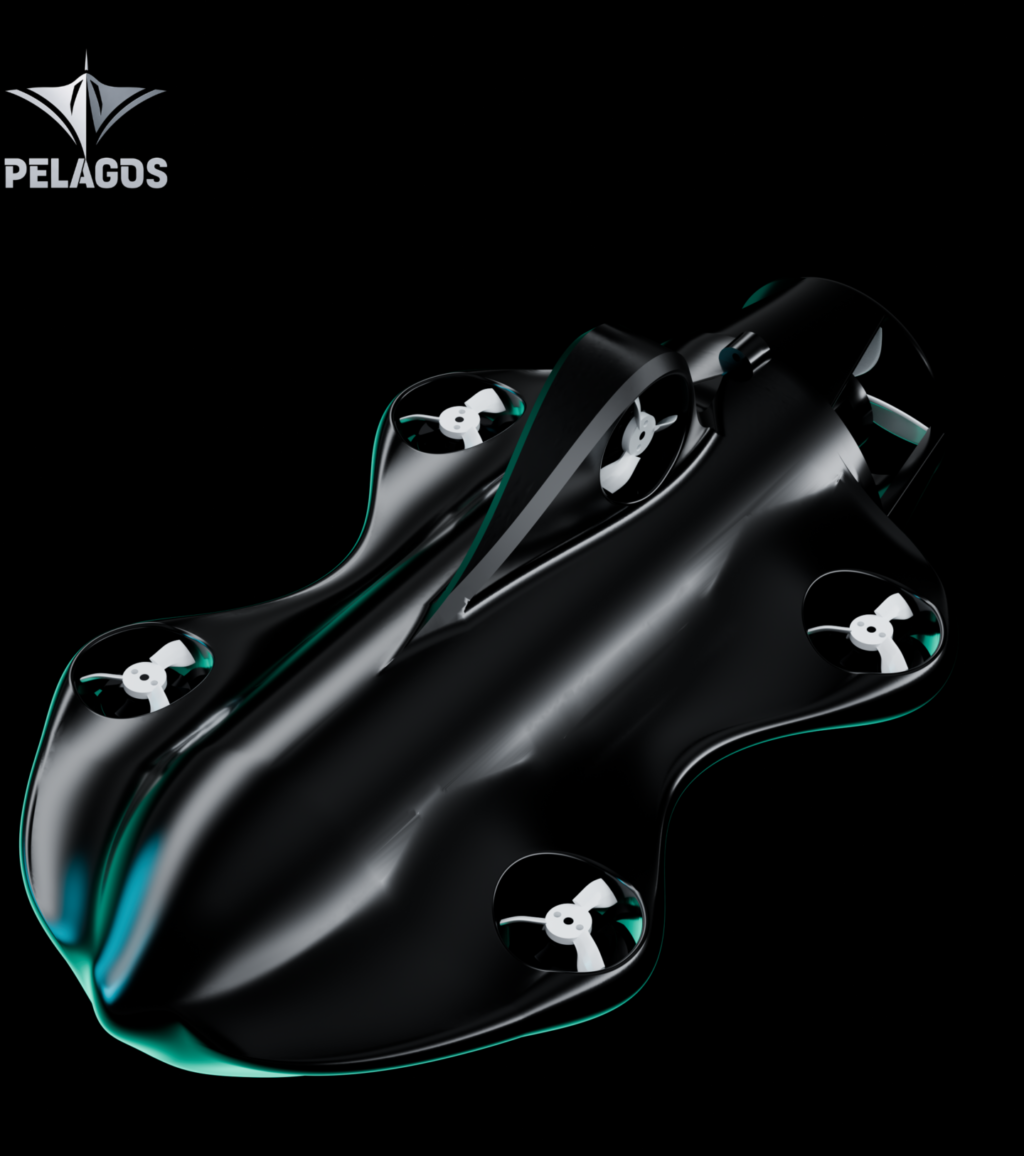
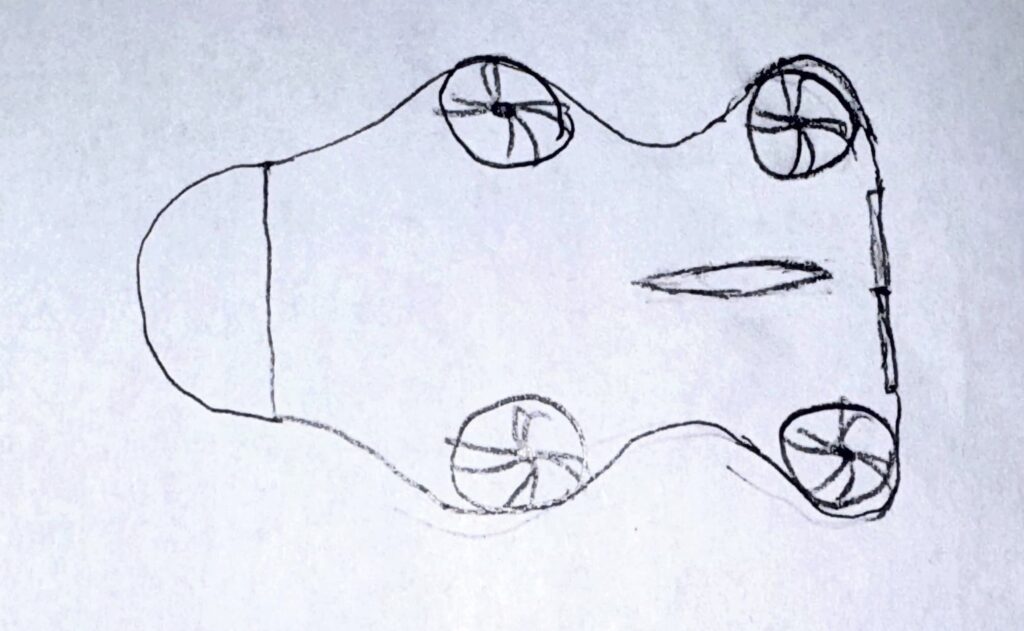
Traditional AUVs are often torpedo-shaped and designed to survey large areas. Vantage uses distributed thrusters for precision maneuverability around ship hulls, piers, and confined spaces. It offers a micro, backpack-portable design and can be deployed by small teams.
The result is a platform designed to make underwater intelligence gathering and inspection more accessible and operationally flexible than traditional systems.
“Beyond its size and maneuverability, we’re developing onboard autonomy, multi-domain interoperability, modular sensor payloads and compatibility for underwater recharging,” says Scrivens. “The goal is an affordable vehicle that a small team can deploy without a large support operation.”
Building Connections, Opening Doors
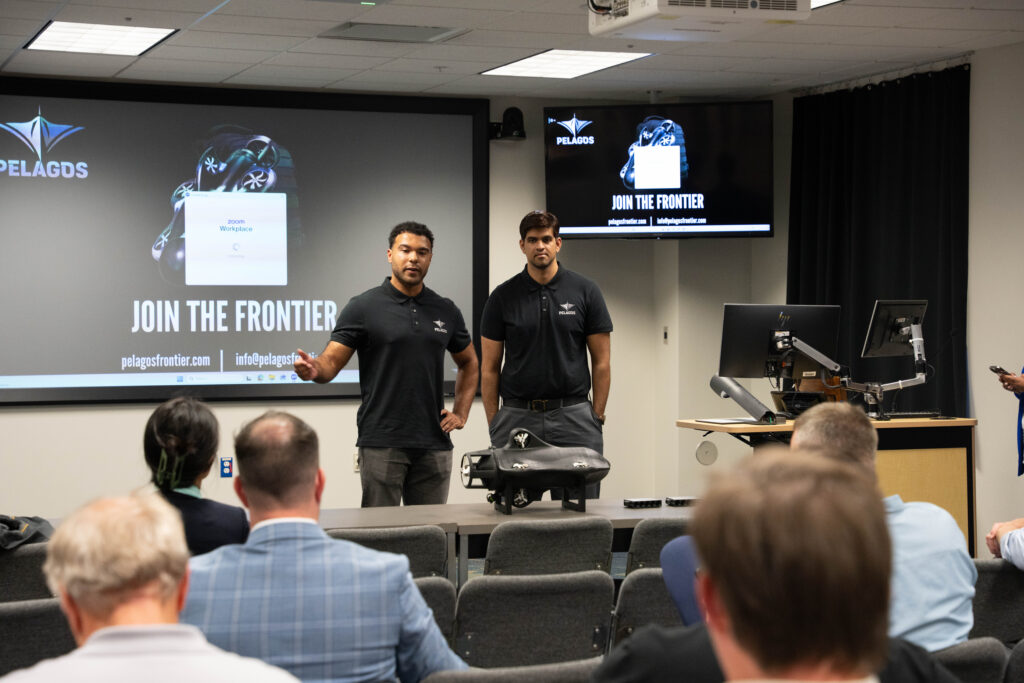
Some of Pelagos’ industry connections have been expected, in marine security and defense technology. However, others have opened more unexpected doors.
The team’s senior technical advisor, David Russell, previously held an engineering leadership role at Birket Engineering, a company with extensive experience developing ride systems for Disney attractions.
Through his connections in themed entertainment, David identified unconventional potential applications for Vantage in immersive underwater entertainment experiences, and the team was invited to send the Vantage prototype to Florida to explore the opportunity further.
Pelagos’ defence advisor introduced the team to Todd Kleperis, an ocean entrepreneur and founder of TEKMARA.
“I had the opportunity to pitch Todd on what Shrey and I were building with Vantage, and he believed in the platform enough that he offered to help us out and start opening doors,” says Scrivens.
TEKMARA has now become Pelagos’ first commercial customer, having placed a purchase order for Vantage. The team is currently working towards docking-free underwater recharging that will allow Vantage to return, recharge and redeploy autonomously using TEKMARA’s subsea infrastructure.
“The battery is one of underwater autonomy’s biggest limitations. Solve recharging, and Vantage stops being a drone you launch and becomes something that lives out there,” says Naphade.
To cap off a successful few months of industry pitches and networking, Pelagos’ work was recently profiled by BetaKit, a Canadian tech and startup online publication.
Advice for Carleton Students
Looking back, Scrivens’ advice is straightforward: start building, test your ideas and reach out to people beyond your immediate network.
“Honestly, don’t be afraid to send a message to anyone. I’ve spoken to people you’d never think you could reach just by reaching out,” says Scrivens. “I’ve learned that leadership can be grown, and when people tell you, ‘You can’t do it,’ you can just say, ‘Watch me.’”
He also encourages students to work with peers whose strengths complement their own. Naphade and Scrivens’ complementary skillsets are a key asset to the company they’re building, as is the friendship they formed during their university years.
As Pelagos moves toward its first customer deployments, its success is a testament to the Carleton engineering education and community, which fosters teamwork and friendships that help graduates build professional networks, diverse teams, and products at the frontier of technological innovation.