NPSIA MA – FAQ
Your first point of contact for the MA program is the MA Administrator, Avi Slack. To ensure a prompt reply, please copy (cc) internationalaffairs@cunet.carleton.ca in all correspondence.
Please include your Carleton ID (10XXXXXXX) each time you email NPSIA administration, to ensure that we can access your student information and provide you with correct guidance.
Familiarize yourself with Carleton’s Office of Graduate Studies Regulations.
Familiarize yourself with Carleton Office of Graduate Studies “Terms and Conditions of Admission and Funding.”
Forms
Forms for registration status changes, course registrations, course withdrawal, leave of absence, and program withdrawal are found here.
Admissions Questions
Preparation for Arrival At NPSIA
-
Students should complete their economics prerequisites – namely Introduction to Microeconomics and Introduction to Macroeconomics – before the start of the program as per our Admission Requirements.
If students need to complete their economics prerequisite, we strongly recommend that they take Carleton University’s ECON 1001 and ECON 1002. Spaces are reserved for NPSIA students in the summer ECON 1001/1002 course offerings.
If a student fails to complete the economics requirement before the start of the NPSIA program, it will negatively impact their progression through their MA program. Students without the economics prerequisite will not be allowed to register in the mandatory NPSIA economics course. Note that these mandatory economics courses are only offered in the Winter term. Failure to complete the compulsory NPSIA economics course will affect the student’s ability to participate in the co-op program and the timeframe for degree completion.
-
We strongly recommend students take Carleton University’s ECON 1001 and ECON 1002 in the summer before the NPSIA program begins.
Carleton’s summer sessions of ECON 1001/1002 are taught online, in an asynchronous format. Please note that the final exam for these courses is ‘in person.’ Students can arrange for distance e-proctoring for a fee. The fee schedule is outlined here: Exam Services – Service Pricing and Late Fees – Exam Services
For students admitted with an economics condition, we have reserved spaces in these summer sessions of ECON 1001/1002.
Please note that conditions are removed on a rolling basis before registration opens
-
To fulfill the economics requirement, any micro- and macro-economics courses should be at the same level as the standard introductory economics courses that students would take in a university major or honours economics degree program. [I.e. these courses should provide the economics content for students to advance to intermediate-level (second or third year) university economics courses.]
Please note that any economics courses taken outside of Carleton are subject to review by NPSIA’s Associate Director. As course codes and descriptions change, and given the different universities attended by our students, we cannot keep a complete list of courses that meet the entrance requirements.
If you are not certain that the courses you have taken meet the required standard, please check with your home university’s economics department or course calendar to ensure that they are the introductory courses for students enrolled in economics degree programs, or the equivalent.
If you have any questions about the suitability of your undergraduate economics courses, please contact internationalaffairs@carleton.ca .
For students without their economics prerequisite, the easiest way to fulfill that prerequisite is to take the online (asynchronous) ECON 1001/1002 at Carleton the summer before the NPSIA program.
-
If you do not have any background in international relations, you may wish to take undergraduate courses in international relations, international political economy or other global studies courses.
Students should ensure that they have their micro and macroeconomics prerequisites completed during their undergraduate degree. Please see information specific to the economics prerequisite.
-
Prior to registration for your first year of NPSIA, all incoming MA and JD/MA students must submit an official transcript to the Office of Graduate Studies indicating they have completed their undergraduate degree.
The degree must be sent directly from the Undergraduate institution to the Office of Graduate Studies (Graduate.Studies@carleton.ca) and it must have a degree conferral date.
The provision of this transcript will ensure that the conditions on offers of admission are removed.
Failure to provide these transcripts will delay the ability to register in courses.
Students with late convocations or who graduate in late summer will need to provide the Office of Graduate Studies with a letter from their undergraduate institution and an unofficial transcript showing all courses have been completed/graded. Such a letter will temporarily permit Fall term registration. However, Winter term registration will not be permitted until the Office of Graduate Studies receives an official transcript with a degree conferral date.
Please note that admission conditions are removed on a rolling basis.
-
Students who have taken similar graduate courses at other institutions may be eligible for advanced standing. There are two forms of advanced standing – with the transfer of credit, and without the transfer of credit. Please note that many of NPSIA’s courses have content specific to NPSIA’s international affairs program, so advanced standing is not automatic – it is considered on a case-by-case basis
Advanced Standing with Transfer of Credit: As per Graduate Studies Regulation 6.1, graduate courses completed at another institution or at Carleton University may be accepted, on a case-by-case basis, in partial fulfilment of Carleton’s degree requirements.
Master’s candidates may be permitted to transfer the equivalent of up to 40 per cent of their coursework credit requirements on admission. If a Master’s candidate is granted transfer of credit for 40 per cent of their coursework credit requirements, their remaining credits at Carleton must be at the 5000 level and must be INAF courses.
Transfer of Credit will be determined upon admission by the Office of Graduate Studies on the recommendation of NPSIA. No form is required; please email the MA Administrator to request advanced standing with transfer of credit.
Advanced Standing: This refers to the recognition that students have fulfilled certain program requirements in previous programs without the transfer of credit. Students are not required to take certain courses if they can demonstrate subject competence earned at the graduate level through academic transcripts and course outlines. However, students will still need to complete 5.0 credits to earn their degree. No form is required; please email the MA Administrator to request advanced standing with transfer of credit.
Advanced Standing for Economics Courses: Students admitted to the International Trade and Economic Policy (ITEP) field will be exempt from taking the field-required economics courses (INAF 5308 ) if they have previously completed an equivalent economics course. To receive advanced standing, the student will have to share the course outlines and have received a minimum grade of A-. Students will received advanced standing without transfer of credit – in other words, they will be required to replace INAF 5308 with an alternative economics course from NPSIA or another department (fourth year and up), selected with the approval of the M.A. Program Supervisor based on their relevance to the chosen program of study. No form is required; please email the MA Administrator to request advanced standing with transfer of credit.
International Students
-
NPSIA cannot provide advice on visa processes, housing, etc. for international students. Carleton has an International Student Office that is best placed to provide accurate and timely advice to students. This office provides wide-ranging support to international students, including on immigration as well as study permits
-
No. International students who attend university classes without a study permit are studying without authorization under Canada’s immigration regulations. Every application for temporary residence requires the applicant to make sworn statement to IRCC that includes indicating if they have ever studied or worked without authorization. Studying without authorization may influence the outcome of future applications for temporary residence, such as a study permit application or a post-graduate work permit.
Student Status
Full-Time and Part-Time Status, Leave of Absence
-
As outlined in Carleton’s Graduate Regulation 7.9 on ‘Status’, student status is determined at the time of registration:
Full- or part-time status is established at the time of admission to a program. Graduate students admitted and registered as full-time students will be required to continue in and complete their program as full-time students and will be assessed full-time fees for the duration of their program. Graduate students admitted and registered as part-time students will be required to continue and complete their program as part-time students and will be assessed part-time fees for the duration of their program.
For students admitted as full-time students, they will be considered as full-time students – and charged full-time student fees – regardless of the number of courses in which they are enrolled.
Students must be registered as full-time students to access funding, including TA assignments.
If students want to change their status to part-time they must meet the requirements for this change of status (see below) and apply using this form for a change in status.
Students will lose their student status if they remain unregistered for three continuous terms (twelve months).
-
If you face circumstances that require you to be absent from studies, please apply to take a Leave of Absence (LOA).
An LOA provides graduate students with the opportunity to temporarily suspend their academic studies due to personal, medical, professional, or other valid circumstances while maintaining their active student status at the university.
Financial support is normally suspended during the leave, and tuition fees are not assessed during the period of leave.
Time spent on a leave is not included in the time period allotted for completion of the degree and program time limit will be adjusted accordingly.
For more information, consult the Graduate Studies Website: https://gradstudents.carleton.ca/leave-of-absence-procedures/
The LOA form is available here: https://gradstudents.carleton.ca/wp-content/uploads/2025/07/Academic_Registration-Change-Form.pdf
-
NPSIA is designed as a two-year, full-time, in-person master’s program. We expect that students should be able to attend classes in person during the day. All the required courses for the program are only offered during the day.
The program has a part-time option. Part-time students are required to complete the same requirements as the full-time program and are given 6 years to complete the MA degree and can take no more than 0.75 credits per term. Please see Graduate Studies Regulation 7.9.
Part-time students must register for a minimum of one term in three and must complete INAF 5016, INAF 5017, INAF 5018 and their economics course requirement within their first 2.5 program credits. Part-time students must be able to attend classes in person during the day.
-
The Office of Graduate Studies will permit a student to permanently change their status to part-time if:
- The student has received a full-time permanent work contract that would prevent them from studying full-time; or,
- The student has received a full-time work contract that will extend for a year or longer, which will prevent them from studying full-time.
Please note that students with funding packages who permanently change their status to part-time will lose their funding.
Part-time students must register for a minimum of one term in three and must complete INAF 5016, INAF 5017, INAF 5018 and their economics course requirement within their first 2.5 program credits.
Please note that a change in registration status may impact your ability to receive external funding or awards, student fees, eligibility for certain university services, eligibility for certain government programs (Federal Student Work Experience Program – FSWEP) and employer reimbursement or sponsorship.
To change their program status, students should complete the following form and submit it to internationalaffairs@cunet.carleton.ca for approval.
Finances and Funding
-
NPSIA does not manage student accounts or tuition fees.
Students with issues related to their student account balance (fees and tuition) or who require fee reimbursements should contact Student Accounts for assistance.
-
Graduate Student tuition fees are based on the number of registered credits.
Student Accounts offers a Tuition Fee Estimator, where you can estimate your student fees based on the number of credits and your residency. Select “Graduate – Non-Thesis” (unless you are entering your second year and have been approved to do a thesis).
-
The Office of Graduate Studies has information on Financial Aid.
Students requiring assistance with OSAP or other government financial aid should contact the Awards and Financial Aid Office.
-
Funding is awarded to NPSIA students based on the strength of their application package. Each student’s funding package is outlined with their offer of admission. Please refer to the Office of Graduate Studies – Financial Assistance for further information.
Once students have begun their program, additional funding, awards, and bursaries are available to NPSIA’s students. NPSIA will send out email reminders with application instructions and deadlines for additional funding opportunities, including OGS and SSHRC funding.
Please consult the Office of Graduate Studies – Awards and Funding for further information about these funding opportunities.
Students must be registered as full-time students to access funding, including TA assignments.
-
Only full-time students can be teaching assistants. Students who receive a teaching assistantship with your offer of admission must remain full-time students and ensure that they are available between Monday to Friday during normal business hours.
Assignments are managed through your TA profile in Carleton Central.
Assignments are issued at the beginning of each term and no later than the end of the second week.
TA Orientation is held by the Office of Graduate Studies and is highly recommended for all new TAs. Please review NPSIA’s TA information page for complete TA details and requirements.
Students who did not receive a TA position can apply for an Outside Priority TA (OPTA) through their Carleton Central Account. (Main menu, look under TA Management, then choose TA Outside Priority Applications and follow the instructions)
If you received a Research Assistantship with your offer of admission, students will be assigned to a NPSIA faculty member at the beginning of the fall term. Please reach out to us for your RA assignment.
-
Students must be registered as full-time students to access funding, including TA assignments.
Please note that students will lose their “student status” if they remain unregistered for three continuous terms (twelve months).
Arrival At NPSIA
-
NPSIA hosts an orientation session during the first week of classes in September. Orientation is mandatory for all incoming MA/JD-MA NPSIA students. In August of each year, NPSIA sends out an email to all incoming students with full orientation details and itinerary.
Please consult NPSIA’s website and its Welcome Page for incoming students. Here you will find our one-page overview for MA students and MA/JD students, and our Registration package for incoming MA students and MA/JD students.
In-Program Questions
NPSIA’s Fields and Specialisations
-
Collaborative Specialisations utilize various departments across Carleton to provide an interdisciplinary, in-depth knowledge of a topic. Each Specialisation requires a core foundational course that students take in the first year of the program, as well as other specific courses that provide students with knowledge and analytical skills relevant to the topic of the Specialisation. Information about NPSIA’s Specialisations is provided here.
Students apply to Collaborative Specialisations after they have been admitted to NPSIA and before their first term at NPSIA. Please note that enrollment in a Specialisation is not part of your admissions offer. An email is sent to all incoming students inviting them to apply. Enrollment in Specialisations is limited. Students will be admitted to these Specialisations based on the strength of their admission file.
Fields are specific to NPSIA and reflect key subject areas of international affairs research and policy. Fields provide students with general knowledge of a particular subject area. The mandatory economics class that students take in their first year (Winter term) is tailored to their Field.
-
NPSIA offers students the opportunity to participate in five Collaborative Specialisations.
Africa Studies:
- Provides students with interdisciplinary training and skills to better understand Africa’s role in shaping the past, present, and future of international affairs.
Climate Change:
- Provides students with the tools to understand how climate change will impact state power, patterns of global competition and cooperation, and impact the effectiveness of international institutions.
CyberSecurity:
- Enables students to analyse the strength of technological systems, processes, and platforms, the role of international norms, laws, and standards for cyberspace, and the nexus between human rights, governance, security, and technology.
Data Science:
- Provides students with the skills necessary to gather, collate, analyze and present the complex array of data that can help explain international phenomenon ranging from economic processes to climate to conflict.
Latin American and Caribbean Studies:
- Provides students with the interdisciplinary training and skills to better understand the important role of the region to Canada and to international affairs.
-
International Trade and Economic Policy (ITEP):
- Provides students with a foundation in basic international economic theory;
- Examines policy questions and applications to institutional arrangements in areas of trade, foreign direct investment, finance, international economic law, and other international economic relations.
Diplomacy, International Organisations and Foreign Policy (DIFP):
- Examines the theories and practices of diplomacy, foreign policy, and global governance.
- Analyses the role of states, including Canada, and other policy actors in addressing global policy problems.
- Examines the role of international law, the formal UN system of international organizations, and non-state actors in shaping global governance.
Conflict, Fragility and Development (CFD):
- Examines the theories of economic and social development, displacement and humanitarian crises, and fragility and violent conflict.
- Examines policy responses to conflict, fragility and development, including humanitarian engagement, official development assistance, the role of non-state actors, and regional and international institutions.
National Security, Intelligence and Defence (NSID):
- Provides students with an in-depth understanding of the core theories, concepts, challenges and controversies in security, intelligence and defence studies.
- Examines applied policy issues such as defence policy, civil-military relations, intelligence collection and analysis, and arms control and disarmament.
To graduate with a Field Designation, students must take three courses (1.5 credits) associated with the Field. The list of Field courses is available in Carleton’s Graduate Calendar – Programs – International Affairs.
-
Students rank their preferences for Fields during the application process. Students are assigned a Field with their offer of admission. Students can request a change of Field after the start of the program. If space is available, students can transfer to another Field.
-
Each Specialisation has specific and unique course requirements. It is the student’s responsibility to be aware of these program requirements.
Students must apply to these Specialisations before beginning the first year of their program. Expressing interest in Specialisation in your NPSIA application form does not constitute admittance to a Specialisation.
NPSIA will send an email to all first-year students before the start of the Fall term with an application form for the Collaborative Specialisations.
NPSIA is given a quota for each Specialisation, therefore, spaces are limited. Applications will be evaluated based on your application file.
Students who are admitted into a Specialisation will be notified via email.
If you are admitted to a Specialisation, your audit will reflect that Specialisation once your degree requirements are completed.
More information on each Collaborative Specialisation can be found here.
-
You will be notified of your Field with your offer of admission.
-
Students can request a change of Field during their program. If space is available in another Field, these requests are typically granted.
Students who wish to change Fields should request that change before completing their Field Economics course.
-
The Specialisations include required courses in the Fall term of the student’s first year. Students are therefore not allowed to enroll in a Specialisation after they have begun their program.
-
The Field Designation OR Collaborative Specialisation is listed on the degree.
To graduate with a field designation, students must take three courses (1.5 credits) associated with the Field. The list of Field courses is available in Carleton’s Graduate Calendar – Programs – International Affairs.
Please note that students do not need to secure a Field Designation to graduate from the program. If students fulfill the other mandatory requirements, they are eligible for graduation.
To graduate with a Collaborative Specialisation, students need to fulfill the degree requirements of that specialization. Please see the collaborative specialization pathway documents.
Should you complete both a Field Designation and a Specialisation, only one (the Field OR the Specialisation) will appear on your diploma.
Upon graduation, you can request a letter from the MA Associate Director or the NPSIA Director that states completion of your Field Designation, Specialisation and/or Co-op designation.
NPSIA Courses
-
A Field course is an approved class that is part of a specific Field. Please see Carleton’s Graduate Calendar – Programs – International Affairs for the list of Field courses and consult the course timetable to identify those courses being offered in a given term.
Only courses listed in the Graduate calendar as field courses can be counted; Non-NPSIA courses or courses taken on exchange will not be counted towards your field designation.
Students have priority registration only in their Field courses.
-
An elective is a course that is not part of a student’s designated Field.
-
There are time limits for withdrawal from graduate courses. These time limits will impact course fees and determine if the course (and its grade) shows up on the student’s university transcript.
Students should pay close attention to the dates for withdrawal from courses. These dates are listed on the academic calendar for graduate students.
Non-NPSIA Courses
-
All non-NPSIA courses must be approved by the Associate Director before they can count towards your degree. There will be no retroactive approvals for non-NPSIA courses. If you take a course outside NPSIA without receiving permission from the department, it will not count towards your degree.
The determination of whether non-NPSIA courses are eligible to count towards your degree is at the discretion of NPSIA. The Graduate Calendar states that INAF students can take 1.5 credits in courses offered outside of NPSIA, with a maximum of 1.0 credits from a single department. This rule facilitates international exchanges; it does not mean that students have the ‘right’ to take non-NPSIA classes.
The following criteria will be used to assess non-NPSIA course requests:
- The course subject matter is international in scope;
- The course subject matter is not offered within NPSIA courses, AND the subject matter is essential for student research or to develop a specific area of expertise;
- The student is on a co-op, exchange, or work duty outside of Ottawa and NPSIA online options are not available or suitable for the student.
Please note that fourth-year courses are not approved without meeting the above criteria, as well as an agreement with the course instructor that course assignments will be equivalent to a NPSIA graduate-level seminar.
Students must submit a request for non-NPSIA courses using this form. This request must include a justification that reflects the above criteria, as well as the course outline. If the course outline is unavailable, students must include the course description.
-
As per Section 7.15 of Carleton’s Graduate Regulations, Carleton has an agreement with the University of Ottawa that facilitates students enrolling in University of Ottawa courses.
Students submit this form, the non-NPSIA course request form, and a copy of the course outline to request permission to enroll in University of Ottawa graduate courses.
All non-NPSIA courses must be approved by the Associate Director to count towards your degree. Students must submit a request for non-NPSIA courses using this form. The criteria outlined above for non-NPSIA classes will apply to University of Ottawa courses.
-
Ontario universities participate in an Ontario Visiting Graduate School (OVGS) program that enables graduate students to register in graduate courses at other universities in Ontario. Students pay tuition at their home university and are hosted at another university.
NPSIA students interested in participating in this program are responsible for obtaining permission from the host university and for ensuring that the necessary paperwork is completed.
Please note that we will consider these courses only in exceptional circumstances – i.e. if students are working/posted outside of Ottawa, or if these courses are essential for their research and training.
Students will submit the OVGS form, the non-NPSIA course request form, and a copy of the course outline to obtain the approval of the Associate Director. The criteria outlined above for non-NPSIA classes will apply.
-
Students can enroll in graduate courses in universities outside Ontario, but they must pay fees to the host university to take those courses. Students are still required to obtain approval from the MA Associate Director for these courses by submitting a non-NPSIA course request form and a copy of the course outline. The criteria outlined above for non-NPSIA classes will apply.
Course Registration
-
All full-time first-year students are required to take at least 1.5 credits in the Fall and Winter terms.
The Fall term consists of your required courses: Statistics INAF 5016 (0.5 credit), Law and International Affairs INAF 5018 (0.25 credit), and International Policymaking in Canada INAF 5018 (0.25 credit) plus one INAF elective (0.5 credit).
The Winter term consists of your required Field economics course (0.5 credit) plus two INAF Field/elective courses (1.0 credits).
Please see the NPSIA pathway document for guidance on the timing of program elements.
We recommend that first-year students do not exceed 1.5 credits; however, students can register for a maximum of 2.0 credits.
Please review the Registration Package you received via email for a detailed breakdown of your first-year courses. -
Enter the CRN number (ex. 21664) into one of the blank boxes below your registration worksheet and select “Add Course.”
Once you have entered this information, the course should be listed on your worksheet, and you can select “proceed to registration.”
You should get a failed attempt message.
When you return to the Override Request page, you should be able to proceed.
Please note that you can review the status of your Override Request on Carleton Central. If the request is approved, you will receive an email with the approval as well as detailed registration instructions.
-
All students must submit a registration override request to register in their winter term Field Economics course.
These courses have restrictions in place to reserve space for INAF students in a specific Field and so that we can ensure students have satisfied their economics prerequisite conditions.
-
All non-NPSIA courses must be approved by the Associate Director before they can count towards your degree. There will be no retroactive approvals for non-NPSIA courses. If you take a course outside NPSIA without receiving permission from the department, it will not count towards your degree.
The determination of whether non-NPSIA courses are eligible to count towards your degree is at the discretion of NPSIA. The Graduate Calendar states that INAF students can take 1.5 credits in courses offered outside of NPSIA, with a maximum of 1.0 credits from a single department. This rule facilitates international exchanges; it does not mean that students have the ‘right’ to take non-NPSIA classes.
The following criteria will be used to assess non-NPSIA course requests:
- The course subject matter is international in scope;
- The course subject matter is not offered within NPSIA courses, AND the subject matter is essential for student research or to develop a specific area of expertise;
- The student is on co-op, exchange, or work duty outside of Ottawa and NPSIA online options are not available or suitable for the student.
Please note that fourth-year courses are not approved without meeting the above criteria, as well as an agreement with the course instructor that course assignments will be equivalent to a NPSIA graduate-level seminar.
Students must submit a request for non-NPSIA courses using this form. This request must include a justification that reflects the above criteria, as well as the course outline. If the course outline is unavailable, students must include the course description.
-
You can submit an override request to be considered for a waitlist.
-
You will not be able to register until you have met all your conditions. Please arrange for them to be cleared as soon as possible.
Evaluation: The Grading System
-
NPSIA uses Carleton’s grading system, outlined in Section 10 of the Graduate Studies Regulations. The grading system is outlined below.
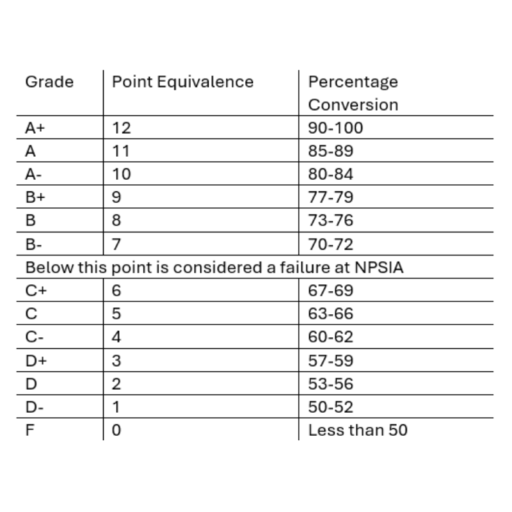
-
As per Carleton’s Graduate Studies Regulations 11.3, NPSIA’s program requires its students to obtain a grade of B- or better in each course that counts towards their degree. NPSIA does not permit exceptions to this rule.
Students should pay close attention to the dates for withdrawal from courses and withdraw from courses if they risk not meeting the B-requirement.
These dates are listed on the academic calendar, found here: https://calendar.carleton.ca/academicyear/
-
The rules governing Academic petitions and appeals are outlined in Section 15 of Carleton’s Graduate Studies Regulations.
As outlined in Section 15.2 of Carleton’s Graduate Studies Regulations, within 20 working days of the release of final grades, students may request that one or more of their grades be reviewed. The policy governing the process of grade appeals is outlined in the Coursework Grade Appeals Policy from Graduate Studies.
-
As per Carleton’s Graduate Studies Regulations 11.3, NPSIA’s program requires its students to obtain a grade of B- or better in each course credited towards their master’s degree.
Failure of a Single Course:
If you receive a grade of C+ or less in a single course, it is a ‘failed course’ and cannot count towards your degree.
You will receive a letter after the end of the term indicating that you have failed a course. The letter will outline two options.
- You may repeat and successfully pass the failed course, should you wish for it to count for credit.
- You may replace the failed course with another eligible course. If you select this option, the failed course code and the grade will be listed as “extra to your degree” on your transcript.
- When you repeat a course, the attempt with the best grade will count in the audit and be included in your CGPA calculation. The attempt with the lower grade will be bumped out of your degree and moved to a section of your audit called “COURSES SET ASIDE”. Both grades will always appear on your transcript.
Failure of Two or More Courses:
You will receive a letter after the end of the term indicating that you have failed two courses. Students will be withdrawn from the program if they receive two grades below B-.
Language Requirements
-
All students must provide proof of second language proficiency prior to the completion of their program.
We recommend students complete this requirement as soon as possible. Do not leave it until the end of the degree, or you will experience graduation delays.
As outlined here, students have various options to fulfill the second language requirement.
Students with no prior knowledge of a second language are encouraged to contact NPSIA’s Language Advisor during their first term to discuss their options for completing the language requirement. All students must begin their language training no later than the first semester of their second year in the program.
If students complete a language course at Carleton to obtain their second language requirement, the course grade will be listed on the transcript but will not count towards their degree requirements or their CGPA.
-
Yes, NPSIA offers a Rosetta Stone Package to all incoming students in September of each year. We will send out an email to students before the start of the fall term to enroll in the Rosetta Stone Program. Note: this option is only available in September and will not be available after the enrollment deadline. Students can complete the requirement through Rosetta Stone on their own; however, you will need to coordinate your completion of the program and language test with NPSIA’s language advisor.
Important: Please be aware that your Rosetta Stone license will expire after one year.
-
NPSIA accepts the official languages of the United Nations, namely Arabic, Chinese, English, French, Russian and Spanish.
NPSIA also accepts other languages that are taught on a regular basis by Carleton’s School of Linguistics and Language Studies (SLALS.
NPSIA will consider, on a case-by-case basis, other languages to fulfill the second language requirement if two conditions are met. First, students must be undertaking research that requires proficiency. And second, SLALS must have the ability to test for proficiency.
Please note that it will facilitate your employment opportunities in Canada to be able to work in both official languages.
-
Please fill out this language form and submit it by email to Carleton’s language advisor.
We recommend students complete this requirement as soon as possible. Do not leave it until the end of the degree, or you will experience graduation delays. -
Students who completed French Immersion in high school must have achieved a grade of B+ or higher (77 % and above) in their grade 12 French full immersion course to meet the second language requirement. Please submit proof of this grade to NPSIA’s language advisor.
Students who completed French Immersion in high school with a grade of B and lower (76% and below) need to complete one of the following options to meet their second language requirement:
- Alliance Française test de niveau https://af.ca/ottawa/en/diagnosis-and-orientation/#/. Students need to meet level B1.4. (Nominal Fee charged by Alliance Française);
- Self-assessment test – Public Service Commission (Government SLE) (level needed B) https://www.canada.ca/en/public-service-commission/services/second-language-testing-public-service/self-assessment-tests.html (Free);
- Obtain a DELF-DALF B1 certificate. This official certificate is recognized worldwide. https://af.ca/ottawa/tests_et_examens/delf-dalf/#/ (Fee – expensive).
-
Students cannot graduate without fulfilling their language requirement.
If a student has fulfilled their course requirements but NOT their second language requirement, they can continue working on their second language without being registered in courses/paying tuition. Once the second language requirement is completed, they can apply for graduation.
However, students must complete this second language requirement BEFORE their degree completion time limit ends. The degree time limit varies according to student status – i.e. part-time/full-time status and number of co-op terms. (See FAQ on Student Status.) This time limit is indicated on the student audit.
If students have completed all the other program elements EXCEPT their second language requirement, and their degree completion time ends, they cannot receive a program extension. Once the language requirement is completed, the student will need to reapply to the program – using their original admissions package – and apply for graduation.
Master’s Research: Essay and Thesis Options
-
Please refer to the guidelines for Master’s Research Essays (MREs) and Master’s Thesis, as well as the research guidance document.
An average of A- is required to undertake a Thesis or an MRE.
Any students expressing interest in an MRE or thesis must enroll in INAF 5015 – Research Methods in their first Winter term at NPSIA.
The MA Associate Director will provide an information session in the Fall term for all those interested in undertaking an MRE or thesis.
-
Students indicate their interest in pursuing an MRE or thesis option when they fill out the Program Completion form on January 31 of their first year.
The MRE or Thesis proposal is due on May 1 of their first year.
After the Research Proposal is submitted, the MA Associate Director assesses the proposal, determines if students meet the grade requirement, and corresponds with the proposed Supervisor. If the proposal is acceptable, the student will be notified by email and advised of next steps. If the proposal is not acceptable, the student will be advised to complete their degree via coursework.
-
Please refer to the guidelines for Masters Research Essays (MREs) and Master’s Thesis, the research guidance document, and the guidelines for graduate supervision.
We recommend that students search for a supervisory team in their first semester at NPSIA.
The Supervisor must be a NPSIA faculty member. The Advisor can be faculty members at NPSIA or at other relevant departments at Carleton, NPSIA fellows or adjunct professors, government officials, experts at non-governmental organisations, including think tanks, or other experts identified in consultation with the Supervisor.
Consider the following attributes when selecting a Supervisor and Advisor.
- Academic expertise
- Policy expertise
- Inter-disciplinarity breadth
- Administrative feasibility
For further information, please consult Graduate Studies’ Supervision Appointments Policy and NPSIA’s guidelines for graduate supervision.
The Supervisor has the primary role in the process and generally determines when a research essay or thesis is suitable for evaluation. Advisors may be more or less engaged in the research essay or thesis depending on the relationship they work out with the student. In some cases, Advisors are closely involved in all aspects of the essay; in other cases, they may play a limited role based on specific functional, methodological, regional, or policy expertise. Both the Supervisor and Advisor are responsible for reading and evaluating the essay.
For further information, please consult NPSIA’s Guidelines for Supervision, as well as Graduate Studies’ Responsibilities and Expectations Policy, which outlines the responsibilities of supervisors and students.
-
Once approved for an MRE or Thesis, students should consult with their supervisor to determine when they should register in the MRE course (INAF 5908)/Thesis course (INAF 5909).
Please note that students are not obligated to register in these courses in the first summer of their MA program. Students typically register for these courses when they begin their research.
Please note that when students begin fieldwork for their MRE or thesis, they MUST be registered in the MRE/thesis course.
-
Students can write an MRE while on Co-op, but must be aware of the challenges associated with juggling full time work and a research essay
Program Completion Timeframe
-
Carleton’s Graduate Studies Regulations establish the time frames for program completion.
Full-time
All master’s students admitted as full-time students must typically complete their degree requirements within two calendar years after the date of initial registration. Terms of non-registration are equated to full-time registration terms when calculating the overall time to program completion. Each term that students participate in the co-op program extends the completion timeframe by one term.
Part-time
All master’s students admitted as part-time students must typically complete their degree requirements within six calendar years after the date of initial registration, unless their program states otherwise. Terms of non-registration are equated to part-time registration terms when calculating the overall time to program completion. A change of a student’s status from part-time to full-time status will result in a pro-rated reduction in the required time to completion for each subsequent term of full-time study.
Failure to complete the program within the prescribed timelines or inability to maintain continuous registration will require reevaluation of the student’s entire program and may result in termination.
Research and Writing Support
-
Carleton’s MacOdrum Library has a dedicated librarian for international affairs who is available to meet and support the research needs of NPSIA students. Our dedicated librarian is Julie Lavigne.
-
Carleton’s Office for Graduate Studies provides writing support for students. This support includes sessions on academic writing for students whose first language is not English, professional writing, and preparing for your Master’s Research Essay or Thesis. Further information can be found on their website: https://carleton.ca/gradpd/writing-support/
Carleton’s Centre for Academic Support provides writing support services for Carleton’s students, including graduate students. You can book a 50-minute consultation session to discuss challenges you face with your written assignments. The Centre also coordinates online support services. Further information can be found on their website: https://carleton.ca/csas/support/one-on-one-appointments/
Graduate Professional Development Services provides extensive support to graduate students who are planning to write a research essay or thesis. You can book a writing support appointment and attend writing workshops held throughout the term. Further information can be found on their website: https://carleton.ca/gradpd/writing-support/
Co-op and International Exchange Options
Co-op Program
-
Detailed information about the co-op program is provided here. MA students at NPSIA can apply for co-op in their first term, provided they meet the eligibility criteria, namely:
- Students must complete the required 1.5 credits in the Fall term to apply to Co-op;
- For students to continue in the second term of co-op, they must complete 3.0 credits, including their mandatory economics course.
The Carleton Co-Op office manages co-op applications.
Please be familiar with the university regulations that govern Co-op for graduate students.
NPSIA will host an information session on Co-op for students in the Fall Term. An email will be sent out to students with co-op application details and deadlines each term.
-
The Co-op office works hard to recruit employers for our Co-op students. In the past, some employers have complained about students taking classes during the day.
Therefore, to protect the integrity of the Co-op program and ensure that it is available for NPSIA students in the future, students enrolled in the Co-op program are only permitted to register for one evening class.
-
Graduate students will, by default, retain full-time status while on a Co-op Work Term.
Students do not have to be registered in classes while on coop. If students are not registered in courses, they will only be charged the Coop Work Term fee and U-Pass fee (with optional opt-out).
Students can enroll in 0.5 credits while on co-op (1.0 credits if they are enrolled in an MRE). Any courses taken during the Coop program must be in the evening.
-
Full-time co-op students with funding packages will continue to receive funding while on Co-op.
-
If students have finished all their degree requirements, they are not eligible for co-op. If the language requirement remains, but students have finished all their coursework, they are ineligible for co-op.
International Exchanges
-
All outgoing exchanges are managed through the International Student Services Office (ISSO). Please visit their website for more information and deadlines on outgoing exchanges.
Exchange applications must be made through the ISSO and initiated well in advance (approximately 1 year) before going on exchange. Therefore, you will need to begin the application process during your first year at NPSIA for an exchange during your second year of studies.
Please note that NPSIA will not be able to provide extensive administrative support to prospective exchange students given the number of international universities with which Carleton has exchange agreements, the differences in their programs, and the complexities of the exchange process. It is the student’s responsibility to verify the exchange requirements.
-
If a student has received a funding package, that funding will remain in place while the student is on exchange.
Students will NOT be able to work as a TA at Carleton while they are on exchange. Students must request a Leave from Duties (LFD).
If Students have an RA position, their ability to continue while on exchange is at the discretion of their supervisor/ grant holder.
-
Please note that we do not have the capacity to provide extensive support to students while planning their coursework on exchange.
It is the student’s responsibility to research the institution where they will study and to ensure that the courses they plan to take can count towards their NPSIA degree.
Please note that the courses you take on exchange must be at the graduate level. These courses will count as electives towards your degree. As part of the NPSIA requirements, you can only have 1.5 non-NPSIA credits count towards your degree.
You will need to receive approval for these courses before the start of your exchange. To obtain that approval, please fill out the International Exchange Program Approval form that lists the courses that you are taking and outlines their equivalencies in Carleton credits.
Course equivalences for Carleton credit are determined using the European Credit Transfer System (ECTS). An exchange course must equal 6.0 ECTS to equal 0.5cr at Carleton. Courses can be bundled together to equal 6.0 ECTS. To determine the course equivalencies, students should consult the official course equivalencies database.
Not all universities are listed in the Carleton equivalencies database. If your exchange university is not listed, please consult the International Studies Support Office for support in determining credit equivalencies.
Once you fill out the form, please submit it to the NPSIA administrator for approval.
-
NPSIA students can take the equivalent of 1.5 credits while on exchange. These courses must be at the graduate level and be relevant to the field of international affairs to count towards your degree. Please note that NPSIA students have a maximum of 1.5 non-NPSIA course credits that can count towards the degree, so students on exchange must ensure all their other courses are INAF courses.
-
After you have completed your exchange, you must arrange to have an official transcript sent by your host institution to the International Student Services Office at Carleton by email at exchange@carleton.ca.
-
Please note that the grades that you receive at the exchange university will be listed as SAT/UNSAT on your transcript. The SAT grade will not be incorporated into your overall GPA, but the course credits will count towards the 5.0 required to earn your MA degree.
In determining whether a grade received on exchange is SAT, we take into account the different grading standards of universities. The grading system at British and French universities is much harsher than the NPSIA grading system. For example, students on exchange at Sciences Po who receive a grade of 12/20 are considered to have received a passing grade – i.e. the equivalent of a B- at NPSIA.
Please note that all the courses on the International Exchange Form that are eligible towards the NPSIA degree will be listed on your transcript. If you have extra INAF credits, they will count as ‘extra to degree.’
-
No. The courses taken on exchange count towards the 1.5 non-NPSIA credits students are allowed while enrolled in the NPSIA Program. Carleton’s Graduate Studies Calendar designates the courses that can count towards the Field Designation.
-
We are aware that non-Canadian universities have different grading standards, and we consider these differences when assessing whether the grade meets NPSIA’s standards for a pass or SAT.
Student Affairs
Program Rules and Regulations
-
Carleton’s Office of Graduate Studies sets the university regulations that apply to graduate students. These rules and regulations are found here:
https://calendar.carleton.ca/grad/gradregulations/
General academic policies are found here:
https://gradstudents.carleton.ca/resources-page/forms-policies/#academic-policies
Academic Conduct
-
NPSIA students are governed by Carleton’s Academic Integrity Policy. This policy outlines academic integrity standards related to plagiarism, cooperation or collaboration, and classroom behaviour. It also outlines university policies if students are suspected of violating academic integrity, including the rights of students to due process.
-
If you are feeling well, you should attend class.
At the graduate level, much of the learning revolves around the discussion of the concepts with your professor and your classmates during seminars. The class environment is enriched by the presence of all graduate students, as each of you has unique perspectives on the course material. By not attending class, you will miss this important learning opportunity and could potentially also miss pertinent information related to the course requirements. Your absence will also be reflected in your final grade.
If you must miss a class, it is a courtesy to inform your professors that you will be absent.
-
Carleton University’s Academic Consideration Policy outlines the University’s approach to students facing short-term and long-term extenuating circumstances, including illness.
Its definitions are the following:
Extenuating circumstances are circumstances that: are beyond a student’s control; have a significant impact on the student’s capacity to meet their academic obligations; and could not have reasonably been prevented
Short-term: Medical or extenuating circumstances (normally) lasting up to five days.
Long-term: Medical or extenuating circumstances (normally) lasting more than five days.
The Policy outlines the following responsibilities for students and instructors. Please note that this policy does not obligate instructors to accept submission of work; students may instead be allowed a late withdrawal from the course.
Students
- Act within the principle of good faith when requesting Academic Consideration.
- Consult the course syllabus about the instructor’s policy or procedures for requesting academic consideration.
- Contact your instructor(s) as soon as possible, and normally no later than 24 hours after the submission deadline. Student must notify their instructor no later than three (3.0) working days after the term work was due.
- Notify your instructors or supervisor, as appropriate, of your absence or inability to complete the academic deliverable in question due to medical or other extenuating circumstances.
- Complete and submit appropriate self-declaration documentation if requested by the instructor.
For short-term circumstances, please notify the registrar’s office using this online form.
For long-term circumstances, please notify the registrar’s office using this online form.
- Work with your instructors and/or the Registrar’s Office to determine any academic considerations.
- Complete academic deliverables according to the timeframe of any implemented academic accommodations.
Instructors
- Recognize the University’s Academic Consideration Policy for Students in Medical or other Extenuating Circumstances.
- Recognize self-declaration forms submitted by students per the policy’s principle of good faith.
- Determine the appropriate academic consideration options for students, if applicable (see Guidelines for Instructors).
- Consult and/or work with the academic departments and the Registrar’s Office for clarification or facilitation of academic consideration, as required.
- Consult with the student in question and communicate the appropriate academic consideration while ensuring all learning outcomes and accreditation requirements are met.
- Ensure confidentiality of any sensitive information or documentation received.
-
Graduate Studies Regulation 9.4 outlines Carleton’s policy regarding deferred term work.
- Students who claim illness, injury, or other extraordinary circumstances beyond their control as a reason for missed term work are responsible for immediately informing the instructor concerned and for making alternate arrangements with the instructor. In all cases, this must occur no later than three (3.0) working days after the term work was due.
- In cases where the term work is due on the last day of classes, the alternate arrangement must be made no later than three days after the last day of classes.
- In the event that the altered due date must extend beyond the last day of classes in the term, the instructor will assign a grade of zero for the work not submitted and submit the student’s earned grade accordingly; the instructor may submit a change of grade at a later date.
- Normally, any deferred term work will be completed by the last day of the term.
- The Registrar or Graduate Studies cannot defer term work.
- In cases where a student is not able to complete term work due to illness or injury for a significant period of time/or long term, the instructor and/or student may elect to consult with Graduate Studies (graduate courses) to determine appropriate action.
- If a student is concerned that the instructor did not respond to the request for academic accommodation or did not provide reasonable accommodation, the student should consult with the department/school/institute chair/director.
If a mutually agreeable accommodation to complete course requirements before the course grade submission deadline cannot be achieved, the Associate Dean will become involved.
If academic accommodation is not granted, and the student receives word before the academic withdrawal deadline, the student may elect to withdraw from the course(s).
If academic accommodation is not granted, and the student receives word after the academic withdrawal deadline, the student may submit a petition to the Graduate Registrar (graduate courses) for a final grade of WDN (Withdrawn) in the course(s).
If academic accommodation is granted, but the student is unable to complete the accommodation according to the terms set out by the instructor as a result of further illness, injury or extraordinary circumstances beyond their control, the student may submit a petition to Graduate Studies (graduate courses).
Non-Academic Conduct
-
NPSIA is committed to ensuring that our learning environment is respectful, safe, and inclusive. To maintain our reputation as Canada’s best graduate program in international affairs, every member of the NPSIA community – students, our administrative team, instructors, and faculty – has a shared responsibility to foster and maintain this positive learning environment.
NPSIA students are governed by The Student Rights and Responsibilities Policy, which details Carleton’s expectations for non-academic conduct. Among other things, the policy outlines the rights of all students to a learning environment free of disruption and harassment, details the process for student complaints, and outlines disciplinary measures for students. This policy applies to students both inside and outside the classroom.
NPSIA also has guidelines, our Statement of Values and Principles. These guidelines highlight that our commitment to excellence in research and teaching rests on four pillars: the pursuit of knowledge through scholarly rigour; dignity and respect; academic integrity and freedom; and diversity and inclusion.
In your engagement with each other – both inside and outside the classroom – ensure that you comport yourselves according to these standards.
Please also remember that not all members of the NPSIA community share the same backgrounds and experiences. Some of your colleagues may have experienced interpersonal violence or encountered stigma and discrimination. Some may face physical or mental health challenges. Other members of the NPSIA community may be deeply affected by political unrest, violence, and conflict occurring in other countries; they may have suffered personal loss or be deeply concerned for the safety and well-being of their family, friends, and community.
Please be sensitive to the potential impact of your words and actions both inside and outside the classroom.
-
We all want you to succeed in your MA programme at NPSIA, so please let us know if you are facing challenges so that we can help you navigate through them and complete your requirements for the NPSIA programme.
Carleton has many support services designed to help students cope with stress. Please take advantage of these resources if you are finding it challenging to manage your coursework.
This Carleton University Website provides a list of resources for students: https://wellness.carleton.ca
This link outlines resources dedicated to serving Carleton’s graduate students:
https://gradstudents.carleton.ca/counselling-and-wellness-services/
Preparing for Graduation
-
Unfortunately, the Audits are not updated by the Office of Graduate Studies until approximately a month before graduation.
Students are responsible for ensuring that they have completed the requirements for the NPSIA program. Please consult the program completion checklist.
Any courses that were approved to count for degree credit (e.g. non-NPSIA courses) that sit on your audit as ‘Courses Not Used – Extra to Degree’ count for degree credit as part of the review of audits for graduation. Any courses not counting for the correct requirement or courses that are not correctly listed (for example, economics requirements) will be corrected at the same time.
If you have satisfied your second language requirement during your program, this will be updated during the graduation audit process.
All these changes will be made before graduation during the audit review process; no further action is required by the student.
-
Once a student has completed NPSIA’s MA program requirements, they will be asked by Graduate Studies to apply for graduation.
If a student wishes to take additional courses after completing the MA program requirements, they can return to Carleton as a Special Student.
The student would apply to graduate, register in these additional classes, and inform NPSIA and Graduate Studies that they would like their student status to transition to a ‘Special Student’ once the Graduation Lists are approved by the Senate.
-
All students must apply to graduate once they have completed all program requirements. Students can apply to graduate through their Carleton Central student portal. Note, if you are unsure if you will complete your requirements on time, we recommend you apply to graduate. Should you not complete your degree requirements, you can simply cancel your application or contact NPSIA to request a cancellation. Please review all graduation application info here, as well as dates and deadlines for each graduation cycle.
Convocation is not managed by NPSIA. Please visit Carleton’s convocation website, which provides complete convocation information for graduates and guests.
updated June 2026