Past Event! Note: this event has already taken place.
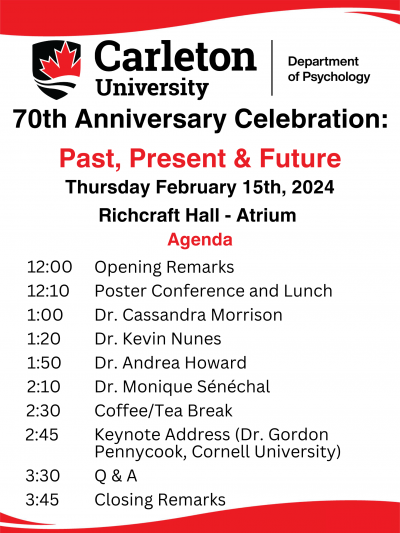
70th Anniversary Celebration: Past, Present & Future
February 15, 2024 at 12:00 PM to 4:00 PM
| Location: | Atrium Richcraft Hall |
| Cost: | Free |
The Psychology Department invites you to join us in celebrating our 70th anniversary! This event will feature a lunch and graduate student poster session, talks by some of our own faculty members (Cassandra Morrison, Kevin Nunes, Andrea Howard, Monique Sénéchal) and an external speaker (Gordon Pennycook, Cornell University)!
Poster Presenters
Anna Stone, Atara Lonn, Audrey Hodgins, Ellen Coady, Emma Holmes, Jessie Swanek, Joy McLeod, Mark Dennis, Megan DeGroot, Morgan Joseph, Muntaha Panhwar, Rachel Sharp, Sara Lapsley, Sarah Enouy, Shine Soki, Tiffany Cheng, Tyler Thorne
Faculty Talks
Dr. Cassandra Morrison: The relationship between subjective cognitive decline and cognitive change in older adults
Dr. Kevin Nunes: Do Attitudes Affect Violent Behaviour?
Dr. Andrea Howard: Planned and unplanned drinking to get drunk: An ecological momentary assessment study of undergraduate drinkers
Dr. Monique Sénéchal: Developmental Psychology: Addressing theoretical and applied questions
Keynote Address
A framework for understanding reasoning errors: From Fake News to Global Warming and Beyond

Dr. Gordon Pennycook
Associate Professor
Himan Brown Faculty Fellow
Department of Psychology
Cornell University
Many of the problems that we face as a species emerge from failures of our own decision-making. However, a major impediment to developing meaningful solutions to this overarching problem is that there is substantial disagreement in psychology about the primary and characteristic sources of reasoning errors. Prominent theories espouse that deliberative reasoning is infirm in the face of salient intuitions and, when used, may actually exacerbate partisan bias via motivated reasoning. In this talk, I challenge these ideas and provide evidence that errors typically stem rather from a mere failure to sufficiently engage analytic thinking. Indeed, individual differences in analytic thinking are consequential for a wide variety of beliefs and behaviors, including moral judgments, religious/ paranormal/ conspiratorial/ pseudoscientific beliefs, and susceptibility to misinformation and pseudo-profound bullshit. Furthermore, the spread of misinformation can be slowed by simple prompts that trigger people to reflect on accuracy. Thus, reports of the death of reason has been greatly exaggerated and there are ways to improve our decision-making, so long as we accurately characterize what leads to errors in the first place.
Oops! We could not locate your form.