Carleton Vintage Computing for Educators
The Carleton University Vintage Computing collection has several educational elements.
-
Era Timeframe Tech used What it meant Mainframes 1950’s to early 1970’s, with mainframes continuing in enterprise use afterward Vacuum tubes in the earliest systems. Later used transistors, then integrated circuits Large centralized machines for governments, banks, airlines, and big business. IBM Minicomputers Mid-1960’s through the 1980’s Mostly transistorized systems at first, then used integrated circuits Smaller, cheaper multi-user computers for labs, departments, and smaller organizations. DEC Microcomputers Early 1970’s – present day Microprocessors/CPU’s on a single chip Personal Computers for individuals and small offices. Later cloud servers and data centers for business. We can classify the Evolution of computers through these 3 main computing era’s.
The Carleton collection spans the microcomputing era – that is computers that have a CPU on a single chip.
-
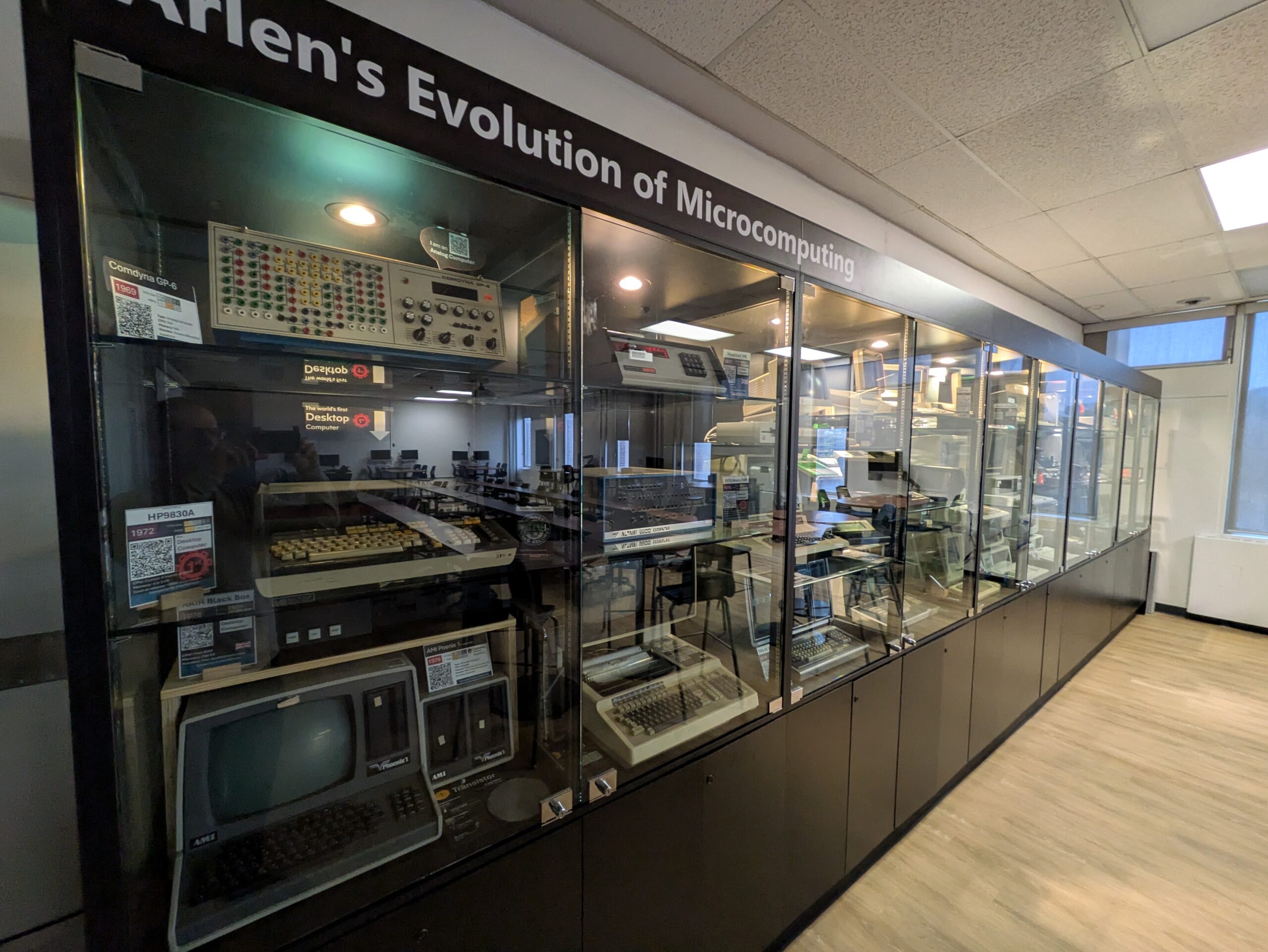
Arlen’s Evolution of Microcomputing Display showcases many notable computers.
10 most important innovations in the Evolution of Microcomputing
- The Transistor
- Central Processing Unit (CPU)
- The Computer
- Operating Systems (O/S) & the GUI
- Hardware development
- Software Development
- Networking and the Internet
- Computer Graphics & Sound
- Cybersecurity
- Smartphone
These 10 Innovations are highlighted with a yellow circle and found throughout the display. All 10 innovations make up what a computer is and how they evolved.
Who is Arlen?
Dr. Arlen Michaels donated his lifelong vintage computer collection to Carleton University. Many of the computers on display are from Arlen’s collection. To recognize his generoius contribution to the school we named the display in his honour.Notable Computers
All the computers in the display are notable in some way:- An Analog Computer: Comdyna GP-6
- First Desktop Computer: Hewlett-Packard HP9830A
- First Personal Computer: MITS Altair 8800
- First luggable computer: Osborne 1
- First Laptop: Epson HX-20
- First PC: IBM 5150 (Original PC)
- First Mac: Apple Macintosh (Original)
- First iPhone: Apple iPhone (Original)
- First solid state handheld game: Mattel Electronics Auto Race
Canadian Computers
- Canada has a vinatge computing history.
- Volker-Craig: Volker Craig VC404
- Commodore: SuperPET SP9000
Ottawa Computers
Indeed, there were notable companies that made computers in Ottawa.
- Bytec: Bytec Hyperion
- Nabu Nabu 1100
- Personal Computer NPC-2
- DY4: DY4 Orion V
- QT Computer: QT Computer Systems SYS-I6
-
Some of the equipment is in working order.
- Vintage gaming computers
- Luggables
- HP 9830A
We have some luggables that are interesting to unbox.
-
The vintage computing flyer references all the computers and has mystery computing items scavenger hunt to complete.
Arlen’s Evolution of Microcomputing Flyer (pdf)
Each computer has a fascinating and educational story to tell. -
Interesting and educational microcomputing videos
Computer/ Tech Significance Youtube MITS Altair 8800 First personal computer https://youtu.be/uDc31O9GnFo?si=WHKTEME5L6DJjazT SUN Microsystems Sun Microsystems mattered because it shaped modern networked computing through workstations, Unix, SPARC, NFS, and Java. https://youtu.be/P1TsVW4P5DI?si=CsW_rEBqclRaHI31 How are Microchips made CPU’s run every computer on earth https://youtu.be/dX9CGRZwD-w?si=L5j3qowFIhaKmipU How are GPU’s made GPU’s enable computer gaming https://youtu.be/h9Z4oGN89MU?si=m9qQNEyQVqdkx4Nw [28:29]