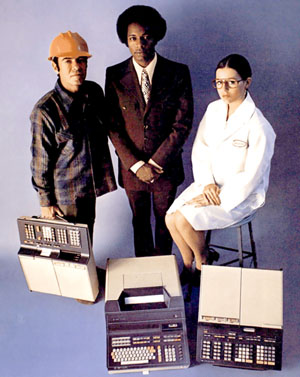
Hewlett-Packard HP9830A
Hewlett-Packard HP9830A
[Vin1]

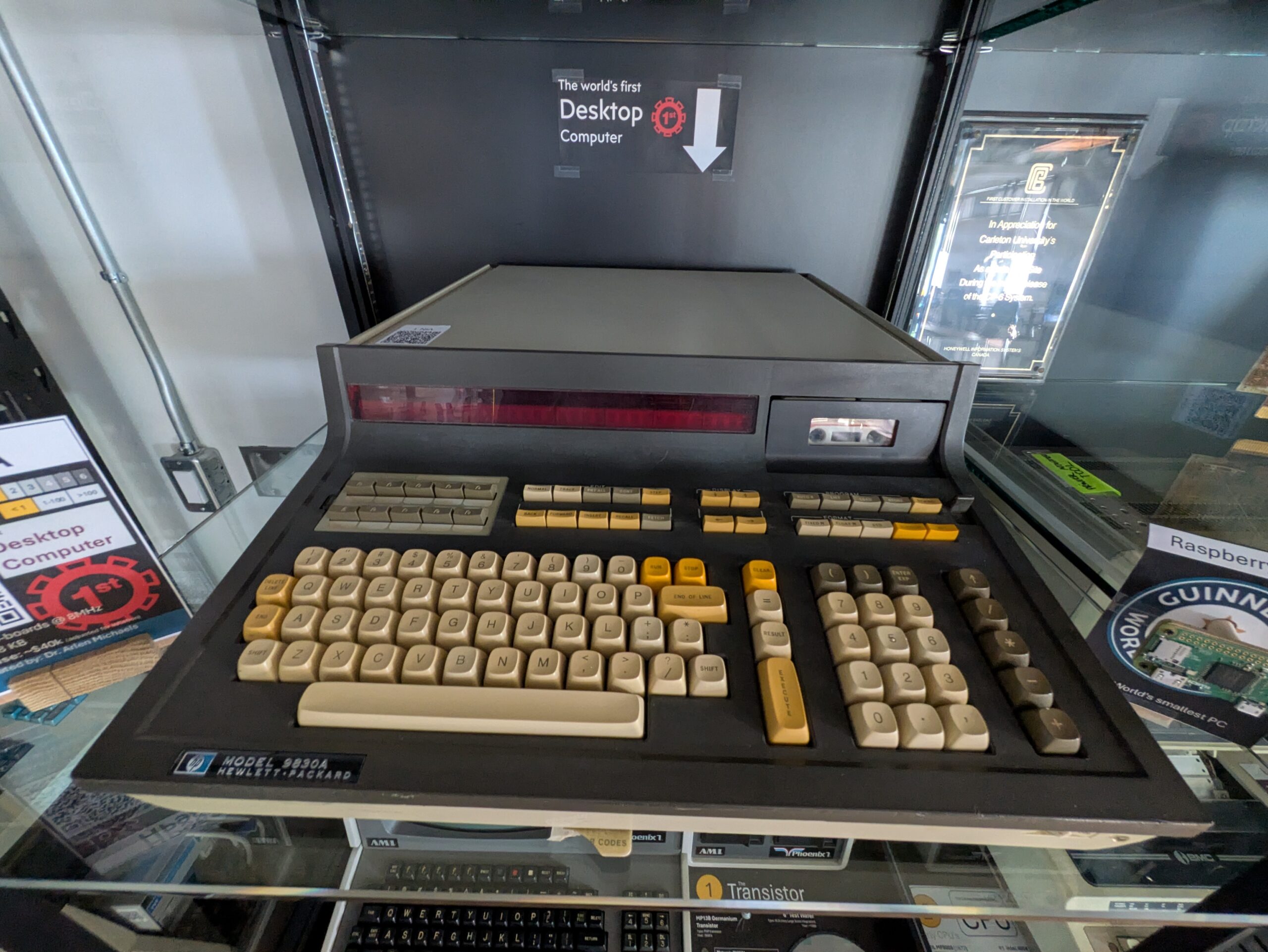
The Hewlett-Packard HP 9830A, launched in 1972, was a landmark in the evolution of desktop computing, integrating a full BASIC programming language interpreter in ROM to offer immediate programmability without external loading. It featured a 16-bit bit-serial CPU derived from HP’s minicomputer architecture, a 32-character alphanumeric LED display, a full QWERTY keyboard, and a cassette tape drive for storage. Weighing around 20 kg, the HP 9830A combined calculator convenience with general-purpose computing power, supporting advanced programming features like recursion and immediate mode execution. Designed for engineers and scientists, it was notable for expanding the concept of programmable calculators into a true desktop computer form factor.
The Hewlett-Packard HP9830A stands out as the very first desktop computer. No earlier device combines all these: high-level language (BASIC) in ROM, alphanumeric display, keyboard, and storage in one portable-like package. Some notable computers were released earlier like the Olivetti Programma 101 (1965/Calculator), Datapoint 2200 (1970/terminal computer), Kenbak-1 (1971/did not run a high level programming language), and the Q1 computer (1972/was released several months later). Intel had just released their first 4-bit CPU the 4004 which was not powerful enough for a modern computer. The landmark 8-bit Intel 8008 was released during the same year as the release of the HP9830A which started/enabled/fuelled the microcomputer revolution of the 1970’s.
- Manufacturer: Hewlett-Packard
- Type: All-in-One Desktop Computer
- Announced: December 1972
- Release Date: Early 1973
- Cost at release: USD $5,975 (CAD ~$41,000 adjusted for inflation)
- Cost with peripherals: USD $10,000 (CAD ~$68,000 adjusted for inflation)
- MIPS: 0.075 (75 KIPS)
-
- CPU: Custom 4-boards @ 8MHz
- RAM: 4KB or 8KB
- Display: 32 character LED
- Storage: Built-in cassette drive
- Ports: Printer, ROM and I/O
- Optional: thermal printer
-
Operating System: BASIC (stored in ROM, called ‘BASIC Plus’ in some references)
Supported Languages: Primarily BASIC, with the capability for machine language programming for advanced users.
-
The HP 9830A is a landmark vintage computer announced by Hewlett-Packard (HP) in 1972. Here are some interesting facts about this pioneering machine:
- First Desktop BASIC Computer: The HP 9830A (1972) was one of the earliest all-in-one desktop computers to boot directly into BASIC from ROM, years before microprocessor-based PCs appeared.
- Marketed as a “Calculator”: HP called it a calculator to bypass corporate purchasing restrictions on computers, making it easier for businesses to acquire.
- While it was too expensive in its day to be considered generally obtainable by individuals, the 9830A is a contender for the title of ‘first personal computer’.
- The Hewlett-Packard HP9830A stands out as the very first desktop computer. No earlier device combines all these: high-level language (BASIC) in ROM, alphanumeric display, keyboard, and storage in one portable-like package. Some notable computers were released earlier like the Olivetti Programma 101 (1965/Calculator), Datapoint 2200 (1970/terminal computer), Kenbak-1 (1971/did not run a high level programming language), Q1 computer (1972/was released several months later). Many notable computers claim to be the first desktop computer but were released after the HP9830A like in 1973: Micral, Wang 2200, Scelbi-8H, MCM/70, Mark-8 and later MITS Altair 8800 (1974), IMSAI 8080 (1975), IBM 5100 (1975)
- The Kenbak-1, often cited as the first personal computer, did not run a high-level programming language. Instead, it was programmed using pure machine code with binary instructions entered through switches and output via lights. It lacked a native programming language interpreter such as BASIC and operated at a very low-level instruction set, limiting its usability compared to later computers that integrated programming languages directly
- The Olivetti Programma 101, despite sometimes being called one of the first “desktop computers,” was essentially a programmable desktop calculator. It performed arithmetic and branching operations but mainly acted as a calculating machine rather than a general-purpose programmable computer with a stored-program language environment. Programs were stored on magnetic cards, and the machine printed outputs on paper, characterizing it more as a sophisticated calculator rather than a computer running a general-purpose language.
- The HP9830A was built Like a Tank: The machine weighed about 20 kg, with a robust design and gold-plated circuit boards.
- Expandable System: Users could add up to eight plug-in ROM modules for extra features, such as matrix math or plotter control.
- Audio Cassette Storage: Used standard audio cassettes for data storage, an unusual and practical choice at the time.
- Fast Printing: Typically paired with a thermal printer capable of 240 lines per minute using standard fax paper rolls.
- True Desktop Computer: Considered by many as one of the first true personal desktop computers, bridging the gap between calculators and general-purpose computers.
- Immediate Mode Operation: Allowed users to type in expressions and get instant results, precursor to modern interactive computing.
- Recursion Support: Its architecture allowed recursion, a rarity for its era.
- Self-Contained System: Included keyboard, display, storage, and BASIC interpreter, all in one box.
-
Dr. Arlen Michaels