Bachelor of Cybersecurity
The School of Computer Science faculty and staff are dedicated to providing you with the information and support you need to succeed at Carleton. This page is designed to help you plan your courses and craft your student experience. Use this page to learn more about the different facets of your undergraduate program, including academics, campus life, co-op, and more!
On this page
Preparing for your Studies
Program Requirements
Laptop Requirements
Your Undergrad Advisors
Are you a first-year student with questions about registration or looking for tips on selecting courses?
Watch this fantastic video prepared by students from the Carleton Computer Science Society
Access the slides shown in the video here
Still Have Questions? We’re Here to Help!
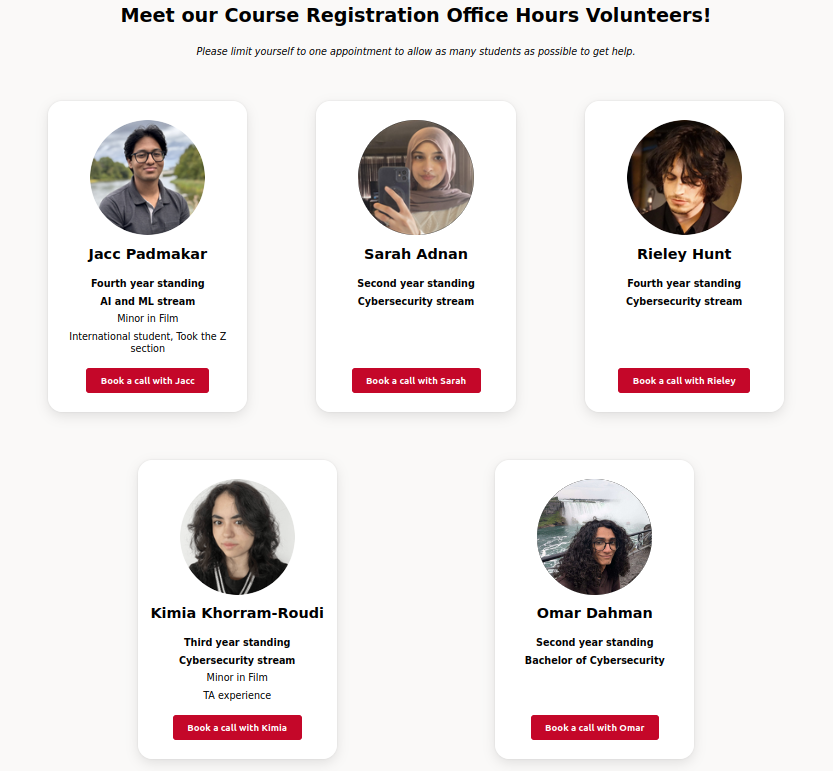
Book a one-on-one meeting with a member of the Carleton Computer Science Society (CCSS) between June 28 and July 10. This is a great opportunity for first-year and transfer students to learn about academic life at Carleton from a current student. To book a time, please visit the CCSS Course Registration Office Hours.
You can also connect with one of our academic advisors for academic guidance by emailing scs.info@cunet.carleton.ca, or by visiting the School of Computer Science main office in Herzberg 5302 between 8:30 a.m. – 12:00 pm and 1:00 pm – 4:30 p.m.
Academics
Courses and Registration
Welcome to Carleton and your Bachelor of Cybersecurity degree program! More information on registration, course selection, electives and prohibited courses, and your academic audit can be found by following the link below:
Minors
In addition to your Major (i.e. Cybersecurity), students in the B.Cyber. program may add a maximum of two Minors to their degree. You may view the Program section of each degree in the Undergraduate Calendar to see the requirements of the specific Minor that you are interested in. Adding a Minor is optional. Students can add a Minor using the Change of Program Elements form on Carleton Central. If you have any questions about adding a Minor to your degree, please consult with an Undergraduate Advisor.
-
Some minors are prohibited due to significant course overlap with precluded courses or prohibited courses listed in a minor requirement. Please always refer to the most recent Undergraduate Calendar for the most up-to-date list of prohibited courses. If you notice significant course overlap or prohibited course requirements in your chosen minor, please consult an Undergraduate Advisor before submitting a Change of Program Element (COPE) Form. Please note: the COPE form does not prevent you from selecting a prohibited minor. It is your responsibility to verify eligibility beforehand.
MCS Accelerated Pathway
The MCS Accelerated Pathway allows Bachelor of Cybersecurity students a chance to fast-track their Master’s of Computer Science studies, enabling you to reach your academic and career goals sooner.
Co-op
Co-operative Education combines traditional, in-class education with hands-on experience. As a co-op student, you alternate study terms at Carleton with four, eight, twelve or sixteen month work terms. Co-op work terms allow for the development of key employability skills, exploration of career options and graduation with tangible, workplace experience—giving you a competitive edge in the job market after graduation.
Your first potential co-op admission is in the fall term of your second year, with your first potential work term taking place in the summer term of your second year. You are required to take complete four terms of work to receive the co-op designation. Students generally follow the schedule shown below:
Work-Study Sequence
-
Year 1 Year 2 Year 3 Year 4 Year 5 Term Pattern Term Pattern Term Pattern Term Pattern Term Pattern Fall S Fall S Fall S Fall S Fall W Winter S Winter S Winter W Winter S Winter S Summer Summer W Summer W Summer W Legend
S: Study
W: Work
More information on the co-op program can be found on the Carleton Co-op website, but here are a few links to help get you directed to information on co-op for your bachelor of computer science:
Student Clubs and Societies
Carleton’s extensive network of clubs and societies is another great way to meet new people and pursue your interests outside the classroom. With more than 170 active clubs and societies to choose from, you will certainly find a venue for your academic, social, political or charitable interests. Here is a list of clubs and societies that are related to computer science:
-
- Blueprint
- Technolgap
- cuHacking
- Carleton Artificial Intelligence Society (CAIS)
- Carleton Science Student Society (SciSoc)
- Carleton Computer Science Society (CCSS)
- Carleton Cybersecurity Club (CCSC)
- Carleton Game Development Club (CGDC)
- Carleton Quantum Computing Society (CQCS)
- Women in Computer Science (WiCS)
- Carleton CUSEC Society (CCS)
- Carleton Blockchain
- All clubs and societies
Student Wellness and Support
University success is achieved by not only maintaining good study habits and attending class, but also by taking care of yourself. There are many resources and services on campus and in the community to help you better understand, manage and improve your mental health and wellness throughout your degree and beyond.
-
- Wellness Service Navigator
- Health and Counselling Services
- Computer Science Teaching Assistants
- School of Computer Science Undergraduate Advisors
- Science Student Success Centre (SSSC)
- The SSSC also offers a Computer Science Study Group
- Academic Advising Centre
- Centre for Student Academic Support (CSAS)
- Paul Menton Centre for Students with Disabilities (PMC)
- 2SLGBTQ+ Resources
- From Intention to Action (FITA)
- Equity and Inclusive Communities (EIC)
- Centre for Indigneous Support and Community Engagement (CISCE)
- AVP Indigenous Teaching, Learning and Research
- Global Opportunities & International Student Services Office (GO-ISSO)
- Carleton Athletics
- Carleton Wellness programs
- Get Help Now – Crisis/Urgent Counselling Support