Cambridge
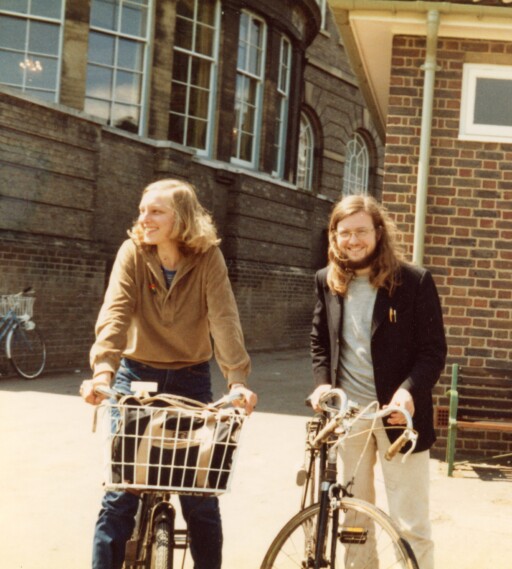
Interview with Janet Siltanen
Helin Burkay and Amanda Wilson
Part 1 – Universities of Waterloo and Cambridge
HB: Janet, what are some of the most important experiences that stand out for you throughout your career that shaped you as an academic?
JS: I did my undergraduate degree and my MA Degree at the University of Waterloo, and that’s where I got some encouragement to carry on as an academic. My mentor and supervisor was Margrit Eichler. I took every course I could possibly take from her, both as an undergraduate and as a graduate student. She supervised my master’s thesis, and let me know that there was a fund available that would pay young academics to travel around the world and study at the same time. I thought, this sounds excellent! So I applied for the Commonwealth Scholarship and got it. And that’s how I ended up doing my PhD at Cambridge. When I arrived at Cambridge, I realized that there was no formal PhD programme, but I did have a supervisor and Social and Political Science (where I was enrolled) provided office space and did introduce a seminar for graduate students to help develop their thesis plans.
HB: That seems like a different world.
JS: It was quite a different world, especially coming from North America, where there are highly developed Doctoral programmes with not only supervisors but also committees, dedicated graduate courses and comprehensive exams.
And that’s where this book [Women in Society: Interdisciplinary Essays, 1981] comes in. I was looking for a network of fellow grad students and in the process got invited to participate in teaching an undergraduate course. The course was Paper 45 and titled Women in Society. There was a group of women, both professors and graduate students who were teaching it, and I got invited to join the teaching group. My article in that book is based on a lecture I did in that course. And the women involved in Paper 45 became my sisterhood group. And then we got invited by Virago Press to actually publish those lectures. It was a wonderful experience. This book is quite important to me, because it really represents a kind of coming out, you know, as somebody who might have something to say about these things.
And then I think from that point, I continued to look for people to connect with, to work with, to spend time with. And that’s how the book with Michelle Stanworth came about [Women in the Public Sphere – A Critique of Sociology and Politics 1984]. It was really important to me, because I so admired Michelle’s contributions to gender issues in Sociology, and it was thrilling to work with her. She was at that time a Sociology professor at East Anglia Polytechnic.
HB: It seems like there were people like you who were looking for a similar kind of sisterhood.
JS: Yes. Cambridge was still a very male dominated place. Through the Commonwealth Scholarship links, I also connected with the first cohort of women admitted to Trinity College. They were graduate students, mostly from North America. My friend Lynne Pepall was one of that cohort.
AW: The image that I have of the UK would be that graduate programs would have a much deeper history there and that it would have been like a transplant the other way.
HB: You’re also coming from a geographically, politically, and culturally different place. as well. How was that?
JS: It was challenging. There was no Sociology Department per se. I was in Social and Political Science (SPS), which included sociologists but there were also sociologists scattered in different units. There were some in the criminology unit. There were some in the applied economics unit. It had a bit of an identity problem.
But SPS, bless its heart, created an attic space where people associated with the unit could hang out, and we did. And lots of people knew about this space. Even though they weren’t involved in SPS, they used to come and hang out there. David (my then partner, now husband, who was in History) used to come and hang out there, and so did Lynne who was in economics. So the SPS attic became a kind of meeting place for displaced foreign students and it was very supportive. It was a very loose network of students that provided forms of support that the institution wasn’t ready to provide yet.
As I said, we did have supervisors, although they were not well compensated for taking us on. I think my supervisor, Alexander Stewart, was paid 8 quid to supervise me for a term. 8 quid is like $16, max. And coming from North America, where everything was much further developed in terms of graduate programs, it was a bit of a shock, but it led people to look for ways to connect and have support and find their own networks both inside and outside the university.
It was 1976, when I started, so I wasn’t there too long before Thatcher got elected in ‘79, and, in fact, more years than I would like to remember involved her as the Prime Minister. But that also created interesting opportunities. I was part of the Greenham Common ‘Embrace the Base’ activism, which happened in, I think it was ‘82. The base was an active Royal Air Force missile base. The Greenham women had encampments around the base perimeter, and they did different kinds of actions. One of the actions they called for was this embrace the base activity, and the idea was we’d all come to the Greenham camp and at the designated signal we’d all join hands and we’d encircle this base that was behind the wire fence. Men were invited to look after the nursary. David was there. The men were responsible for looking after the children and feeding them and keeping them entertained. That whole Greenham experience was a very, very powerful one.
HB: It’s such a pivotal moment in a lot of things that have happened afterwards.
JS: There was a lot of contestation at the time too within left politics. Another event that I attended with Michelle Stanworth, involved a dispute within the editorial board of a new periodical called Politics and Power. It was started by Barry Hindess and other prominent writers on the left in the UK. Women were included on the editorial board but at a particular point the woman resigned en mass, every one.
AW: What happened?
JS: They called this public meeting, to discuss this sorry state of gender politics on the left in the UK. So we went down from Cambridge to the meeting in London. And both sides were there, the guys were there, the women were there. And I mean nothing got resolved, but it was an interesting public airing of grievances to do with patriarchy continuing in the guise of left politics.
That’s around the time that feminists started to talk about the need for prefigurative politics. In 1979 Sheila Rowbotham, Lynn Segal and Hilary Wainwright published a book called “Beyond the Fragments – Feminism and the Making of Socialism”. It caused quite a stir and the authors did a tour around the UK to talk with people about the book. They came to Cambridge, and I went to the talk. It was a very interesting time, because things were being said out loud. Things were being contested, including on the left. The argument in that book was that women can’t wait until after the revolution for people to treat them decently, that the politics of the left has to be prefigurative of decency for all. It is a very powerful argument. It made a big impression on me and I have continued to use and share that idea.
AW: One of the things we wanted to talk about is the evolution in your scholarship, from gendered labor to more methodological questions. There’s a parallel to what you were just talking about in terms of prefiguration that our methods and our methodological stance, is an opportunity to rethink present realities and how we can use research as a tool of prefiguration.
JS: I really enjoyed thinking about that. I was very well taught at the University of Waterloo in quantitative methodology, but I wanted to get away from quantitative methodology. Because I was becoming a bit disenchanted. I mean, I appreciated the Waterloo approach because it was very investigative. It was like, here’s a model, it’s a mathematical model, it makes assumptions. Are these assumptions that can be relevant for whatever problem you’re studying? They weren’t mechanical about applying quantitative methodology, they were quite thoughtful about it, but I’d had enough of it, and I wanted to do something different. And that proved over my entire 30 whatever years as an academic to be a bit of a challenge – to leave that behind.
But in my first year at Cambridge, Tony Giddens was the SPS tutor at my college and I did a year with him reading philosophy of social science. And then I wrote a paper at the end where I tried to reconcile what I’ve been reading in the philosophy of social science and what I knew about quantitative methodology. It was a bit of a struggle because at that moment I felt quite split. But I did make some progress over the years, and I think the 2017 paper that Nick Scott and I did on the assumptions made in intersectionality modeling (“Intersectionality and quantitative methods: Assessing regression from a feminist perspective” International Journal of Social Research Methodology, 2017, 20(4):373-385), I can trace back within my history. So I did hold on to it, and it did recur, even though I tried to get away from it.
One of the earlier recurring moments was looking at the UK and the work on occupational segregation done by the Department of Employment, and discovering that the statistic that they were using was also impacted by the proportion of women in the labor force, irrespective of where they were working. I wrote a paper about that. The work with the International Labour Office came at that moment in time, and I joined up with Jenny Jarman and Bob Blackburn because he was an SPS scholar, but he was also a bit of a statistician. I’m not a statistician. I was just a well-trained methodology person. We bid for this contract to write a research manual, and what was interesting about it, was it really helped clarify in my mind some of the fuzziness and thinking about occupational inequality by gender. They didn’t want a high level, high computer use strategy, because they have offices everywhere, and some of their offices don’t have any computers whatsoever. So they wanted a methodology that could be reliable but was also very accessible. That was a nice thing about doing this project – trying to make a more valid, but also a more accessible way of tracking women’s progress through the labour market. The ILO published our manual as “Gender Inequality in the Labour Market – Occupational Concentration and Segregation”. It came out in ’95 just after I started at Edinburgh in ‘94.