Carleton
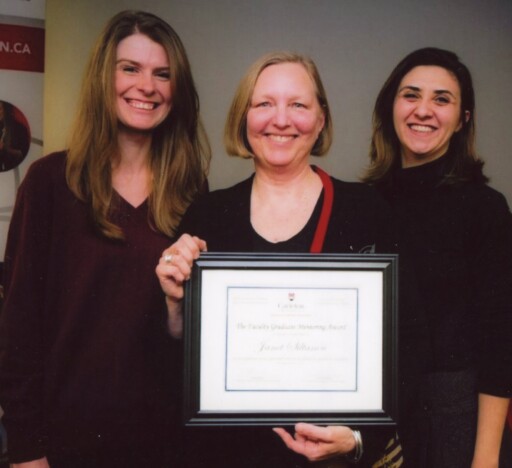
Interview with Janet Siltanen
Helin Burkay and Amanda Wilson
Part 3 – Carleton University
HB: You can see this trajectory of a feminist practice, and how to challenge some of the norms since Paper 45. We’ll talk more about your approach to mentoring and supervision later, but we can see the foundations of that here. How did it evolve from there?
JS: I think my generation of feminists were very concerned, as was I, with being independent and not having to endure circumstances that were unstable because of economic dependence. So it was always very important to me that nothing, including mothering, get in the way of me being able to support myself, and whatever children I may have.
So that went well, that worked out. But the thing I didn’t have preparation for was elder care. And I went through probably 14-15 years, being sandwiched between raising a toddler and then an elementary school child and elder care. And I did very little beyond the minimum in my job for that period of time. I mean, I was conscientious, but there was no way I was going to be able to think of a paper, write a book, do a research project, etc. Being able to return to those things when eldercare was no longer on my plate was really great and for most of that period I worked with Fran Klodawsky and Caroline Andrew on our projects about feminist organizing, which was fantastic, very enjoyable. We produced the 2017 book “Toward Equity and Inclusion in Canadian Cities” published by McGill-Queen’s. And again, prefiguration sort of popped into that discussion. It was quite wonderful to talk with the Ottawa-based women of CAWI (City for All Women Initiative) and introduce the idea of prefiguration and then hear it in conversations casually, coming up. They still use it quite a bit.
HB: How was Carleton Sociology?
JS: It was good. I was hired at the same time as Bruce Curtis. I think I was hired as the research person, and he was hired as the theory person. My feeling is that the sociology-anthropology divide had been a little more obvious prior to the two of us being hired. I think over the years that division became less stark. There was a lot of cross fertilization between those two parts of the department.
To be honest, I found the transition from Edinburgh to Carleton quite tough actually. The teaching was really tough, compared to what I had been doing, and assumptions I could make about what people did or didn’t want to spend their time on. I had to make a lot of adjustments. One of the things that it encouraged me to do was to connect with Andrea Doucet to get our Gender Relations book sorted out, partly as a way to kind of figure those things out.
The grad program was thrilling, it attracted such great students, and it seemed to be going well, and the students seemed to be well supported. It was great to have that as part of my job, because at Edinburgh it was primarily undergraduate work, with an occasional supervision. But the graduate program was such a strong part of the Carleton sociology program’s identity. It just had a very different feel. I was supervising PhD students from the get go and that was an exciting experience. Lynda was among the first PhD cohort that I was involved with.
I was chair of the sociology graduate program for a bit, and we went through an evaluation during my time as chair, and it was very gratifying. The external assessors were using words to describe us that I had not heard before. You know, calling our program a national treasure. And they were very, very impressed with the quality of students that came into the program, the resources the department was willing to put into the program to make sure that they did well while they were there. The level of achievement, the level of students actually finishing and graduating was pretty impressive, and the fact that almost all of the faculty were in on it, either teaching or supervising. It was very much a kind of collective project.
HB: Carleton Sociology was one of the first sociology departments in the country…
JS: I remember being a newbie sociologist at University of Waterloo and reading John Porter, who established the department, and reading Wally Clement. I mean, its reputation in Canadian sociology is big. So it’s quite cool, to have come to this department. What a thrill that my first year of teaching at Carleton included a graduate course with Wally Clement!
AW: You hear stories of how it used to be in certain sociology departments where there were these pitched political battles, between, like the Marxists or the post-structuralist, where certain people who, like, wouldn’t talk to each other. Was there that politically charged atmosphere when you were there?
JS: Not everybody got along, as with any workplace. Also, academics kind of thrive on disagreement too. I mean, it’s such a lone wolf profession. It wasn’t for me. That’s not what I wanted, which is why I cultivated all my women’s groups. But you know, for a large part you’re on your own, and you’re setting your own targets and driving yourself to do certain things. When you need to come together and collaborate, like in a department meeting, that can be challenging, and messy. Except for one or two occasions where things got quite testy, the department was pretty solid in supporting itself, arguing for itself and supporting colleagues. And that got even better as time went on. I think making connections across the boundary between sociology and anthropology was part of making that happen, that we were all in it together, as opposed to two separate units.
AW: We want to talk about mentorship. For us, that was a lot of the driving force, or inspiration behind this whole project was the shared experience of mentorship that we had from you. From our perspective, we certainly see that both modeling and thinking about how to approach supervision and mentorship with care and attention as a significant contribution of your work. We’ve all had these experiences with you, where, while still being very professional, you extended an ethic of care to us, not just as students, but as human beings. And that had a big impact on us.
HB: One of the things that got me thinking about this project initially was during my post- doc and talking to other Phd graduates who came out of their program burnt out and feeling like they had to keep doing it. At that time I gave myself a liberty to think about academic work differently, because I had just come out from a very different experience. After the PhD I felt confident in my academic abilities, but I also felt like I was seen as a whole human being in the process.
I remember the moment I walked into your office in the middle of a writing crisis, and I was like, I can’t do this, it’s not shaping up. I don’t know what I’m going to do. I don’t have any income for the next 2-3 months. And I sat down and cried. And you just listened and said, I wish I could do more. I can’t do more, but I can listen. And I thought listening is actually enough. I could do the academic bit myself, but I couldn’t do the other bit myself.
JS: So one of the positive things was that advantage of having Carleton’s good reputation for graduate studies. Amazing students came into the program, and amazing students are amazing to be around, so it was always a pleasure. I knew how hard it was to pursue a PhD – because I had found it hard myself.
But it was always a pleasure to engage with wherever people were at. And I think it’s quite important to say that. Some people see PhD supervision as a way to get other people to advance their work, or extend their approach. And I didn’t work like that. I look at the topics of theses I’ve supervised, and I think, what did I have to contribute to that? But all of the specialist knowledge came through the door when you (the student) walked through the door. You had the specialist knowledge about your topics, and the drive to say something significant about it. So my supervision strategy was all about the process and facilitating and just trying to keep people going in circumstances that were not always pleasant.
I always felt a little bad that I didn’t have more substantively to offer. But I knew that one of the skills I had was to listen carefully and to try and help students identify their next step. And that produced quite a lot of good stuff. I was always very awestruck by how accomplished our students were. I had a lot of empathy for where students were at, especially when they got stuck and a lot of admiration for the fact that they kept going, because I knew that was not easy.
It’s a bit of a cliche, I suppose, but I learned so much. But, it didn’t always work, and it didn’t work in circumstances where students were not driven by the topic. So as long as students were driven by the topic, I could help with the process. If students weren’t driven by the topic, there wasn’t much I could do. They had to be the driver.
I think about the design spine; it’s an empty piece of paper, and it has some substance to it, but basically it is about trying to hold on to the process and see your next move in the process. And it was fun developing that, and it’s fun talking about it with people. But I often get a sense of disappointment that the answers aren’t on the page. The answers have to be put on the page by the person doing the research.
It’s fun and interesting to sort of link back to my women’s groups that I tried to form along the way. You know, because it’s a lonely business. Even in the profession, it’s a bit of a lonely business. So it’s been very rewarding. Those relationships with graduate students have been some of the most rewarding parts of the whole thing. It’s interesting to note that most of the students I have supervised were women. I think Nick Scott is the only male PhD student I’ve supervised. I did supervise male students for MAs and I was on committees of male students for PhDs, but he’s the only one who was brave enough to ask me to be his supervisor. And, eventually, we worked together and co-authored an article for The International Journal of Social Research Methodology.
AW: I feel like sometimes there’s this whole ‘tough love’ approach to teaching and students, that even comes from professors who otherwise express a politically progressive approach. Almost a disdain for students. I’ve been thinking about a pedagogy of care as a counterbalance to that. One of the things I’ve been wondering is what does it look like when we, as mentors or professors, approach teaching and approach our relationships with students from an ethics of care. And what does a pedagogy of care look like?
To me, an ethics of care is never trying to punch down on your students, or make them feel small or less than. Not that you didn’t hold us to a particular standard, and didn’t say ‘that’s not good enough try again’, but you never had that sort of condescending flavor that I think some academics have. In my own practice of trying to think through what a pedagogy of care looks like to me, I find inspiration from thinking through how you approached mentorship.
JS: Thank you.
HB: I think it’s worth acknowledging that it’s a choice. Not instilling fear, but containing the space in a respectful way, as a person is moving through the graduate school and this institution, and understanding the person as a whole is a choice.
JS: One thing that has shifted among graduate students is that when I went through graduate school, nobody was married, nobody had children. There were relationships, but their responsibilities were not as extensive as they are now. I think a lot of graduate students now have families, have partners, have a lot on their plate. I don’t know how that translates to an ethic of care, but just recognizing that these individuals are sacrificing a lot to go through this doctoral program and are putting aside a lot, and are dealing with a lot while they’re going through this program, has to be some significant element of that.
AW: I often think back to my experiences as a grad student, and there was just this almost like luxury of time, that the only thing you were doing was being a grad student. So you could go to the talks and the seminars, and immerse yourself in that life. I don’t think that exists, maybe not at all for graduate students anymore, or certainly more and more of them yet. They just don’t have that graduate student experience, where they are just enmeshed in that life, and that’s all they really have to think about.
JS: I think about my pals from Cambridge that I just visited. We were all single during our PhDs. There were relationships, but they weren’t at the point where you were caring for babies or things like that.
AW: I think all, nearly all, of my PhD students now have kids.
I think a lot of what I learned is from you, in terms of how to relate to students, and also the confidence to supervise people, even if their subject matter is not necessarily what I do. Understanding it as a relationship of support and mentorship, that you can support the process even if you don’t know a lot about whatever that thing is.
That stance of approaching students with a sense of care and curiosity, and genuine interest in them succeeding in what they’re doing. I think the way that I orient to students goes back a lot to the standard that I learnt from you.
HS: Thank you for spending this morning with us.
JS: Thank you both for your initiation of this project. I am so touched that you wanted to undertake it. And thank you to all those who contributed.