Descriptions Archive
-
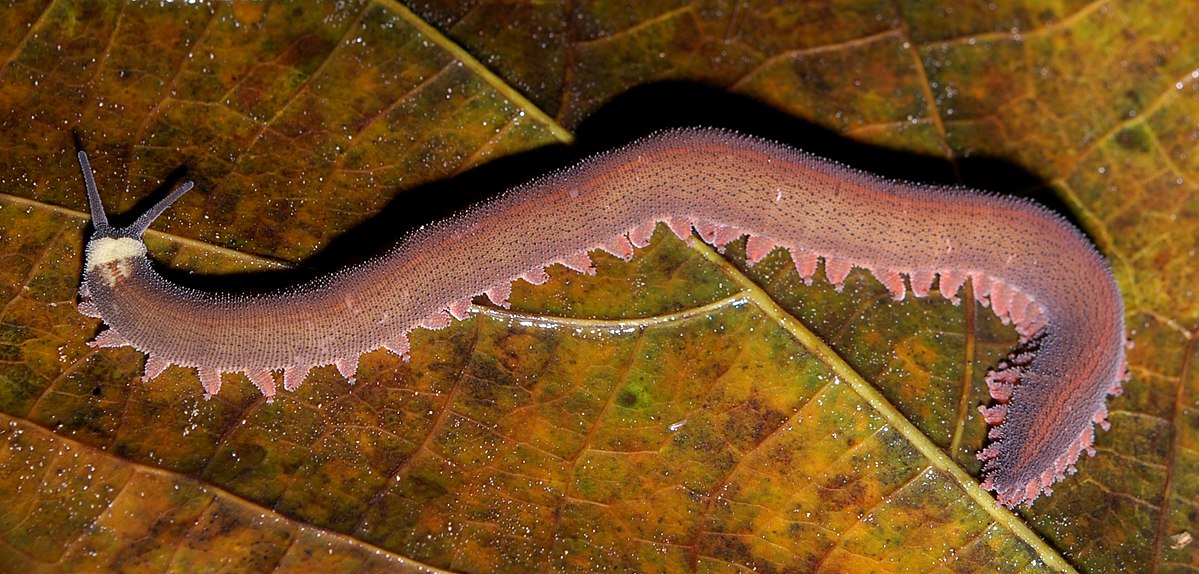
Thank you for this fascinating question. Let me first provide a little background for readers unaware of where this curious hypothesis came from. In 2009, a highly prestigious journal, the Proceedings of the National Academy of Sciences (PNAS), published a short communication written by Donald Williamson, a marine biologist at the University of Liverpool. Williamson proposed that a hybridization event between organisms very different in form—a velvet worm (see image below) and an unknown winged insect—gave rise to the Lepidoptera (butterflies and moths) and other insects that have caterpillar or grub-like larvae and a winged adult. Williamson did not provide any evidence that such an event might have happened, but he did propose that a look at the length of the lepidopteran genome might support his idea: the Lepidoptera would be expected to have an extra large genome, consisting of insect genes that determine adult form, as well as velvet worm genes that code for larval form. He also suggested that researchers with access to velvet worms try to inseminate a cockroach with velvet worm sperm.
As a “communication” in PNAS, Williamson’s paper did not have to go through the usual peer review process. Instead, it was accepted for publication by an editor, Lynn Margulis, who is renowned for her “endosymbiont theory”, in which early bacterial cells engulfing smaller cells gave rise to more complex organisms and ultimately led to the evolution of plants, fungi and animals. She endured years of criticism for her unorthodox idea before it was finally accepted by the scientific community, an experience that probably led her to be sympathetic to Williamson’s fringe idea. Nevertheless, peer review is an important part of weeding out ideas that can be easily debunked, as was the case for Williamson’s hypothesis. (PNAS has since eliminated the “communication” route to publication.)
At the time of publication, there were already enough studies on genome size in the literature to test Williamson’s hypothesis, as Michael Hart of Simon Fraser University and Richard Grosberg of U.C.Davis pointed out in a quick rebuttal. Insects with caterpillars or grubs do not have more genes than either insects without a larval stage or velvet worms. Moreover, butterflies do not have a set of genes that closely resemble those of velvet worms. In terms of genetic similarity, insects with larvae are most closely related to insects without larvae, and the insects as a whole are more closely related to the other arthropods (spiders, mites, crustaceans, etc.) than they are to velvet worms.
The difference between adult butterflies and their caterpillars is indeed astounding, as is the complete restructuring of the body plan during metamorphosis. However, the larval stage can be explained by natural selection acting upon the juveniles and shaping, through evolution, a form that best accomplishes quick growth and accumulation of the energy resources that the adult will need to disperse and reproduce. Soft bodies and cylindrical shape have been proposed as the best way to grow quickly when constrained by an external skeleton that needs to be periodically shed to allow growth. – Dr. Naomi Cappuccino
Sources:
Williamson, D. I. 2009. Williamson DI (2009) Caterpillars evolved from onychophorans by hybridogenesis. Proc Natl Acad Sci USA 106:15786–15790.
Hart, M. W. and Grosberg, R. K. 2009. Caterpillars did not evolve from onychophorans by hybridogenesis. PNAS 106: 19906–19909.
Maddrell, S. H. P. 2018. How the simple shape and soft body of the larvae might explain the success of endopterygote insects. J. Expt Biol 221
Velvet worm photo: Geoff Gallice on Wikimedia Commons
-
There are many career paths you can follow as a biologist, including these:
- Research: Research biologists study the natural world, using the latest scientific tools and techniques in both laboratory settings and the outdoors, to understand how living systems work. Many work in exotic locations around the world, and what they discover increases our understanding of biology and may be put to practical use to find solutions to specific problems.
- Health care: Biologists in health care may develop public health campaigns to defeat illnesses such as tuberculosis, AIDS, cancer, and heart disease. Others work to prevent the spread of rare, deadly diseases, such as the now infamous Ebola virus. Veterinarians tend to sick and injured animals, and doctors, dentists, nurses, and other health care professionals maintain the general health and well being of their patients.
- Environmental management and conservation: Biologists in management and conservation careers are interested in solving environmental problems and preserving the natural world for future generations. Park rangers protect state and national parks, help preserve their natural resources, and educate the general public. Zoo biologists carry out endangered species recovery programs. In addition, management and conservation biologists often work with members of a community such as landowners and special interest groups to develop and implement management plans.
- Education: Life science educators enjoy working with people and encouraging them to learn new things, whether in a classroom, a research lab, the field, or a museum.
- Colleges and universities: Professors and lecturers teach introductory and advanced biology courses. They may also mentor students with projects and direct research programs.
- Primary and secondary schools: Teaching younger students requires a general knowledge of science and skill at working with different kinds of learners. High school teachers often specialize in biology and teach other courses of personal interest.
- Science museums, zoos, aquariums, parks, and nature centers: Educators in these settings may design exhibits and educational programs, in addition to teaching special classes or leading tours and nature hikes.
- New directions in biological careers: There are many careers for biologists who want to combine their scientific training with interests in other fields. Here are some examples:
- Biotechnology: Biologists apply scientific principles to develop and enhance products, tools, and technological advances in fields such as agriculture, food science, and medicine.
- Forensic science: Forensic biologists work with police departments and other law enforcement agencies using scientific methods to discover and process evidence that can be used to solve crimes.
- Politics and policy: Science advisors work with lawmakers to create new legislation on topics such as biomedical research and environmental protection. Their input is essential, ensuring that decisions are based upon solid science.
- Business and industry: Biologists work with drug companies and providers of scientific products and services to research and test new products. They also work in sales, marketing, and public relations positions.
- Economics: Trained professionals work with the government and other organizations to study and address the economic impacts of biological issues, such as species extinctions, forest protection, and environmental pollution.
- Mathematics: Biologists in fields such as bioinformatics and computational biology apply mathematical techniques to solve biological problems, such as modeling ecosystem processes and gene sequencing.
- Science writing and communication: Journalists and writers with a science background inform the general public about relevant and emerging biological issues.
- Art: All the illustrations in your biology textbook, as well as in newspaper and magazine science articles, were created by talented artists with a thorough understanding of biology.
-
If you are interested in becoming a biologist, there are some things you can do along the way to prepare yourself.
In high school:
Take courses in math and science. Biologists need a solid understanding of math, chemistry, physics, and of course biology. Taking these courses in high school will provide you with an excellent background and allow you to explore what scientists do.Talk to biologists. If you are interested in a health care career, visit doctors or veterinarians and ask for a moment to talk about their careers. If you are interested in outdoor work, talk to park rangers, land managers, and other professionals in your area.
Explore your university options. Deciding where to go to university and what to study can be a daunting task. Research schools of interest. Talk to your guidance counselor, as well as to admissions counselors, faculty, and current students at these schools. There are excellent programs at a wide range of institutions, from large research universities to small liberal arts universities.
Have fun! While studies are important, remember to get out and enjoy yourself as well. Participate in any extracurricular activities of interest: a school club, a science fair, a sports team, or volunteer work. You’ll learn teamwork while developing leadership and social skills, making you stand out not only as a future biologist but also as an individual.
In university:
Talk to your advisor. Your faculty advisor or guidance counselor is a great source of information for advice on classes to take, career path options, and job opportunities.Consider how long you want to be in school. Most life science careers require at least a bachelor’s degree and often an advanced degree, such as a master’s degree. Research jobs typically require a doctorate, which may take five or six years of intense and demanding training.
Ask your professors about part-time jobs. Many professors hire student assistants to help with library, field, and laboratory research. Not only will you earn some money and experience, but you’ll also develop a professional relationship with someone who can give you career advice and write letters of recommendation.
Find summer internships. Internships are a good way to learn about a career, make contacts, and gain experience in biology. Some internships may provide opportunities to do an original research project—a very rewarding experience that will show you how science works and get you thinking about graduate school.
-
There are many universities with strong biology programs. There is no “best” university to study biology. If you are considering a biology degree, search for a school that fits your needs, budget, and lifestyle. Large research universities offer broad course work, a variety of specialized concentrations, and many opportunities for independent research. Smaller colleges allow for small class sizes, individualized instruction, and frequent interaction with professors. In general, there are several key elements that make up a solid biology program at a university:
- Faculty diversity and experience
Most faculty members hold PhD cu_people_degree and have active, productive research programs. The faculty is an accurate representation of the diversity of biological disciplines: botanists, evolutionary biologists, zoologists, biochemists, cell biologists, ecologists, physiologists, taxonomists, and so on. Either the biology program contains faculty members in diverse fields, or the university has several individual departments that complement each other. - Commitment to undergraduate education
Courses are taught by faculty members, not graduate students.
The institution has an active faculty advisor program and an active career advising/career development program.
The curriculum includes a variety of courses that provide a strong background in the natural and social sciences, humanities, and writing, while still allowing students to pursue their individual interests.
Well-equipped libraries with Internet access to biology journals, and easily accessible computer labs for student use. - Research opportunities for undergraduates
Faculty welcome students into their research groups as part-time workers, interns, and research assistants.
Opportunities are available for undergraduates to pursue independent research projects.
There are programs and centers that suit a student’s particular interest, for example, a field station to study ecology, proximity to the coast or a marine station to study marine biology.
Read about the Capital Advantage.
- Faculty diversity and experience
-
Job growth is expected in a number of areas, biotechnology and molecular biology in particular. In addition, the number of openings in federal government agencies charged with managing natural resources, such as Environment Canada and Agriculture Canada, is expected to grow. These openings will become available as many senior-level biologists and life scientists retire in the coming years.
-
A 2003 survey in conjunction with the Abbot and Langer Company found that biologists with less than one year experience have a starting salary of around $35,000 per year. Data from a 2003 US Bureau of Labor Statistics report show that the field of life sciences as a whole has a mean annual salary close to $55,000. As biologists gain more experience and education in their field, those in private industry may earn salaries of over $80,000, while those working in government, academia, and the nonprofit sector earn around $60,000 to $70,000. Those with over 30 years of experience have a median salary of around $103,000. Keep in mind that salaries may vary greatly depending on geographic location, job type, and experience and education.
As you can see, higher salaries are found in private research companies and government agencies, where you may have more job security, advancement opportunities, and independence in your work. While jobs in nonprofit groups or academic institutions may in general have lower salaries, many biologists find great personal reward in working for an organization that is affecting change and has an emphasis on teamwork and collaboration.
Page 3 of 3