Exploring Social Media and Philosophy with Instructor Phil Hoyeck
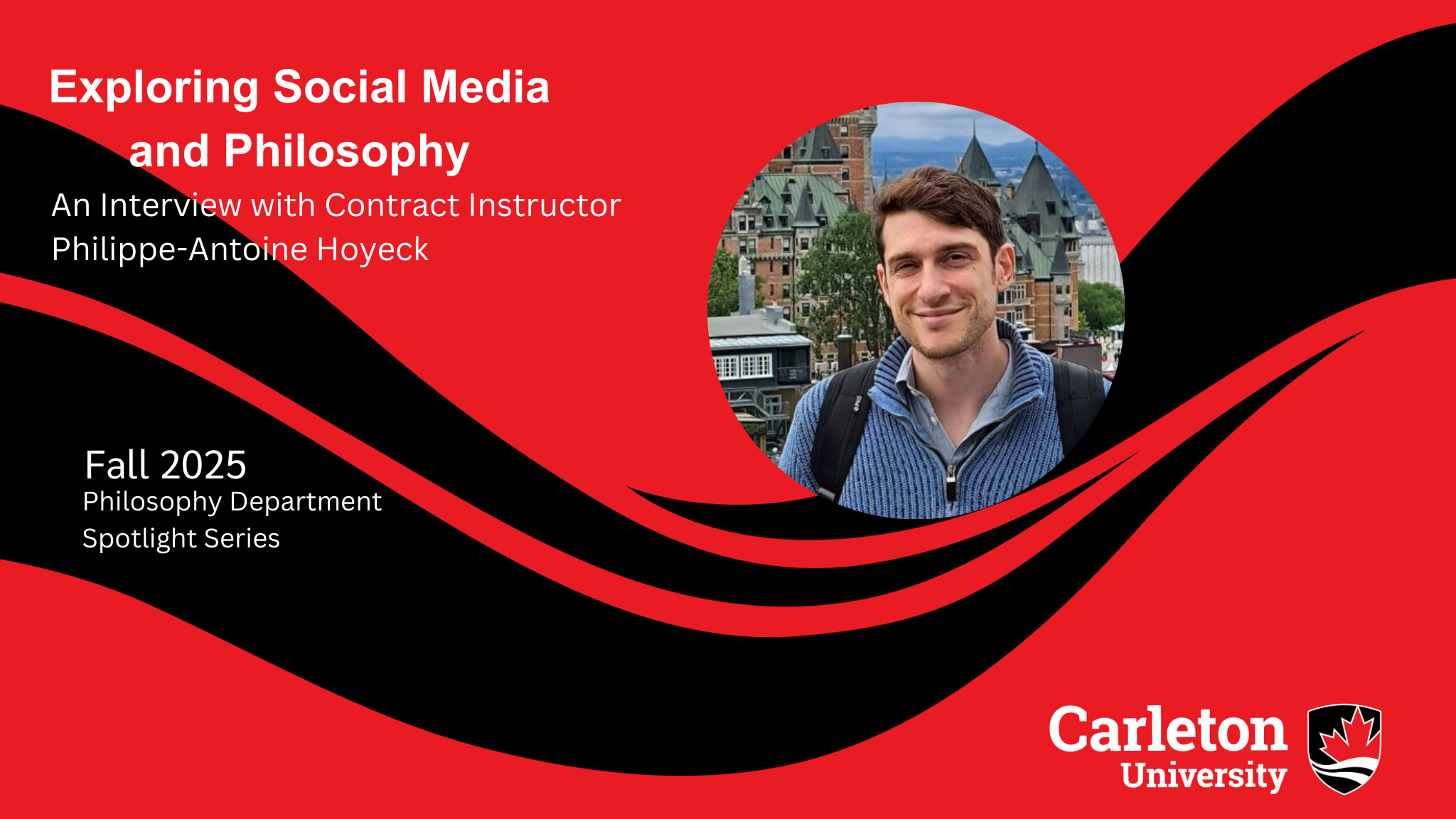
Philippe-Antoine Hoyeck has been a Contract Instructor at Carleton University since 2019. He teaches a variety of classes, including Philosophy and Popular Culture, Philosophy of Love and Sex, and Philosophy of Religion. Outside the classroom, he likes to bring philosophical discussions into the digital realm. On Substack and on X (formerly known as Twitter), he engages with an online community of philosophers, students, and curious thinkers.
We sat down with Phil to talk about social media as a space for public dialogue and his thoughts on the future of public philosophy through digital means.
What drew you to bringing philosophy discussion online? Was there a particular experience that made you realize social media could be a serious space for exchanging philosophical ideas?
Hoyeck: At first, the decision was completely pragmatic. I didn’t start using X with the intention of using it for public philosophy! To explain, here’s some background. My intellectual and academic journeys really haven’t been conventional; honestly, they’ve been a little bit all over the place. I’ve never felt that much at home in academia: the world of conferences, of peer-reviewed papers, of trying to get that extra line on your CV. I love reading, learning, and teaching, of course, but academia itself was never really for me. I’ve always been more interested in doing public philosophy and in teaching than in doing the whole academic thing.
I’d been meaning to write a public-facing book on science fiction and philosophy for a while and kept being told that you just can’t get published anymore unless you have an active social media presence. That’s why, around December of last year, I thought, “Okay, I need to start using X in earnest; otherwise, I’ll never get published.” But what I soon discovered is that X and other social media platforms like Substack are themselves pretty great for doing public philosophy! Soon, the whole thing started taking on a life of its own. I found that it was a good way to meet people in the discipline, to talk to them about things that interest me, and just in general to share my thoughts. I slowly started doing more on there; these days, I’m making memes, posting videos, sharing quotes from books I’m reading, writing Substack articles… and, of course, having a lot of philosophical discussions!
I would have never expected that a publisher would tell you that you must use social media so heavily!
Hoyeck: Yeah, multiple sources have told me that it’s very challenging to publish anything, especially more public-facing work, if you don’t have a strong presence on social media. Actually, at first, it was really discouraging. Around March or so, I saw a post from this author who’d said that she’d had a manuscript rejected by a publisher because she just didn’t have enough of a presence on social media—and she had over 10,000 followers! At this point, I only had 1,000 followers or so myself, so having the kind of presence required seemed impossible remote. I thought, “Oh, I can’t do this, I can’t publish.” It was a lot of pressure! But, since then, my account has grown way more than I’d thought possible at the time. And like I said, it’s really taken on a life of its own. At this point, what I’m doing on social media has basically become divorced from the goal of publishing anything. I’m still working on a couple of books, though!
You are teaching Philosophy of Religion this term, do your online discussions ever connect with what you teach in the classroom? Have your interactions on, for example, X, influenced your teaching or vice versa?
Hoyeck: Yeah, definitely. Actually, the genesis of the philosophy of religion course basically took place on X. I’ve made so many connections on X with people who work in philosophy of religion, who teach it, or are otherwise interested in it, so the first thing I did when I was offered the class was to post on X asking, “What would you want to include on a course outline?” The response was unbelievable. I had dozens of people help out, including some prominent philosophers of religion! Philip Goff weighed in, as did Dale Tuggy, Tyler McNabb, and Ben Watkins. These are all people who have published on religion or, in Ben’s case, who run a pretty prominent philosophy of religion podcast! Patrick Casey, who’s also a scholar of religion, even met with me on Zoom to talk about how to approach teaching the course, since he’s taught similar courses several times. So it’s not just that there’s a connection between what I’m doing on X and this class – it’s that what I’m doing on X is basically the reason the class came together the way it did!
What do you find the most rewarding and most challenging about engaging in philosophical debate on X?
Hoyeck: A lot of it is very rewarding, honestly. I’ve made connections with so many intelligent people: professional philosophers and philosophy students, of course, but also non-philosophers who are just interested in philosophical questions. It’s nice to be able to talk to experts who know more than I do about certain topics, and it’s also nice to be able to help non-experts grapple with ideas I know a lot about. Getting positive feedback on my Substack pieces is also very rewarding. Honestly, just the fact that people are bothering to read and discuss what I write is pretty great, whether their feedback is positive or negative! That’s a big difference between writing on Substack and publishing in academic journals. I think the statistic is that the average academic paper is read by a single person, whereas my Substack pieces are regularly read by upwards of 100 people. That’s amazing!
As for the challenges: if you’re active on social media, there’s always a vocal minority of people who are very angry at you! It’s just inevitable. Every couple weeks or so, a bunch of people will unexpectedly get very upset at me for something apparently innocuous I said. I post a lot of jokes and memes, and no matter how obvious it is I’m joking, at least a few people will take things way, way, too seriously! I also often post quotes from books or papers I’m reading for my class on philosophy of religion, and some people will just take that as me uncritically endorsing the position of the book or paper in question. I mean, sometimes I do endorse the position, sometimes I don’t; more often than not, I just think it’s interesting or worth considering. But if they disagree with the position they think I’m advocating, well, they can get pretty angry! That kind of stuff can be a challenge. Most of the time, I manage to take it in stride, but sometimes it really does get to me. I’ve definitely lost sleep over social media storms I’ve unintentionally set off!
Do you see social platforms as the future of sharing scholarly work and ideas? What advice would you give to students on intellectual and thoughtful use of social media?
Hoyeck: I guess it depends on what you’re looking to get out of it. I don’t really do anything on YouTube myself, but I’m very impressed by the role it’s playing in disseminating knowledge and facilitating academic and philosophical conversations. I listen to a lot of long-form philosophical, theological, and historical discussions and debates on there, and I’m constantly amazed by their quality. There are channels I follow that touch on philosophy of religion and history of religion that do absolutely excellent work: Majesty of Reason really sticks out here, as do Paulogia and Religion for Breakfast. They do a good job of making scholarly discussions accessible to the public, which is, of course, exactly what I kind of want to do with the public-facing books I’m writing! I think that social media can potentially bridge the gap between academia and the general public. YouTube is great for that, and I think Substack can be too. A lot of people use Substack for slightly more specialized work, but everything I do on there is public-facing.
As for advice: I really don’t have much! The only thing I guess I’ll say relates to the attitude you should have and the kind of behaviour you should engage in – or not engage in! – online. We all know there’s a lot of bad behaviour on the internet, but it’s always a bit of a shock when I see philosophy accounts – small, student-run ones, but sometimes also really big ones – behave badly: being petty, mean, uncharitable, and just not very open-minded. So I guess my only advice is to embody the moral and intellectual virtues even when you’re online! When doing philosophy, interpretive charity and intellectual modesty go a long way. You might not have all the answers, your favourite philosopher might be wrong, and somebody who disagrees with you might still have a point! After all, philosophy starts with the recognition that we don’t know!
Thank you, Phil, for answering our questions! You can find out more about Instructor Hoyeck and his research on his research page on our website, and you can find him on PhilPeople, Substack, and X.
Stay connected with the latest from Carleton’s Philosophy community by signing up for our newsletter. Look out for our next Spotlight in Winter 2026!