The Early History of the Department of Systems and Computer Engineering
by Murray Woodside, plus contributions from Spruce Riordon, Ray Buhr, and Samy Mahmoud
This memoir records my memories of the period from my arrival in 1970, until about 2000. Personal recollections and comments of three other early faculty are included at the end: from Spruce Riordon, Ray Buhr, and (a quite full account) Samy Mahmoud.
Systems Engineering (1970 -1975)
Here is how we first presented ourselves to graduate students:
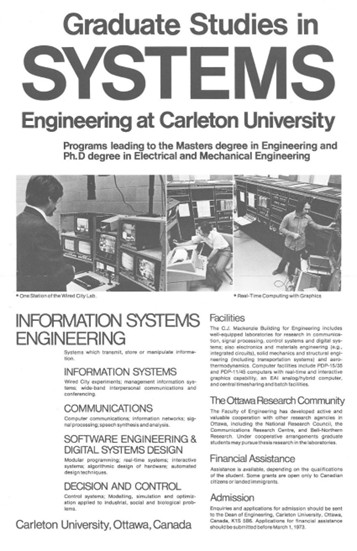
Systems Engineering was new in 1970, and it was just a Division of the Faculty of Engineering, as departments were first created only two years later. There were several ideas of “systems engineering” in the air at that time. One was centered on engineering based on linear dynamics and Laplace and Fourier transforms, for communications and control. A second idea considered complex information systems tied together by computers for both supervision and processing (exemplified by the NORAD SAGE system). A recent report by Philip Lapp sponsored by the profession had identified the future of all of Engineering as “Information Systems Engineering” and we took that as a springboard. We wanted tie Computing in with our existing strengths in Communications and Control. To begin with we had mature programs in communications and control, with a little computing. The undergraduate program had Fortran and assembler programming, real-time computing, hardware and logic, and numerical methods.
Initially the new directions mostly affected the graduate program. Undergraduate Electrical Engineering (shared with Electronics) started with a two and a half year common core across the Faculty (the longest core on the continent) and only three terms of specialization in Electrical Engineering, which limited our innovation in undergraduate courses.
The split between Electronics and Systems in 1970 was and remains unusual. I observed a marked personality difference in the people involved. Electronics adherents clung to reality, such as hardware- related subjects with a strong formal basis in physics, while Systems faculty included more “dreamers” who worked with mathematical models and software. Sometimes the gulf in ideas and priorities was surprisingly wide. The competition between departments was bracing.
These were nine members in 1970, four of them new:
- Don George, communications, also Dean. Don was a distinguished figure and a leader.
- Dave Coll, communications with an interest in computing. Dave bonded intensely to students and had a good research reputation, though he was restless and always in search of new topics.
- Spruce Riodon, control, also Chair. Spruce was looking for something new and found it in database systems; Samy Mahmoud was an early PhD student in that area.
- Bernie Pagurek, control. Bernie did fundamental work in optimal control, and was interested in bio-engineering.
- Malcolm Gullen, who had been with the faculty for a very long time. Malcolm had recently focussed on teaching programming and numerical methods.
- Murray Woodside, control (new). I worked on optimization and on control system identification.
- Bob Morris, communications (new, and a fresh PhD), interested in signal processing.
- Archie Bowen, hardware and logic (new). Archie had worked and taught in microwaves and logic, and had run a computer services company.
- Jim Cavers (new, and a fresh PhD in wireless communications).
Ray Buhr joined the next year, bringing solid industrial background in real-time computing, and a determination to develop a concept of engineered software, based on his experience in nuclear reactor control software (see his note). A nearly complete list of members is included at the end.
From the start we knew we had to define our concept of Systems and establish some new areas of teaching and research. We met intensively over the first couple of years and I remember Riordon made a chart of the research areas to shape the discussion. He felt that database systems were the most central, and he and Pagurek took this up. George and Coll began a pioneering project in video conferencing, later veering into educational uses. I initiated a course in simulation and one in Socio-Economic Modeling, applying control systems models to social systems (e.g. econometric models) from 1971 to 1975. Ray Buhr took responsibility for developing a real computer science program, with courses such as data structures and advanced programming concepts. In 1972 he also introduced a graduate course in Software Engineering, almost certainly the first in this country. The textbook was a not-yet-published manuscript.
When the Division became a Department in 1973 it was called Systems Engineering and Computer Science and it took responsibility for teaching Computer Science to the whole university. This led to a lot of service courses, and developed into the School of Computer Science in 1981.
The biggest departmental research project of the early period was the “Wired Scientific City”, led by Don George and Dave Coll. This was a very early telepresence project, using video technology. Video conference rooms were set up and experiments performed on communications effectiveness… the main stumbling blocks were storage of documents and the low resolution of video, which inhibited sharing text and diagrams. A later incarnation on educational applications included a year-long course-sharing experiment with Stanford University, via a satellite link. Bob Morris developed speech synthesis and talking machines to read to the blind, leading to later work on cochlear implants. Bob also invented a concept of generating very efficient signal processing code tailored for a given application.
A fair summary is that we considered everything to be a system, and were ready to take on just about anything that wasn’t nailed down by someone else. A strong collegial ethic took hold. It was exciting, and with Don George as Dean we had faculty backing.
In 1972 Archie Bowen introduced John DeMercado, from a federal department, who was getting into computer networking and was studying the beginnings of the internet (Arpanet had started up in 1969). John taught a course on Computer Networks for several years, which generated immense interest, and the topic developed rapidly. Esin Ulug came to us from Bell Canada and developed an early layered protocol suite, for example, before leaving for Texas Instruments. As a side project DeMercado sponsored a course on queueing taught by Leonard Kleinrock to Federal civil servants (it was oriented to Arpanet, in which Leonard was a founding researcher). This course was my personal introduction to applied queueing and redirected my research and teaching into performance.
In 1972 we also initiated a joint MSc program with Mathematics on “Information and Systems Science” which admitted students with good computing background but no Engineering first degree (a work- around for us in the computing field). I supervised our first graduate, Rick Moll, who had a first degree in Psychology (where he had applied control-systems models). Rick later did a PhD under John Chinneck, on forest management optimization. This program was very successful, and expanded to include the Business School. The gap it filled became less important and it was closed down around 2000.
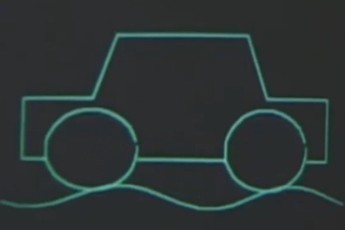
For fun I will mention a program I wrote in 1972 for animating simulations, called ANIM8. ANIM8 was partly stimulated by teaching simulation, and partly driven by my own interest in communicating about dynamics. It used an object-oriented language to declare both simulation objects and visual objects, and made the simulation part drive the visual part. Jim Cavers and Bob Morris used it and improved it, and in 1975 Digital Equipment Corp. gave us a computer in a swap for the rights to ANIM8. Which they never used. The output was drawn frame by frame on a cathode-ray tube and photographed by an animation camera, and you can see the first film I made, here.
A feature of the 1970s was the Engineering Open House. Every second year, the faculty invited the public for a whole weekend and put the labs, and particularly the senior projects, on display. Primitive computer games were played on text terminals. This was a huge event. My best memory is my children and their friends (all quite young) singing Christmas carols together over a video link using the three Wired City test rooms… showing how the young are early adopters.
Systems Engineering and Computer Science (1975-1981)
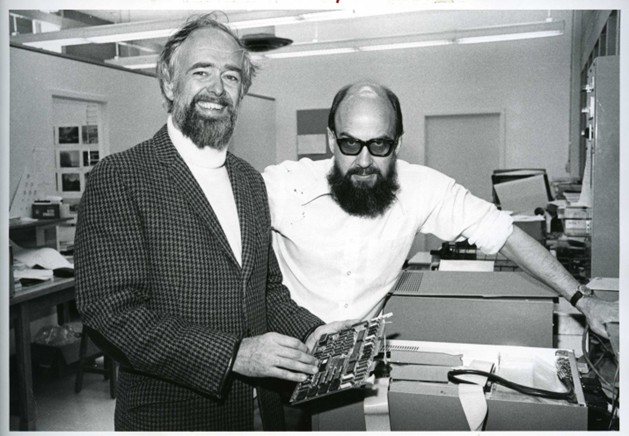
The computing activity boomed. Dave Coll was the second Chair, then Riordon served a second term. Archie Bowen delved into early microprocessors starting about 1975, and with John Knight from Electronics he taught the rest of us about them. He and Ray Buhr did a pioneering project called COSTPRO which developed a multi-processor terminal for a trade document system, which intended to replace paper waybills by network messages. They built their own microprocessors for this (shown in the photo below), and had an elegant terminal envelope made by the School of Industrial Design.
Communications research developed rapidly too although I remember it less clearly; one focus was wireless digital communications with projects by Samy Mahmoud and others. Dave Falconer came from Bell Labs in 1979, with interests in network transmission issues. Dave immediately bought a few miles of twisted pair telephone wire and began experimenting on data transmission over them.
Several people joined to teach Computer Science in the late 70s, and planning began for what became the School of Computer Science. The then Dean of Engineering would not have it in Engineering (after many battles fought by Riordon, in his second term as chair), so it ended up in the Science Faculty. There was a close relationship in the beginning: four of the founding faculty of the School came from Systems and some remaining Systems faculty were also supervisors for CS grad students (I remember this was a significant factor in getting approval for the CS graduate programs). This closeness gradually declined.
To redirect the computing program in Systems, Buhr and Bowen led the planning of a new program focussed on engineering issues and embedded systems, which we called Computer Systems Engineering (CSE). It was established in 1981 and had its first graduates in 1984. (It was not called Computer Engineering because it was not about designing computers, but rather about designing systems that use computers. By the early 90s most schools had realized that was their real concern, too, and the meaning of the term Computer Engineering shifted to match our initial concept.)
Systems and Computer Engineering in the 80s and 90s
With the founding of the School of Computer Science we needed a new name; keeping “Systems” in it was a pledge to maintain a broad outlook. The new CSE program was oriented to embedded software, but was still heavily Electrical Engineering. Bernie Pagurek was Chair from 1981 and had the task of making it all work. We obtained a VAX computer and a cutting-edge SUN workstation network (and Naren Mehta as the first computing support person), and also our first email system.
Mitel funded a Chair in Office Automation, held from 1982 by Roger Kaye. An anecdote from the time held that Electronics had invested a lot of planning in a Chair, with Mitel founder Mike Copland who did his PhD there. Suddenly as they were close to finalizing, Copland said something like “The future of Mitel is in Office Automation, the Chair has to be in Systems”. Ironic.
In software engineering research, Buhr led a Strategic Grant to design a CAD tool for software, called CAEDE (Computer Aided Engineering and Design Environment… these are now called CASE tools). I was co-lead in this and it led me to discover layered queueing, which remained my central interest through the rest of my career.
The joint Institute with University of Ottawa (Ottawa-Carleton Institute of Electrical and Computer Engineering) was founded in 1983 and as the first Director, I strove to persuade people in all three departments to mount a big joint project to celebrate and exploit the connection. In the end I had to lead it myself (with 9 other faculty), in the ARTT project (Advanced Real-Time Toolset). ARTT took some ideas from CAEDE and developed implementation tools and performance tools for embedded systems.
ARTT morphed into the RADS lab, which was the site of a sequence of major projects funded by industry and by centers of excellence, and hosted my Industrial Research Chair in Software Performance Engineering (from 1992). Jerry Rolia (who gave layered queueing its name) was a RADS participant in this period who built up a strong relationship with HP Labs in Palo Alto, and then joined them.
There was a wide range of research in this period. A few examples: AI-based research in network management was carried on by Pagurek. John Chinneck developed his work on feasibility of optimization problems. Control systems, which we had drifted away from, had a rebirth with the arrival of Howard Schwartz. Communications research flourished, notably in digital communications (Samy Mahmoud’s note at the end has more detail on this field).
Computer Systems Engineering in the new Millennium
Around 1998 ideas for new programs began to crystallize. There was a push across the continent to develop undergraduate programs in Software Engineering, which we joined. We could not agree with the School of Computer Science on a joint degree, so we each did it separately. Meeting accreditation requirements was an interesting exercise, made possible by flexibility in the Engineering establishment. (Contrary to the philosophy of the profession, I do not agree that software engineering is based on application of natural sciences!) Don Bailey and I pieced the program proposal together and shepherded it. The new Communications Engineering undergraduate program was brought into existence by Dave Coll at much the same time. The Electrical Engineering undergraduate program became the sole responsibility of the Electronics Department. Tony Bailetti of the School of Business joined us to create the Technology Innovation Master’s program.
Thus at a moment around 2000, when the university became open to substantial hiring, we had three new programs to hire for, and we saw a rapid expansion with about ten new faculty in two or three years. The tech crash of 2001 flooded us with graduate students, and today’s much larger and more diverse department was launched. The striking features of the period since 2000 are the solid establishment of Software Engineering research, the flourishing of the group doing communications research (and the Broadband Networking Research Group), and the development of Biomedical Engineering.
Looking back, I can see that the initial vision we had of Systems Engineering has really borne fruit, in the spread of topics we now cover. What has worked well has been the initiation of new things at the boundaries of established areas. What has been harder is to develop projects that take advantage of synergies between areas. I retired in 2003 and while I remained active in research for a while I am not as conversant with all the recent developments, so someone else should tell the story for this period and onwards.