The Early History of the Department of Systems and Computer Engineering
Appendix A: Three Other Personal Memoirs
1. Systems Engineering at Carleton University: Early Days
Spruce Riordon, March 2016
In 1967 I had just returned from completing my Ph.D. at Imperial College, and had resumed my work in the Radio and Electrical Engineering Division of the National Research Council. Since the focus of my research had changed from electronic circuit design to automatic control, I felt that it was time to find a new work venue. One possibility was to stay at NRC in the Mechanical Engineering Division. In the summer of 1967, I arranged to visit their automatic control group. There I encountered Bernie Pagurek and Murray Woodside. Bernie, whom I had previously met when he visited Imperial College, had joined the Faculty of Engineering at Carleton University, and was spending the summer at NRC. Conversely, Murray was a sessional lecturer at Carleton. As it turned out, Murray planned to spend time in Russia during the following winter, and was unavailable as a lecturer. Berne asked me if I would fill in, and I agreed.
I gave two graduate courses in automatic control in the 1967/68 term. In the spring Don George asked me if I was interested in a faculty position at Carleton. After an informal interview with Dean John Ruptash, I was offered a position in the Division of Systems Engineering, effective July 1, 1968. At the time there were only 25 faculty in Engineering, and Systems Engineering consisted of Don George (Chairman), Dave Coll, Malcolm Gullen, Bernie Pagurek, and myself. The principal fields we covered were communications and control systems, with some activity in electronics, power, and computing. Don George commented facetiously that we had we had the acronym then associated with the Soviet Union C(ontrol), C(ommunications), C(omputing) and P(ower).
In those early days the Faculty was fairly tight knit, in part because of small size, but also because of the program structure. The four-year undergraduate program required that students follow three years of common study, followed by a final year of specialization. The advantage of this scheme was that students graduated with a broad knowledge of the field; at the same time, the structure would allow only a limited range of specialization, in this case, Civil, Electrical, and Mechanical Engineering. Another informal factor in keeping the Faculty cohesive was John Ruptash’s daily ‘briefing’ in the faculty lounge for anyone who dropped in. John was very frank and forthcoming about what was happening in the Faculty the University and in the profession on any given day. As the Faculty became larger and more specialized, these sessions gradually disappeared, and I missed them.
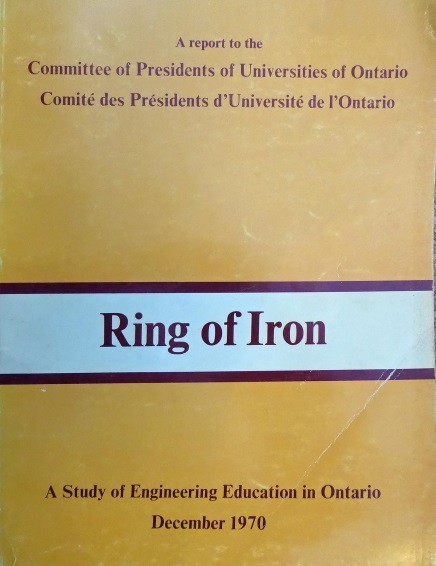
In the summer of 1970 Dr. Philip Lapp paid a visit to the Faculty as part of his survey of engineering education in Ontario. He issued his report “Ring of Iron” in December of that year. In it he commented that “the field of information systems engineering will be of paramount importance in the future, and that such a role be assigned jointly to Carleton and Ottawa universities.” I had become Chairman of the Division that year, and this report resulted in a good deal of discussion. What was ‘information systems engineering’? What were its components? Obviously it would centre on computing, including the storage, transmission, and processing of information in digital form.
At the time our Divisional strength lay primarily in communications (Don and Dave) and automatic control (Bernie, Murray, and me). We were all computer users, but not specialists. While communications made a good fit, control systems were peripheral. This did not mean that we should de-emphasize control simply on the basis of the report. However, as control systems in those days applied in large measure to major industrial processes such as chemical plants, we perceived that we were at a disadvantage in not having plants of this nature in the Ottawa region. Accordingly we decided to move the direction of our teaching and research more towards computing. Murray had joined us by then, and soon after that Ray Buhr and Archie Bowen came on board.
2. Systems and Computer Engineering Notes
Ray Buhr, February 2016
I joined the department at an exciting time when new programs were in the process of being created by a small group of motivated individuals. I had become immersed in computing in a number of ways before arriving. My Phd work at Cambridge required using a room-sized computer with punched paper tape input (!) to solve partial differential equations. On returning to Canada, I worked for several years for a Toronto consulting company in the area of computer control, including using minicomputers of various stripes. I say all this to emphasize that I not only had no academic background in “computer science” but was skeptical of things that were beginning to emerge under that name. Math and science departments were trying to hijack an emerging field that I saw as essentially engineering.
Computer hardware was clearly science-based engineering but what was computer software? Emerging programming languages were a mess. Go-to instructions were a problem. The ability to make programs self modifying by treating instructions as data was a problem. The monolithic sequential nature of programs was a problem in areas such as computer control and communications that required management of concurrent activities in “real time.” Programs were inherently fragile and easily “broken” in unpredictable ways. There was no theory of program “strength” or “robustness” that could used to predict failures (there still isn’t). Not only was there little science but even less of what would normally be understood as engineering. “Software engineering” seemed a contradiction in terms. Programming was actually in the hands of “wizards” who were more like creative writers or musicians than scientists or engineers. That said, I saw “software engineering” as something to aspire to, based on concepts of logical “black boxes” analogous to the physical black boxes of which computer systems were formed.
The logical black boxes would operate concurrently and communicate with each other in a manner analogous to physical hardware, which might include not only elements of physical systems being controlled by computers but also other computers. Engineers are used to thinking of such things in terms of schematic diagrams, so schematic diagrams became a fundamental part of the logical picture. Externally funded projects involving multiple microprocessors that were just starting to come on the scene (for example, COSTPRO) provided practical experience of using these ideas, which ended up being described in a book titled Logical Design of Mulitple Microprocessor Systems coauthored by myself and Archie Bowen. Programming languages that supported concurrent processes (for example, Ada and Modula 2) were appearing on the scene that offered the possibility of designing software in terms of communicating black boxes that were actually directly supported by software. I ended up writing a book about this called System Design with Ada that had considerable influence at the time. Communicating black boxes are all well and good but give no direct idea of the coordinated, purpose-driven, end-to-end activity that emerges. I came up with a concept for this I originally called “timethreads” but eventually renamed “use-case maps” which was described in Use-Case Maps as Architectural Entities for Complex Systems (IEEE Transactions on Software Engineering Dec 1998) and a related book on the application of these ideas to object-oriented programmong. The idea of the various graphical techniques was to provide “lightweight” descriptions of complex systems that engineers would find useful for design and maintenance. These are themes in what was an exciting time at Carleton for all us who were involved. The themes found expression in many new courses and programs in the SCE department. When a decision was made to form a Computer Science department at Carleton, I decided to stay with SCE because I still remained skeptical of computing of the kind I had been involved with as a branch of math or science (I still am).
In all of this, what I remember most is the excitement of developing and discussing new concepts with colleagues and students. It was an exciting time. As I look back on this from half a lifetime away, I find it ironic that programming at the level of creating new applications for new businesses is still in the hands of wizards. The software problems we saw then keep reappearing, except now multiplied exponentially by interconnection of diverse computers and applications. Is “software engineering” still a contradiction in terms?
3. Systems and Computer Engineering
“A Department Constantly Driven by Pioneering Spirit”
Samy A. Mahmoud March 2016
Introduction
I completed my doctoral program in Electrical Engineering at Carleton University in early 1975 and was contemplating a career in industry. While considering a number of employment offers from industry, I received a call from Don George, then the Dean of the Faculty of Engineering at Carleton offering me a faculty position with the Department of Systems and Computer Engineering for a limited term of two years. After some thought, I decided to accept the offer in order to gain some teaching experience with a view to join industry after the two-year term. Well, and as it turned out the two-year limited term was extended to further 35 years of continuous service at Carleton University during which I had the privilege to contribute to the Department of Systems and Computer Engineering as a faculty member and as Department Chair (1986-1998) before I moved on to the position of Dean of the Faculty of engineering and Design (1998- 2006) and eventually to President (Pro Tempore) of Carleton University (2006-2008).
Working in academic administration over a long stretch of time presents a constant stream of challenges and opportunities, foremost of which accommodating the diverse opinions and views of faculty members and other stakeholders and transforming such diversity into strength and a unified force moving forward. Over the years, I found it to be a source of joy and pride to be a member of an academic department, such as SCE, that is endowed by a pioneering spirit to take measured risks and move with the times, anticipating future changes and driving innovations, all within a traditional collegial culture and respectful civility, and constantly thriving to maintain a vibrant and dynamic environment. As I recall my years serving in the department or observing its progress from another post within the University, I consider myself to be fortunate to work closely with the colleagues I had and to be part of pioneering initiatives such as the ones that fill the history book of the SCE Department. SCE will always be my home department and the place of my fondest memories and fulfilled aspirations.
The Years 1975-1985
I started my first year at SCE as faculty member and at the time the focus of the Department was on expanding graduate enrollment, maintaining accreditation of its master’s and doctoral program and seeking more research funding to support new research initiatives and provide financial assistance to graduate students. Essentially we wanted to put the Department on the map of more international recognition and attract outstanding graduate students and recruit new energetic faculty members. We were active on two promising fronts: the dawn of the era of large distributed databases, and the emergence of applications requiring transmission of data over wireless radio channels.
Back in the nineteen seventies, the world of computing and centralized processing was dominated by IBM, with blue machines extended wall-to-wall in every data center. Large databases were centralized and accessible only through a star network of terminals connected to the computer at the center. At the same time, packet switched networks were emerging, leading eventually to the world-wide internet of today. CANARIE is one example of the early Canadian efforts to build such networks. I presented a paper “Optimal Allocation of Resources in Distributed Information Network”, coauthored with Spruce Riordon, the former Chair of the Department and also my doctoral program supervisor, at the first international conference on very large data bases held in Boston in the fall of 1975. The paper essentially challenged the centralized views of databases at the time, with a compelling new architecture which demonstrated that large databases can be distributed and allocated to the computing nodes of a data communications network, and proving that the integrity, concurrent updates and consistency of the large database can be maintained, while gaining the advantages of reliability and fast access times through the distributed configuration. The response to our novel presentation was overwhelming; the paper was published in the inaugural issue of a new transaction on “Very Large Databases”, winning first conference prize and the international recognition that goes with it, and enabling us to recruit excellent international students for the doctoral program and to secure research funding from multiple new sources.
In the late seventies, the Spectrum Management Division of the then Canadian Federal Department of Communications, now part of Industry Canada, called for research and studies on the transmission of digital data streams over wireless channels and awarded our department several research contracts to develop new concepts and examine the feasibility and limits of the emerging data transmission technology. In fact we were granted research licenses to experiment with data transmission over existing licensed frequency bands.
One of the interesting results of the directed research was the development of the first generation version of a mobile data transmission terminal in one of the SCE labs, a very novel one at the time, able to use the gaps in speech communications over wireless channels to transmit data packets in two directions at the rate of 4 kilo bits per second, without requiring a new allocation of spectrum. It is amusing now to recall the configuration of the wireless data terminal which fitted with its keyboard, fluorescent display and processor into small suit case and weighed about 4 kilograms. A prelude for today’s smart phone, one might consider! However, the technology was exploited in the late seventies by Gandalf, an Ottawa company that developed mobile data terminals for various applications. Gandalf was able to integrate the technique into a practical implementation that was deployed in police patrol cars.
Expanding into the digital wireless communications field was a major move for the Department. It accompanied the recruitment of new faculty members with international experience, including David Falconer (AT&T and MIT), Asrar Sheikh (Manchester University), Cyril Leung (Stanford) and Roshdy Hafez (DOC, Department of Electronics). In turn, a large number of outstanding graduate students were recruited, and they fueled the growth of this industry in Ottawa and beyond. Many of our graduates led companies such as Northern Telecom, Blackberry and Erickson who were dominant in the wireless industry at the time. By far we had assembled together a formidable group of faculty members in this field and became in the process leaders in wireless and digital communications. Several international awards followed, and a large number of patents filed by members of the research group.
The Years 1986-1998: My years as Department Chair……
I was appointed as Department Chair during the summer of 1986 with a mandate to expand enrollment at the graduate and undergraduate levels, to develop new academic programs and to provide support to faculty members to enhance their research programs. It was generally felt that our best approach will be to work as groups and teams to the extent possible in order to pool together the available resources and to take advantage of the complementary talents and skills of faculty members.
We convened a series of departmental meetings during the fall of 1986 dedicated to developing a new strategic plan for the department, and engaging in the process nearly all faculty members. The experience was extremely beneficial and productive. It was also essential for us to recognize our unique strengths and capabilities and to match those to future technological trends.
We decided it was time to establish new undergraduate programs dedicated to the fields of communications and software engineering, as opposed to those programs being streams or options within electrical and computer systems engineering programs. Indeed this was a pioneering move that was subsequently adopted by other engineering departments across Canada. It allowed us to sidestep and avoid the controversy that erupted later across the country with respect to the destiny of the field of software and whether it belonged to engineering or computer science. We simply moved on in a pragmatic way. We competed and collaborated as the circumstances required, but consistently acted for the common good.
Research groups were formed in subsequent years and led energetically by senior faculty members, including Real-Time Design and Performance (Woodside), Software Design and Validation Methodologies (Ray Buhr), Digital Communications (Falconer),Wireless and Satellite Communications (Mahmoud), Signal Processing and Sensors (Goubran), Computer Architecture and Microprocessors (Bowen). Still, sufficient room was also provided to other faculty members to pursue individual research directions and topics. The formation of these research groups and their subsequent flourishing were instrumental in securing research funding and winning major strategic NSERC and CFI grants, in fostering links with industry and in positioning the department to lead a number of provincial and federal networks of research excellence in subsequent years. Just for the record, these networks included: TRIO, CITO, NCIT, CANARIE, CPFC, among others. External funding had considerable impact on building new, well equipped research labs in the Department, on the expansion of the building space available to the Department, and in funding hundreds of graduate students over the years.
Technology Innovation Management
In early 1993 I received a call from Denis Forcese, then the Vice President Academic and Provost, recommending that we meet and hold discussions with three professors from the School of Business: Tony Bailetti, John Callahan and Don Gerwin on the feasibility of establishing a new graduate stream or a new graduate degree on the management of technology organizations. The program is to be a joint venture between Systems and Computer Engineering and Business faculty. The idea was appealing given the rise of many technological innovations in Ottawa at the time and the need to inform young entrepreneurs about the vagaries of the business world and how to translate a novel idea or invention into a successful business enterprise. We held several brainstorming sessions with the three business faculty members and the result was the development of a new master’s degree program called Telecommunications Technology Management (TTM) in recognition of the prominence of the telecom industry in Ottawa. The program was launched successfully in 1995 for the benefit of founders of new technology entrepreneurs, people who seek to move to more senior leadership positions and talented professionals who are engaged in launching new business technology ventures. Adopting and promoting this novel program, which has evolved since then and renamed “Technology Innovation Management (TIM)”, represents another example of the timely pioneering initiatives launched by the SCE Department over the years.
Transformation and Diversification of the Ottawa Economy and OCRI
The economy of the Ottawa-Carleton Region was undergoing massive transformation beginning in the late seventies. Traditionally Ottawa has been a Federal Government town, with the Government being by far the major employer and main source of revenue for the local economy. The remaining employers were mainly service sector organizations, including those in education and healthcare. However, with the emergence of new technologies and knowledge based economy, led by companied like Northern Telecom, new fast moving companies like Mitel and an assortment of other smaller start-ups in the IT and semiconductors fields, the economy of the Capital Region was experiencing major transformation.
Gradually, the high tech industry formed a major cluster in the suburbs of Ottawa and started to grow and employ a signficant number of engineers, IT specialist and technologists. Ottawa was informally called “Silicon Valley North”.
The SCE department has always been a very active contributor to the high tech theme of the Ottawa Carleton Region. We forged collaborative research programs with many high-tech companies, our graduates staffed their R&D benches and many of their employees enrolled on a part-time basis in our graduate programs. Some of our faculty members spent part of their sabbatical leaves working on technology transfer initiatives that proved to be effective and profitable.
It is well known fact that among the essential drivers for attracting high tech companies to set up shop in any region is the presence of strong academic institutions that engage in R&D activities relevant to the interests of the industrial cluster. SCE covered this front through its active participation in OCRI (The Ottawa Center for Research and Innovations, and later the Ottawa Center for Regional Innovations) which was established in the Capital Region in 1983 with membership that in included 14 organizations and led by the Ottawa-Carleton Regional Municipality. OCRI actively supported the Ottawa Technology Cluster, attracted new technology enterprises to the Region and encouraged collaborations among its stakeholders. Our Department takes full credit for leading many of such initiatives successfully.
Innovations with Impact: the Carleton Speech Coder
One example of our effective cooperation and contributions to the high-tech industry that stands out is the development of a novel speech coding technique in 1993. The coder was developed as part of doctoral thesis of one of our graduate students (Wilf Leblanc). The algorithm transforms speech from the natural analog format into a digital format suitable for transmission over data networks. The main challenge was to produce high quality coder at the low bit rate of 8 kilobits per second without losing speech quality or recognition of the speaker. The performance of the coder developed in our signal processing laboratory was much more superior by comparison to any coder developed elsewhere at the time. At that time, a new fast expanding Ottawa company, Newbridge Corp., founded by a well know entrepreneur, Terry Matthews was developing frame relay networks and needed efficient speech coders at low bit rates to incorporate into its product line. Terry Matthews knew how to spot the best technology available among many that he would come across, and he opted to select the Carleton Speech Coder and acquired the rights to use it after negotiating a deal with the University. The coder gave Newbridge a competitive edge and a decided advantage, and within a short period of time the company became a world leader in the provision of frame relay networks. The company has since merged with Alcatel and it is one of the legendary success stories of the Ottawa high tech cluster.
Expansion of Enrollment of IT Programs
Rather fortuitously, but also in recognition of the needs of the evolving knowledge economy, the Government of Ontario encouraged universities and community colleges in 1997 to double the enrollment in IT programs offered by engineering and computer science departments, both at the graduate and undergraduate levels over a period of 5 years. The Government provided suitable financial incentives in the form of capital (infrastructure) funding as well as operational funding. Our Department was at the front-center-stage in meeting the needs of this initiative and well positioned to take full advantage of it.
All our undergraduate and graduate programs were eligible for inclusion and we were ready to move forward. Capital funding provided allowed us to expand our work space and furnish new labs. Operational funding enabled us to recruit new faculty members and partially fund the expansion in graduate enrollment.
Collegial Culture
The one aspect that stands above all, and for which I have the fondest memory of my career, is the remarkable collegial culture that prevailed in the Department throughout my years of work. We debated and we had our heated exchanges of views which I consider to be healthy signs of a thriving academic department full of strong personalities and smart people. But it was never personal and never selfish. Each one of us wanted to express her or his views and see those views realized. But outside the meeting room and once we agreed on a common approach we moved forward with good will and cooperative spirit.
These was never a sliver or residue of anger or resentment. We knew and realized that our diversity is also our strength. I can only hope that this collegial culture remain as a lasting heritage of the Department.
Another remarkable practice of the Department has been its ability to integrate new appointees, both junior and senior, and to include them with trust and equality in the decision making process and in the allocation of administrative roles and responsibility within the Department. Having recruited able and talented young faculty it was logical to trust them to supervise graduate students at all levels and to participate in the running of the Department. Young faculty were having their own fun. I recall them forming a special club: “The Under 30 Faculty Club” with colleagues from other faculties, which is the flip coin of the slogan of the sixties “never trust anyone over 30”. The Club soon changed to: “The Under 35 Faculty Club”, then for obvious reasons it vanished as the years went by!
I left the Department in 1998 to commence my first term as Dean of FED. I was comfortable in the knowledge that I am leaving the Department in good and steady hands under the competent leadership of my successor, Rafik Goubran, and the wise support of seasoned senior faculty members who have always been fully committed to teaching and research.
The Early History of the Department of Systems and Computer Engineering