Vacation in Canada, eh? 9: Barkerville, British Columbia
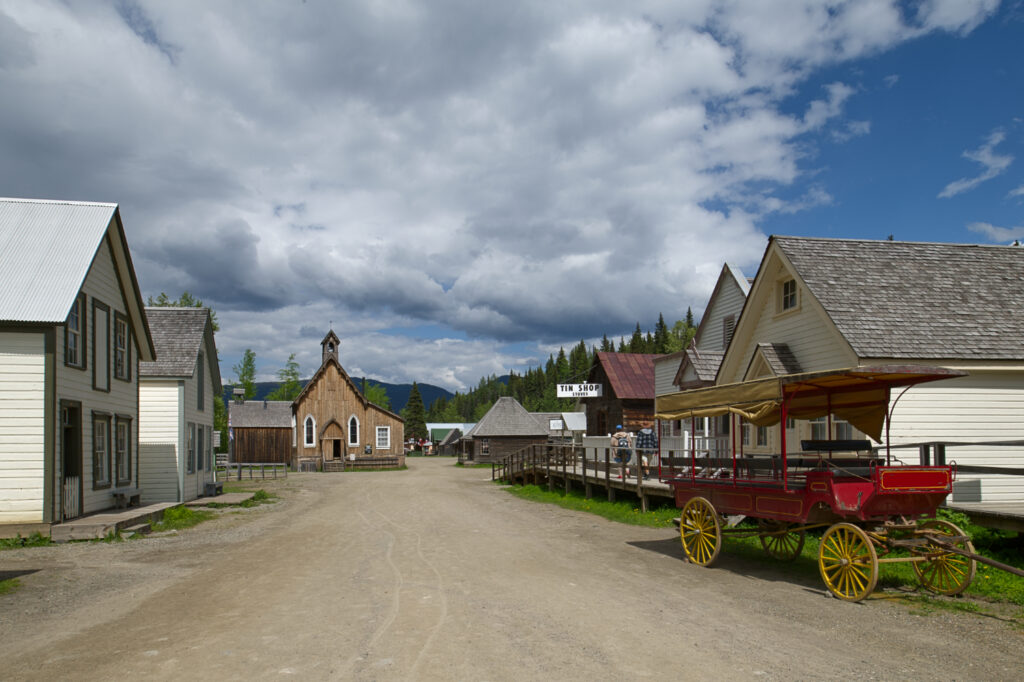
The Gold Rush came to the BC interior in the 1860s, and a whole menagerie of humanity came with it. The buildings of Barkerville bear witness to them all.
We have good reasons to choose Canadian vacation destinations these days. And we have great destinations to visit – especially if you’re interested in architecture. This is one of a series of blogs meant to shine a light on some of our built treasures.
By Peter Coffman
When you visit Barkerville, you should stay overnight in Barkerville itself, rather than in one of the nearby towns. The day-trippers don’t arrive until well after breakfast, and they’re gone by late afternoon. The rest of the time you and the ghosts have the place to yourselves.
I don’t mean that literally – I didn’t see any apparitions while I was there. But in the quiet, empty streets of after-hours Barkerville, stories rush in to fill the void. Here are just a few of them.
The Great Fire
You may be surprised by your first impression of Barkerville. The main street seems luxuriously wide. Cross-streets punctuate it at regular intervals. Buildings are reasonably well spaced and organized. But it was not always thus.
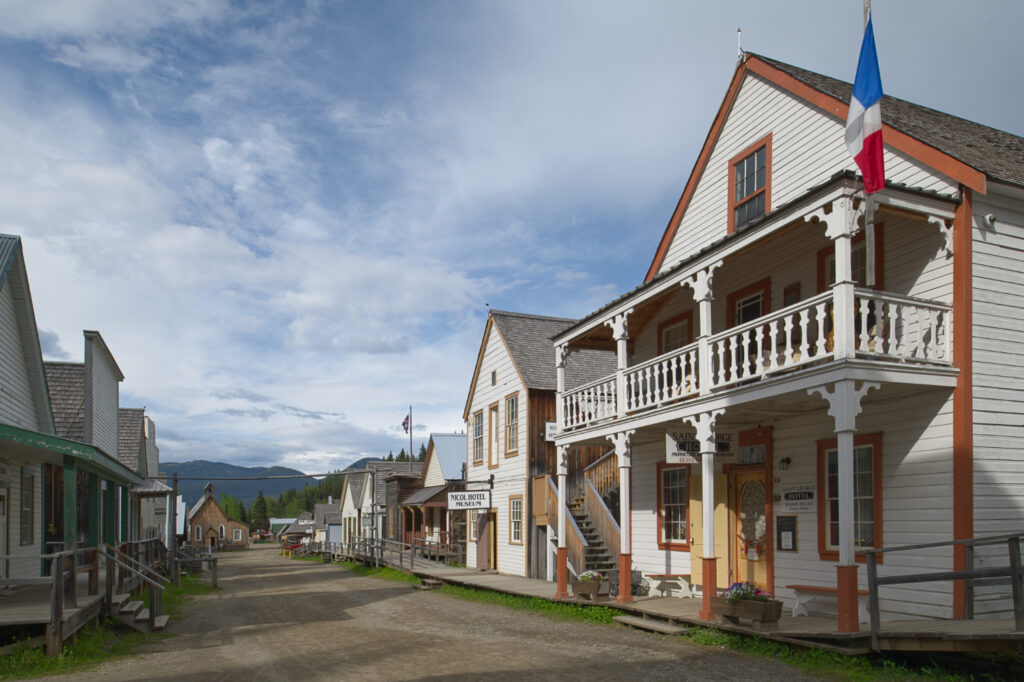
Barkerville sprang up in 1862 in the higgledy-piggledy manner that you’d expect of a mining boom town. They weren’t building a historic site. They were building places to eat, sleep, drink, buy stuff, sell stuff, gamble and amuse themselves when they weren’t digging for gold. Quick and cheap were what mattered. The resulting pile of ramshackle wooden sheds was a perfect firetrap. So when (as the story goes) a salacious miner tried to plant an unwanted kiss on a young woman in September of 1868, the resulting kerfuffle dislodged a stovepipe and spewed ashes that ended up wiping out ¾ of the town in a matter of hours.
Re-building began before even the embers were cold. Quick and cheap still mattered, but this time planning did too. Wider streets, more of them, spaces between houses – with the right precautions, maybe, just maybe, the town wouldn’t be doomed as soon as a single building caught fire.
So far, so good. Plenty of buildings have burnt down in Barkerville in the last 157 years, but the town as a whole hasn’t. Not yet, anyway.
St. Saviour’s Church
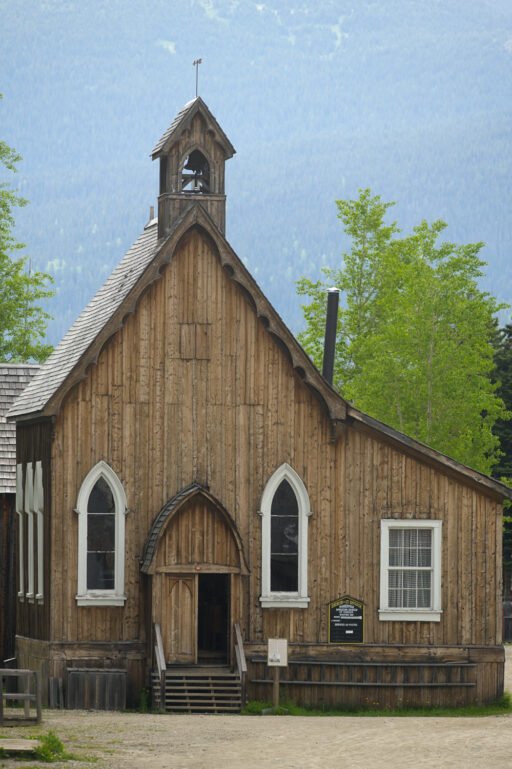
The Anglican Church of St. Saviour was undoubtedly the jewel in re-built Barkerville’s architectural crown (rough-hewn as that crown admittedly is). It was begun in 1868 by the Rev. James Reynard. A native of Yorkshire, England, Reynard arrived in Barkerville just before the great fire to serve as the town’s first Anglican clergyman. He was earnest, hard working, and absolutely certain that he knew the right and righteous way to do everything. This probably endeared him to the bishop, but it wasn’t a good way to win friends in a frontier mining town. Nor was it a good way to attract a congregation. His very small flock gathered in a saloon on Sunday mornings.
Reynard’s measly stipend was not enough to support him. So it wasn’t anywhere near enough to support him, his wife, and their four (soon to be five) children. They endured a life of brutal hardship and deprivation, all seven of them shoehorned into a tiny shed that, in winter, wasn’t even warm enough to keep the communion wine from freezing.
When it comes to building churches, Reynard’s certainty that he knew the ‘right way’ was actually rather well founded. Following the fire, he conceived a design for a new church that showed impressive mastery of the latest ideas about Anglican church design in the Mother Country. He started building it in late 1868, and carried the project on his back until its completion two years later.
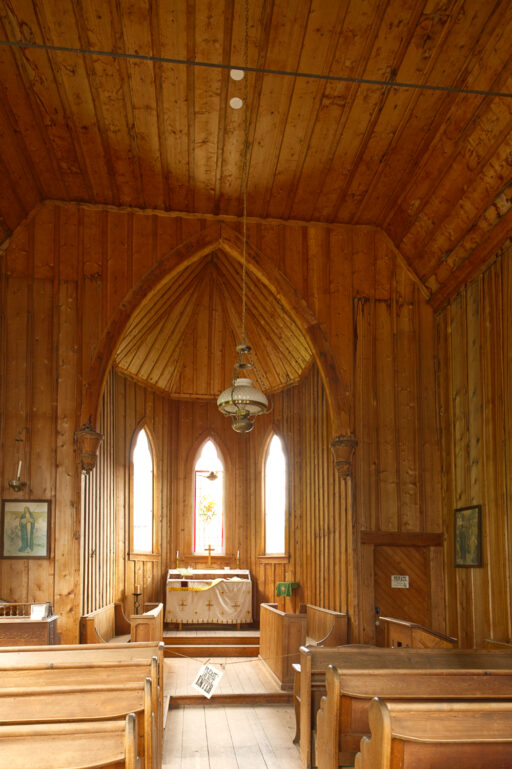
Once the church was built, it seems to have turned some heads. He finally got financial support, from the provincial Attorney General ($1000) and the Hudson’s Bay Company ($250). That enabled him to clear the debt from the church’s construction. And for the first time, people started coming in substantial numbers (by Barkerville standards) to his services.
But this success came too late for Reynard personally. The place and the project had broken him, physically and mentally. He applied to the bishop for a transfer to somewhere – anywhere – less trying, and was sent to Nanaimo in 1871. He died there in 1875, age just 45. Barkerville had, for all intents and purposes, killed him. But it didn’t kill his church, which has outlived him by 150 years and counting.
Chinatown
Some people think that Canadian multiculturalism was an invention of the ‘60s. They may be right – if they mean the 1860s. So many nationalities flew their colours in Barkerville that the main street was nicknamed ‘flag alley’.
The most prominent non-European group in Barkerville was the Chinese. Many came as miners, working for Chinese companies. Their employers dreamt of infinite wealth. The miners dreamt of saving enough money to go back home and buy a house. A few succeeded, many didn’t. Some worked in the mines, others made a living by providing services that the white miners needed, such as cooking and laundering.
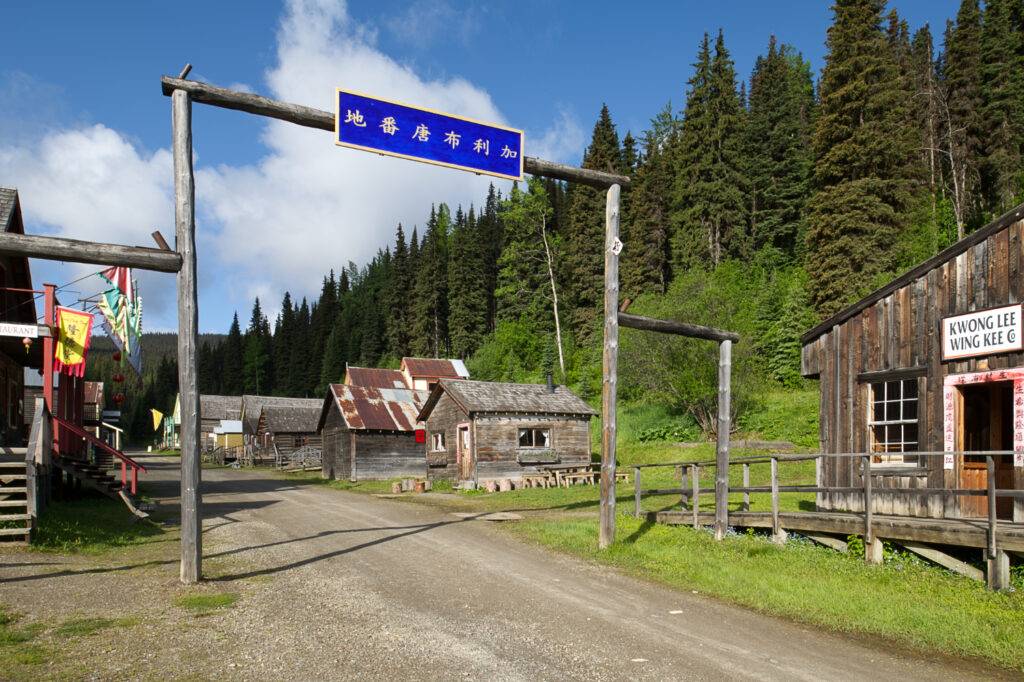
Barkerville had, and still has, its very own Chinatown. It includes houses, businesses, and a National Historic Site.
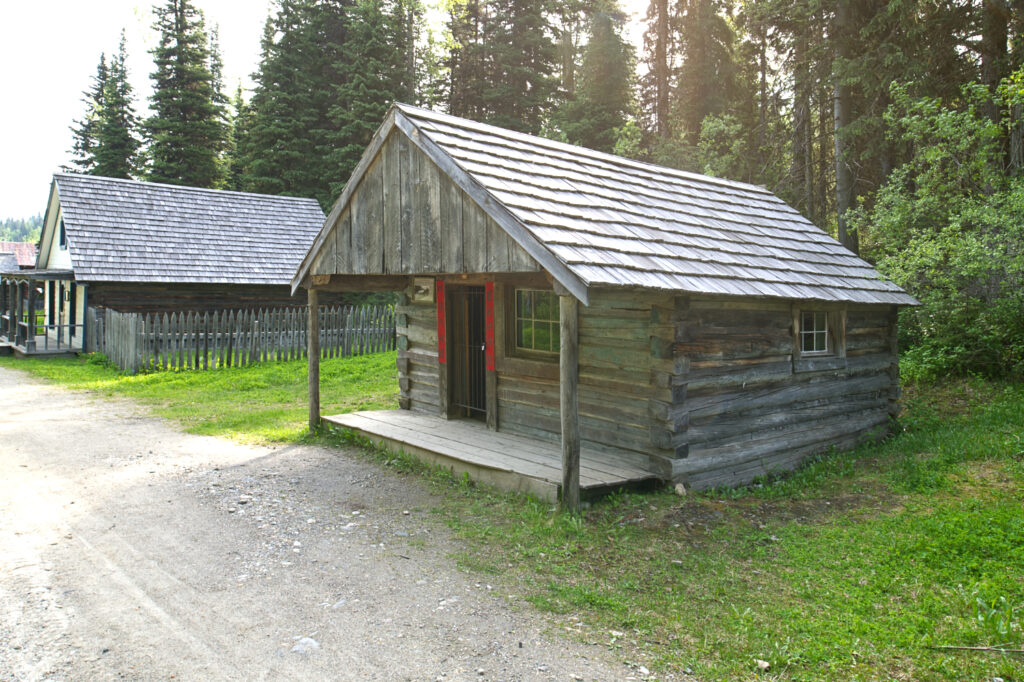
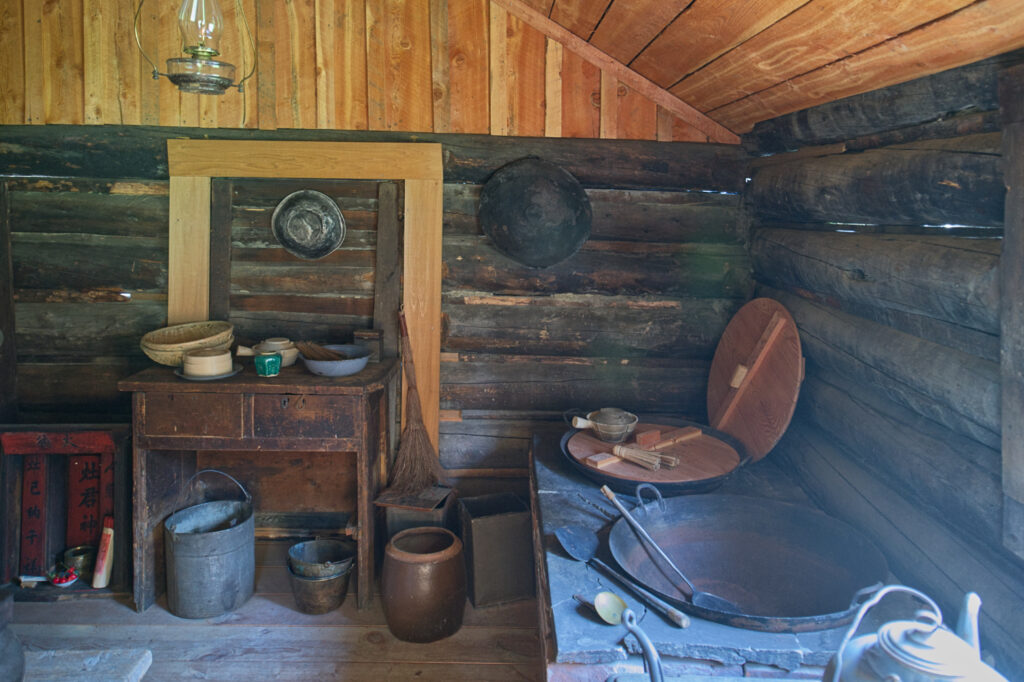
Chinese miners typically lived in cabins like this one. As many as six miners might have to live here. Staggered shift work ensured that there was always a bed available for whichever occupants weren’t in the mine.
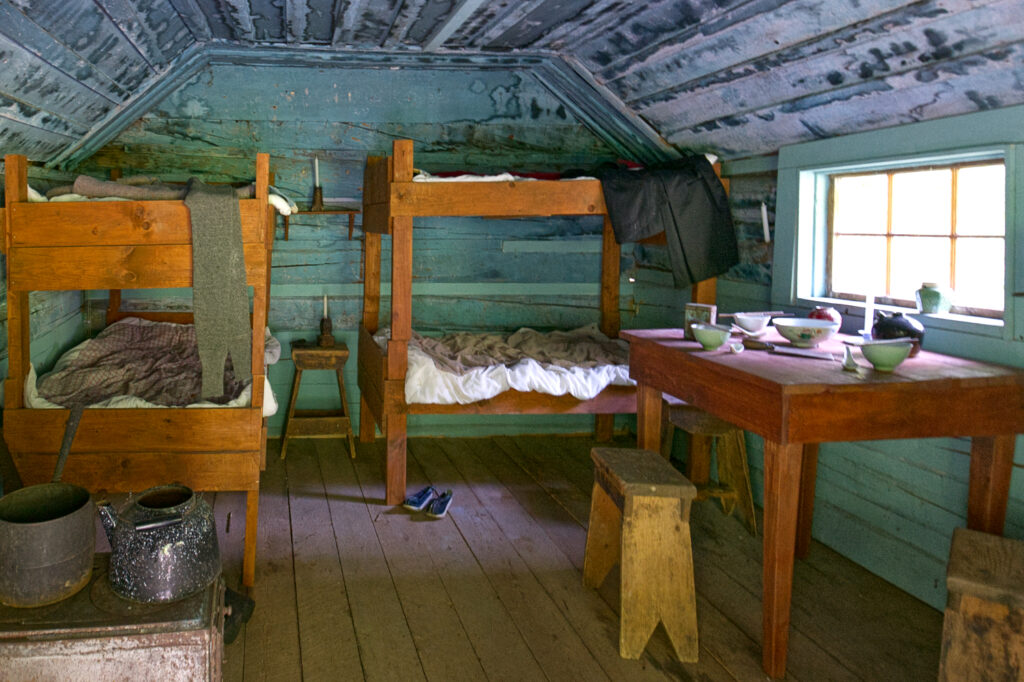
This was a pretty modest lifestyle, even by Barkerville standards. Chinese miners were paid less than white ones, so it was all they could manage (especially if they were hoping to save money).
The Chinese who didn’t work in the mine might operate stores, restaurants, or provide services that white miners needed, such as laundry.
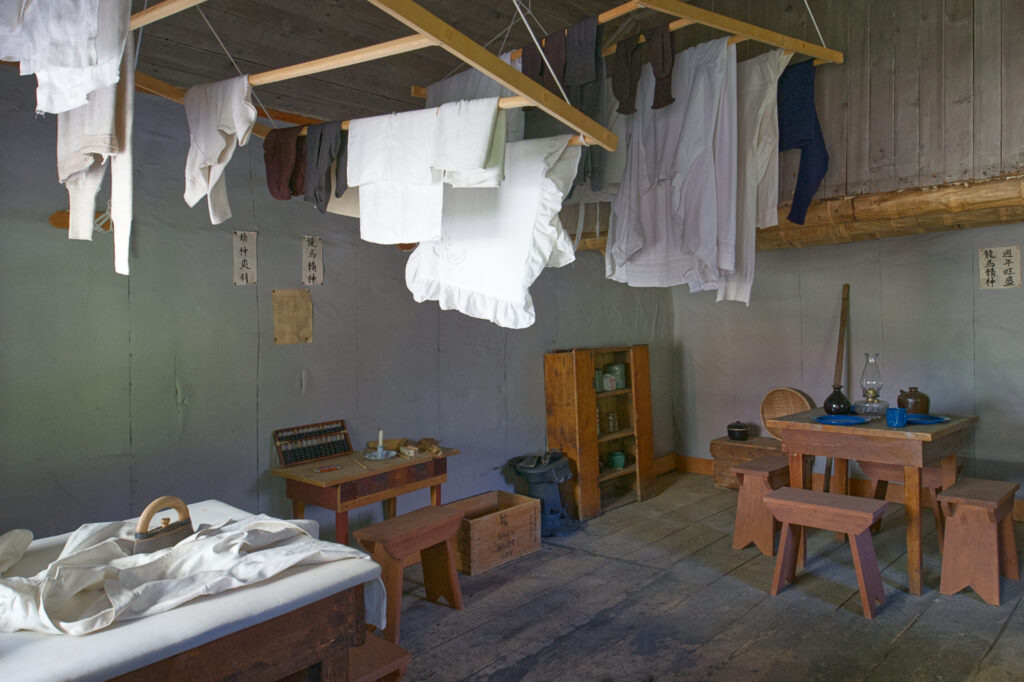
Laundries like this one were businesses and workplaces, but also residences. The shop owners lived on-site, sometimes in a loft space accessed by ladder.
One such owner was Lee Chung, who operated just such a laundry around the end of the 19th century. He boasted of his low prices – made possible in part by his lucrative sideline, bootlegging.
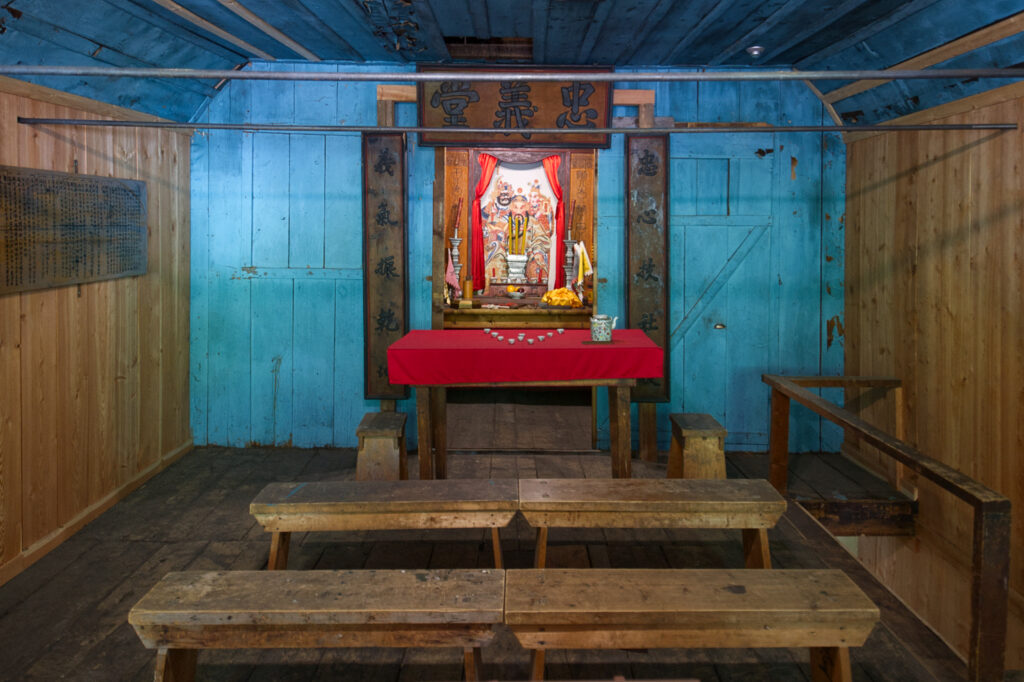
Chinese miners were far from home, but they formed a strong sense of community in Barkerville. The Chih Kung T’ang was central to that community.

The Chih Kung T’ang building is now a National Historic Site in its own right, within the National Historic Site that is Barkerville. It was operated by the Triad Society, an international organization that was partly fraternal, partly political. They offered Chinese workers accommodations, food, community, and the comfort of familiar cultural spaces and practices. They also offered political ideology – they were committed to the overthrow of the Ch’ing Dynasty. They operated in this building from 1874 to 1949.
Epilogue
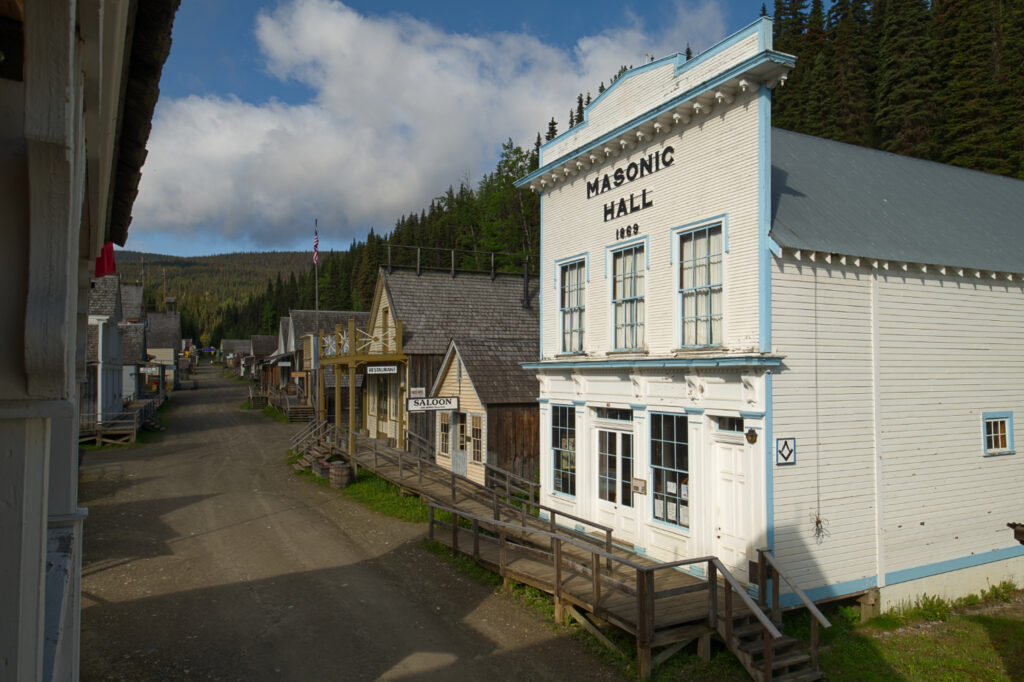
Mining towns experience extreme peaks and valleys. Barkerville’s first peak was before the great fire; its first deep valley was the destruction of the town in 1868. From there it rose again (though more gradually this time), but decline set in, as it always does in a boom/bust resource town. By the middle of the 20th century, Barkerville was almost a ghost town.
The B.C. government came to the rescue by making the area into Barkerville Historic Park in 1959. That eventually became Barkerville Historic Town and Park, now run by the Barkerville Historic Trust. Tourists and school groups fill the place from spring to fall.
Despite that apparent stability, boom, bust, risk and danger seem to be in Barkerville’s DNA. The catastrophic fire in 1868 gave us the Barkerville we know. Another fire last summer almost took it away. In July of 2024, the Antler Creek Wildfire came within just a few kilometres of Barkerville. The place was evacuated. In the end, the fire never reached the town. Barkerville dodged yet another bullet.
Built heritage is fragile. We’d best savour it while we still can.
Peter Coffman, History & Theory of Architecture program
peter.coffman@carleton.ca
@petercoffman.bsky.social
Additional Reading:
Barkerville and the Cariboo Goldfields, by Richard Thomas Wright
…And so… That’s how It Happened, by W.M. Hong
A Traveller’s Guide to the Buildings of Barkerville Historic Town & Park
Barkerville Historic Town & Park website
Barkerville National Historic Site of Canada, Parks Canada
Other blogs in the Vacation in Canada series:
The Exchange District, Winnipeg, Manitoba