Journalism professor Randy Boswell’s writings about Ottawa history have been showcased in a new book and in local media coverage surrounding this month’s 200th anniversary of the 1826 founding of Bytown — the future Ottawa — and the launch of construction of the Rideau Canal.
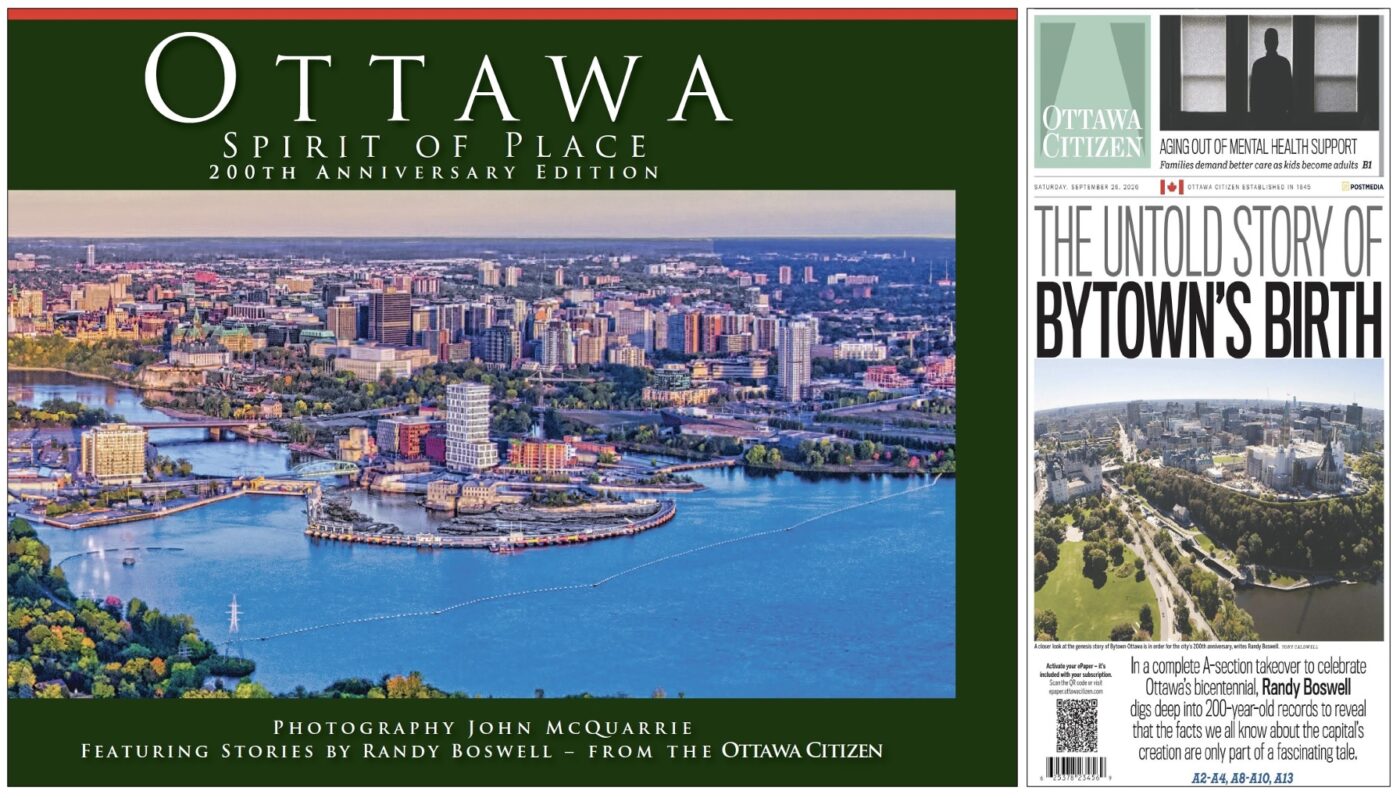
Boswell teamed with Ottawa photographer and publisher John McQuarrie to produce a new, lavishly illustrated book commemorating the city’s bicentennial. Ottawa, Spirit of Place: 200th Anniversary Edition contains new essays by Boswell about the history of Canada’s capital as well as a selection of history-themed feature stories and columns he published over the past 20-plus years in the Ottawa Citizen.
The book’s main essay, a 10,000-word retelling of Ottawa’s origin story, aimed to incorporate details typically missing from existing accounts of the beginnings of the city and the canal, says Boswell. These include the routinely erased backstory of the dislocation and dispossession of the Algonquin Anishinaabe people who had occupied the Ottawa Valley for millennia before the founding of Bytown by canal builder Lt.-Col. John By and Lord Dalhousie, Governor-in-Chief of British North America.
“The seminal ‘moment’ in Ottawa history — the reason the city is marking its 200th anniversary in 2026 — has typically been summed up by local historians as an auspicious meeting of two dauntless British men on Sept. 26, 1826, at a backwoods outpost destined to become the capital of Canada,” Boswell writes. “It’s true. But a closer, lingering look at the genesis story of Bytown-Ottawa invites us to think of that moment in a more layered way, as a series of illuminating scenes surrounding that famous, future-shaping encounter between Lt.-Col. John By and Lord Dalhousie . . .
“In this era of truth and reconciliation, the Indigenous people — whose bonds with the land that became Ottawa reach back thousands of years — are held in high esteem by municipal, provincial and federal leaders. But through ongoing land claims on both sides of the Ottawa River — for centuries the ‘Kichi Zibi’ lifeblood of Algonquin commerce and culture in the capital region — they are still seeking restitution, 200 years after the founding of Bytown, for lost but never ceded territory throughout their ancestral watershed.”
A version of the same essay appeared in the Citizen on Saturday, Sept. 26, billed as a “takeover” of the newspaper’s front section as a special offering to mark the exact day of the city’s 200th birthday. Boswell and McQuarrie also held a book-signing session at Indigo’s Rideau Centre store on the same day.
Earlier this month, CBC Ottawa radio journalist Robyn Bresnahan — a graduate of Carleton’s journalism program — hosted an episode of her podcast, This is Ottawa, exploring Boswell’s fresh research findings about the city’s origins.
For example, Lady Dalhousie — who accompanied her husband on the vice-regal voyage up the Ottawa River that led to the founding of the future Ottawa on Sept. 26, 1826 — emerges in Boswell’s narrative as an important natural historian and collector of botanical specimens in early 19th-century Canada. The story of a maple sprig she collected along the way to the birth of Bytown was traced to the present-day holdings of Canada’s Royal Botanical Gardens after being lost for more than a century in a storage trunk in a Scottish castle.
Photographs of an official version of the letter from Dalhousie to By dated Sept. 26, 1826 — widely hailed as “Ottawa’s birth certificate” — were reproduced for the first time in the book and the Citizen.
And Boswell unearthed other previously overlooked details about the founding of the city, including the fact that — on the eve of Bytown’s birth — By, Dalhousie and members of their respective entourages took a reconnaissance hike through the woods and swamps that would eventually become the path of the canal through central Ottawa — including present-day Old Ottawa South and possibly the campus of Carleton University.
Thursday, October 1, 2026 in Journalism News, News
Share: Twitter, Facebook