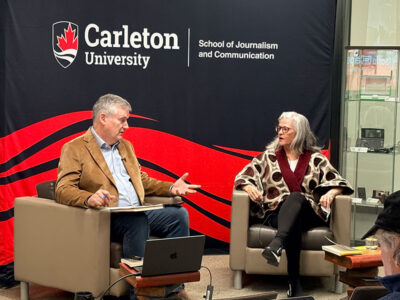
Carleton’s journalism program celebrated the resurgence of “zines” at an event showcasing examples of the self-published, homemade mini magazines produced by Carleton students.
As Carleton journalism professor Matthew Pearson explained, a zine is a publication that often addresses topics from an independent or alternative viewpoint, emphasizing editorial control by the producer. Zines can break from conventional formats and are often photocopied, folded or stapled.
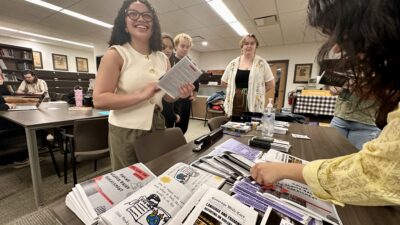
Final assembly of the zines produced by students in Matthew Pearson’s Trauma-Informed Journalism class
Many see a resurgence in zines as a reaction to the ephemeral nature of today’s pervasive digital media world, a place where content can be here today and gone tomorrow. Zines are a rollback to a more analogue time, permanent publications that you can hold in your hand and will never go away.

Journalism professor Matthew Pearson
And as Pearson pointed out, zines as a medium often provide space for marginalized voices and stories that are often excluded from traditional journalism.
In a way, what we now call zines have been used throughout history: in the secretly written and circulated literature of the Soviet era, in 1970s-era fanzines about punk culture and direct action, in the 1990s when zines explored feminist topics and described experiences with sexism, mental illness, body image and more.
“Zines are a creative act and at times, even an act of resistance,’’ said Pearson, who used zine production as a class project in his course Trauma-Informed Journalism.
“I was interested in bringing zines and zine-making into the classroom, especially at a time when I see so many young people gravitating to this form,’’ Pearson said. “Students created zines to explore ways to approach the coverage of a range of issues with greater care.”
A number of Pearson’s students spoke about their experiences with the zine project during the April 1 event in the school’s resource centre.
“At a time when journalism feels increasingly dehumanized because of AI … it was really special to work in such an imperfect and human medium,” said fourth-year journalism student Elissa Mendes, who was part of a team producing a zine called “How to report with care – even when it feels like the world is on fire.”
“It was just really nice to be able to operate outside of the framework of what was significant, interesting and new and satisfying to corporate media and focusing on what sells and generate clicks and instead, focus on how we can serve communities,” Mendes said.
Abyssinia Abebe, also a fourth-year journalism student, spoke of her team’s experience producing a zine called “The War on Women – online gender-based harassment.”
“Addressing this online-based harassment is about addressing misogyny in our society and that’s what we tried to get at here,’’ Abebe said.
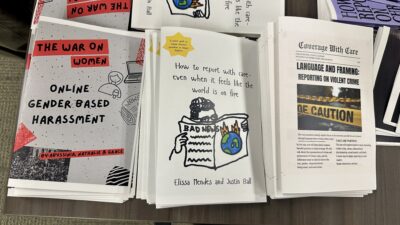
Some of the zines produced by students in the Trauma-Informed Journalism class
Another of those who spoke at the event was 2024 journalism graduate Laura Blanchette, producer of the Mid City zine that focuses on municipal politics. Notably, Blanchette launched the Mid City zine project – which recently produced its ninth issue – with the support of The Peter Mansbridge Emerging Reporter Fund, a Carleton award designed to support undergraduate and graduate journalism students pursuing an innovative research or reporting project with a focus on topics of governance and public social policy.
Blanchette spoke about a resurgence in ‘analogue’ publications that keep things local and focus on community.
She sees the mission of her zine as “bringing people into politics, especially city politics and local politics because that is where I think we can have a big impact, as citizens and as journalists.”
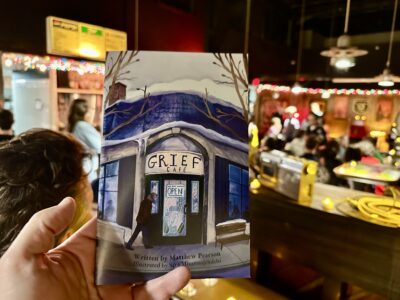
The Grief Cafe zine produced by Matthew Pearson and illustrator Sara Mizannojehdehi, was released March 31
The journalism school event took place the day after Pearson launched his own zine – The Grief Café: a hands-on guide to heartache and healing – at an emotional event held at the Happy Goat coffee shop, on Laurel St. in Ottawa. Working with illustrator Sara Mizannojehdehi (a graduate of Carleton’s Bachelor of Media Production and Design), Pearson produced a powerful collection about grief and how to deal with the aftermath of losing a loved one.
Wednesday, April 1, 2026 in General, Journalism News, News
Share: Twitter, Facebook