| When: | Thursday, April 2nd, 2026 |
| Time: | 10:00 am — 4:00 pm |
| Location: | Richcraft Hall, 4400, SJC Resource Centre |
| Audience: | Alumni, Carleton Community, Current Students, Faculty, Professionals, Staff and Faculty |
| Contact: | Liam Young, LiamC.Young@carleton.ca |
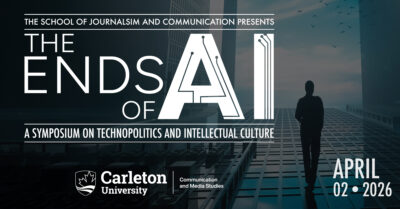
AI is everywhere but nobody really knows what it is, what it means, or what its ends will be. Not even the sector’s major developers and investors.
Institutions and individuals are told to prepare for the AI revolution, already underway, that will transform every corner of culture and politics. Industry talking points have quickly migrated into institutional frameworks and strategic planning. AI skepticism is typically dismissed using familiar tropes of ludditism. More considered arguments suggest most skepticism rests on assumptions about, or experiences with, out-of-date models.
Meanwhile, the global economy is increasingly integrated with AI not just via large-scale infrastructure build-outs of data centres and energy grids, but also through investment strategies of pension funds and private capital alike. The tech sector has happily collected capital for an all-in AI push with NVIDIA, OpenAI, Google and Anthropic leading the way. Thirteen-figure company valuations and utopian pronouncements from CEOs have positioned the AI sector as “too big to fail.” But influential voices in investment and intellectual circles suggest the bubble is going to burst, and fast.
What is the role of scholarship and intellectual culture amidst all of this flux? How can academics elbow their way into policy conversations, whether at the local level of our home institutions or more broadly at various levels of government and industry?
To try to get some collective bearings, we will approach the thorny problem of AI through the scholarly field of Communication and Media Studies, asking, among other questions, how scholars are responding to AI within Canadian universities and policy in a moment where our universities and government are mobilizing discourses of productivity (to integrate AI into the substrate of government and business), geopolitical rivalry (to integrate into defence or adopt digital sovereignty stances), and acceleration into futures of ambient and abundant AI (students and citizens must adapt rapidly—whether this is to accept or mobilize a political opposition to this situation)
More generally, we ask:
- What is AI? (what technologies, institutions, cultures, people comprise it as an apparatus or stack)
- Which events and experiences define at present?
- How should AI be situated historically? Is it ruptural or sedimentary? What is at stake in adopting these, or other, historical lenses?
- Which intellectual frameworks or traditions help us to pose questions about and develop relationships to AI, or to more generally think through our emerging “AI condition”?
- How do bubbles burst and what comes after? How do actors of various kinds comport themselves to take advantage of the post-bubble moment?
Format
This symposium will provide panel discussions; dispatches from experiments with AI in scholarship, teaching, and academic admin; a live recording of The Data Fix podcast; and informal discussion.
Speakers
- Sibo Chen (TMU)
- Mél Hogan (Queen’s)
- Patrick McCurdy (Ottawa)
- Fenwick McKelvey (Concordia)
- Tanner Mirrlees (Ontario Tech U)
- Jeremy Packer (Toronto)
- Sandra Robinson (Carleton)
- Sonja Solomun (McGill)
Symposium Registration
The Ends of AI Symposium RSVP
Please register so that we can keep you informed of any last minute changes should they occur.