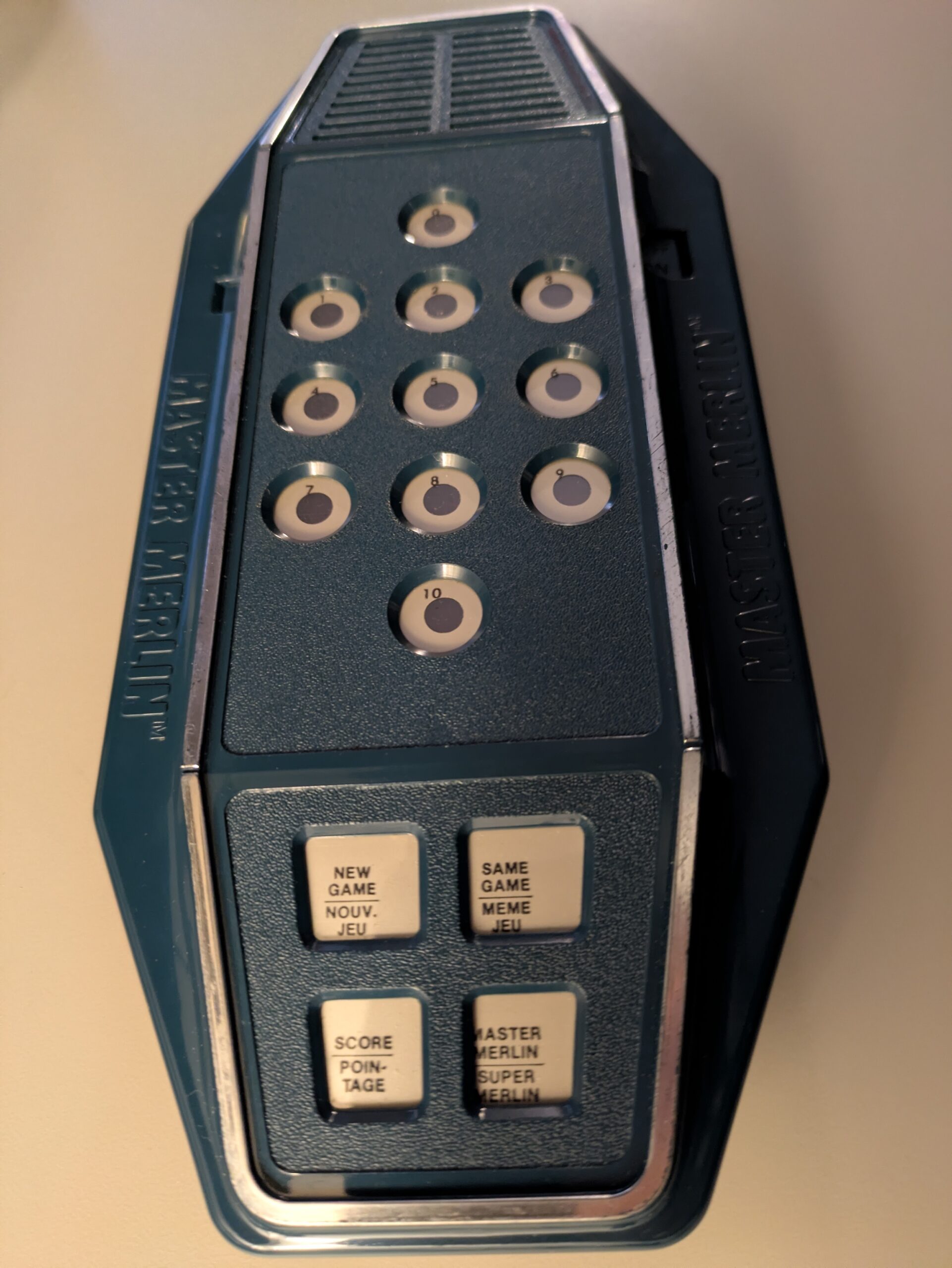
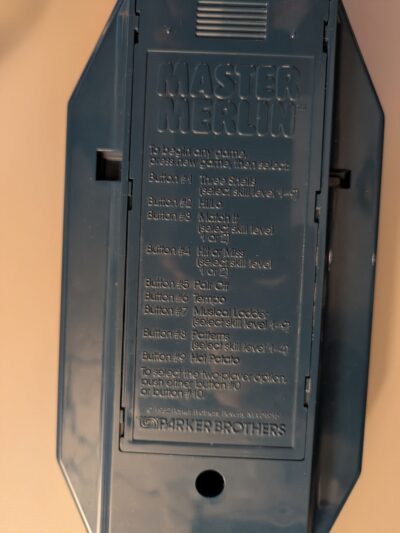
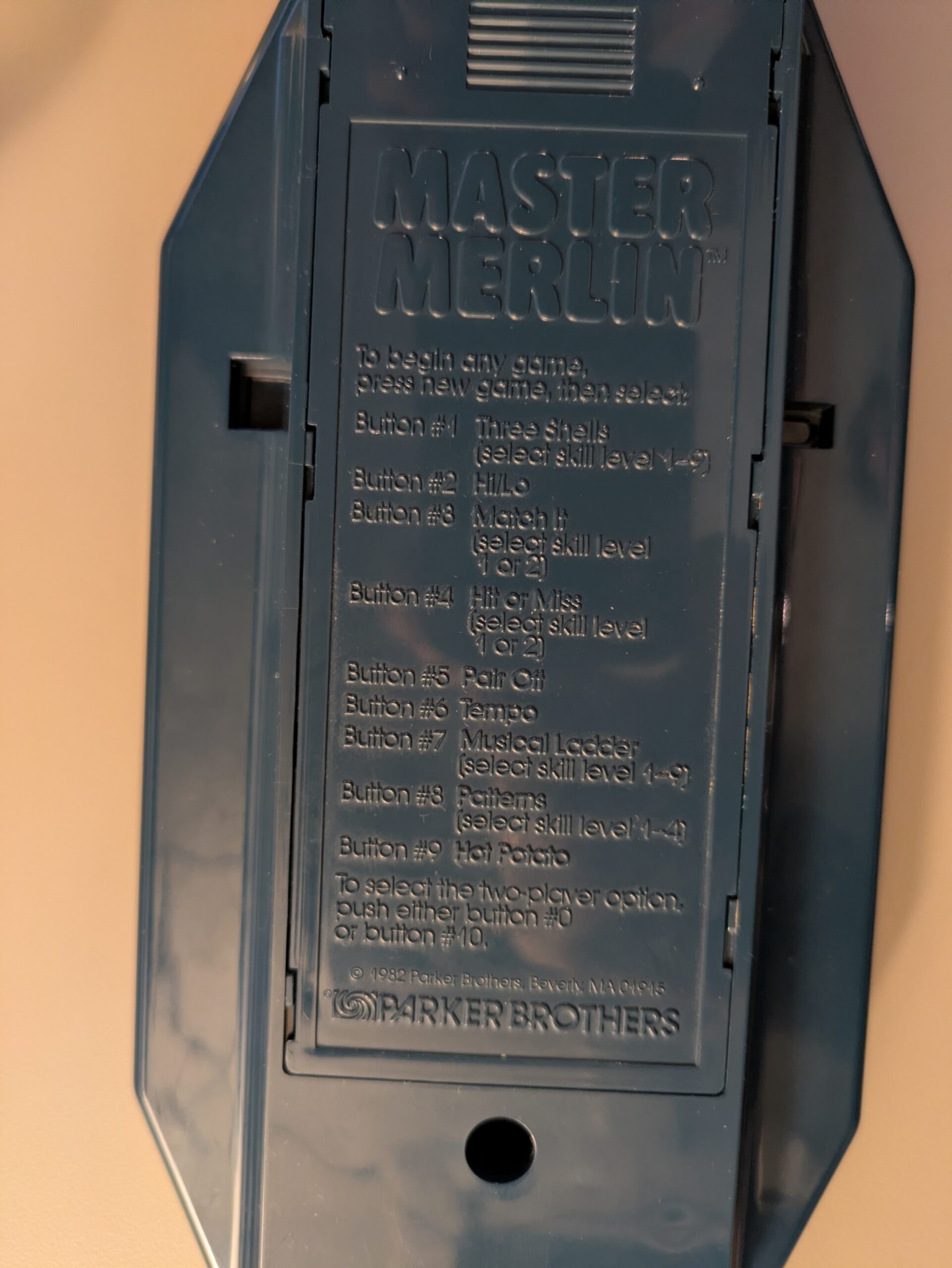
Master Merlin is notable as an early example of a mass-market microprocessor-based consumer device, bringing embedded computing into millions of homes years before most people ever touched a personal computer. Its claim to fame was making a single-chip microcontroller do all the work: logic, memory, I/O, sound, and display. It demonstrated how computing could be cheap, portable, and purpose-built, a design philosophy that directly foreshadowed modern embedded systems. With several million units sold across the Merlin family, it was one of the most popular microcontroller-driven devices of its era, making it historically significant not for programmability, but for normalizing computers as everyday objects rather than lab equipment.
Display: 11 red LEDs arranged in a geometric “wizard board” pattern
Input: 11 membrane push-buttons (numeric + function keys)
Power: 6 × AA batteries (≈9 V total)
Memory/Storage:
On-chip ROM (fixed firmware; exact size undocumented, typically 1–2 KB for this class)
On-chip RAM (tens of bytes, used for game state)
Weight: ~0.45–0.6 kg
Operating System & Programming Languages
Operating System: None. It ran a fixed mask-programmed ROM on the TMS1000 microcontroller with no support for loading or switching software.
Supported Languages: None available to users. The firmware was written by engineers in microcontroller assembly language (and possibly supported by internal tooling or macros at Texas Instruments), but this code was mask-programmed at the factory and could not be changed, accessed, or extended by the owner.
Notables
One of the earliest mass-market consumer devices built entirely around a single-chip microcontroller, selling in the millions at a time when most people had never seen a “computer.”
Helped normalize embedded computing by disguising a computer as a toy, years before PCs became common in homes or schools.
Used LEDs and membrane keys only, no screen, showing how early computing relied on clever UI constraints rather than graphics.
Based on the Texas Instruments TMS1000 family, the first commercially successful microcontroller, a cornerstone of modern embedded systems.
Often remembered as a “thinking toy” or “electronic brain”, marketed more as a wizard than a machine.
Frequently cited as a gateway device that sparked early interest in logic, patterns, and computational thinking, especially among children.
The Merlin family sold several million units worldwide, making it far more widespread than most early personal computers.
Represents the parallel history of computing, not programmable, but vastly more common, demonstrating that embedded computers shaped everyday life before PC’s did.
The original (red) Merlin, “The Electronic Wizard (1978)”, became one of the best-selling electronic games of the 1970’s, widely credited with introducing the public to the idea of a “thinking machine” years before home computers were common, It won major toy awards and firmly established microcontrollers as viable, low-cost brains for consumer products.