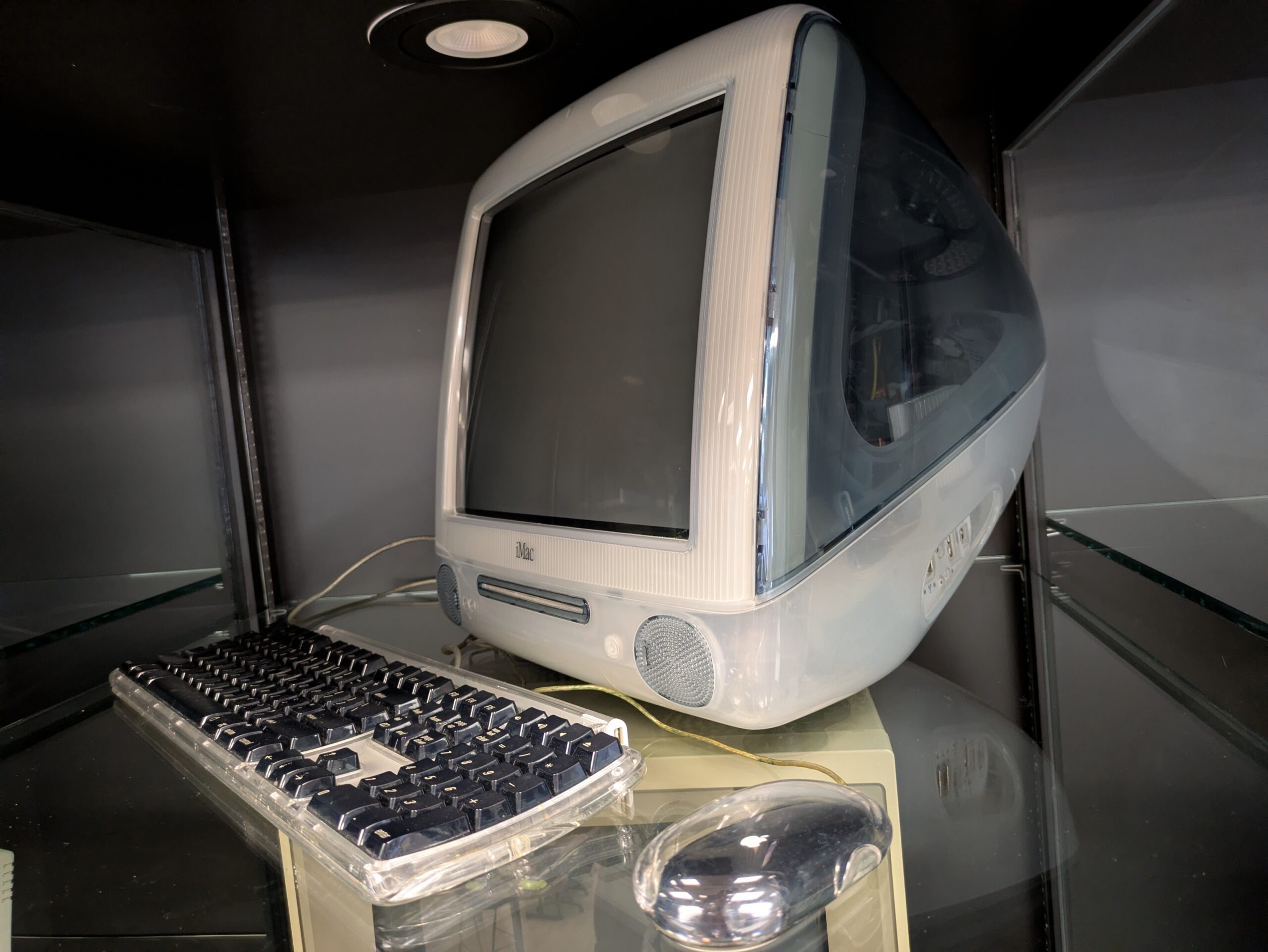
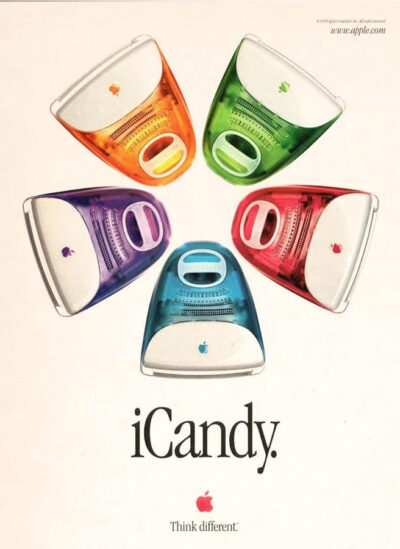
the Apple iMac G3 (introduced in 1998) is notable for re-establishing Apple’s relevance by combining a consumer-friendly all-in-one design with bold, translucent industrial aesthetics that deliberately made the computer a visible cultural object rather than hidden office equipment. Its claim to fame was abandoning legacy technologies (like the floppy drive and serial ports) in favor of USB, signaling a decisive shift toward modern peripheral standards and accelerating their widespread adoption across the industry. Commercially, the iMac G3 was extremely popular, selling millions of units and becoming one of the best-selling personal computers of its era, making it a pivotal artifact for illustrating how design, usability, and standardization reshaped public engagement with computing at the turn of the millennium.
Manufacturer: Apple Computer Inc.
Released: 1998
Type: All-in-One Personal Computer
Cost at release: ~$3,500 (adjusted for inflation)
MIPS: 100-150
Hardware Specifications
CPU: PowerPC 750 (G3) RISC CPU 233 MHz (later models ranged up to 700 MHz)
System Architecture: 32-bit PowerPC
Memory: 32 MB expandable (typically up to 384 MB on early revisions)
Storage: 4–6 GB IDE hard drive (early models)
Optical Drive: 24× CD-ROM (later models included CD-RW or DVD-ROM)
Display: Integrated 15-inch CRT, 1024 × 768 maximum resolution
Graphics: ATI Rage IIc or ATI Rage Pro Turbo, 2–6 MB VRAM (model-dependent)
Ports & Connectivity:
2× USB 1.1 (no legacy serial or ADB ports)
10/100 Ethernet
56k modem
Headphone output
Apple USB keyboard
Apple USB “hockey puck” mouse
Case Design: Translucent colored polycarbonate shell
Weight: Approximately 38–39 lb (17–18 kg) depending on revision
Operating System & Programming Languages
O/S: Mac OS 8.1 (original 1998 Bondi Blue models)
Later Supported Operating Systems (model-dependent):
Mac OS 8.5, 8.6
Mac OS 9.0 – 9.2.2
Mac OS X 10.0 – 10.3 “Panther” (early versions officially supported on many G3 models)
Architecture: PowerPC (32-bit RISC)
Programming Languages:
Native & Compiled Languages
C (MPW, CodeWarrior, later GCC under Mac OS X)
C++ (widely used via Metrowerks CodeWarrior)
Objective-C (primarily under Mac OS X via GCC)
Pascal (historically significant on the Mac platform)
Fortran (academic and scientific computing, via third-party compilers)
Assembly (PowerPC assembly language)
Scripting & Interpreted Languages
AppleScript (native Mac automation language)
Perl (especially under Mac OS X)
Python (early versions under Mac OS X)
Tcl/Tk
Shell scripting (sh, bash, tcsh) under Mac OS X
Educational & Historical Languages
BASIC (various Mac implementations)
HyperTalk (HyperCard stacks, important in multimedia and education)
Logo (commonly used in educational settings)
Web & Multimedia Languages
HTML
Java (early Java 1.x runtimes available for Mac OS and Mac OS X)
JavaScript (browser-based development)
Notables
Widely credited with pulling Apple back from near-bankruptcy after Steve Jobs’ return in 1997.
“Bondi Blue” Icon: Named after Australia’s Bondi Beach, its translucent blue case became one of the most recognizable computer designs ever.
Its controversial removal of the floppy drive helped hasten the industry’s shift to USB and optical media.
One of the first mass-market computers to rely almost entirely on USB, accelerating its adoption across the PC industry.
Internet Computer: Marketed explicitly as an “out-of-the-box internet appliance” at a time when home internet was still novel.
Infamous round USB mouse: visually striking but ergonomically criticized; now a vintage favorite.
Modernized the all-in-one form factor decades after early Macs and influenced later designs like the flat-panel iMacs.
First mainstream computer where industrial design was a primary selling point, influencing consumer electronics broadly.
Frequently featured in late-1990s advertising, films, and TV, reinforcing computing as colorful and approachable rather than technical.
Sold millions of units within its first years, becoming one of the most successful personal computers of its era.