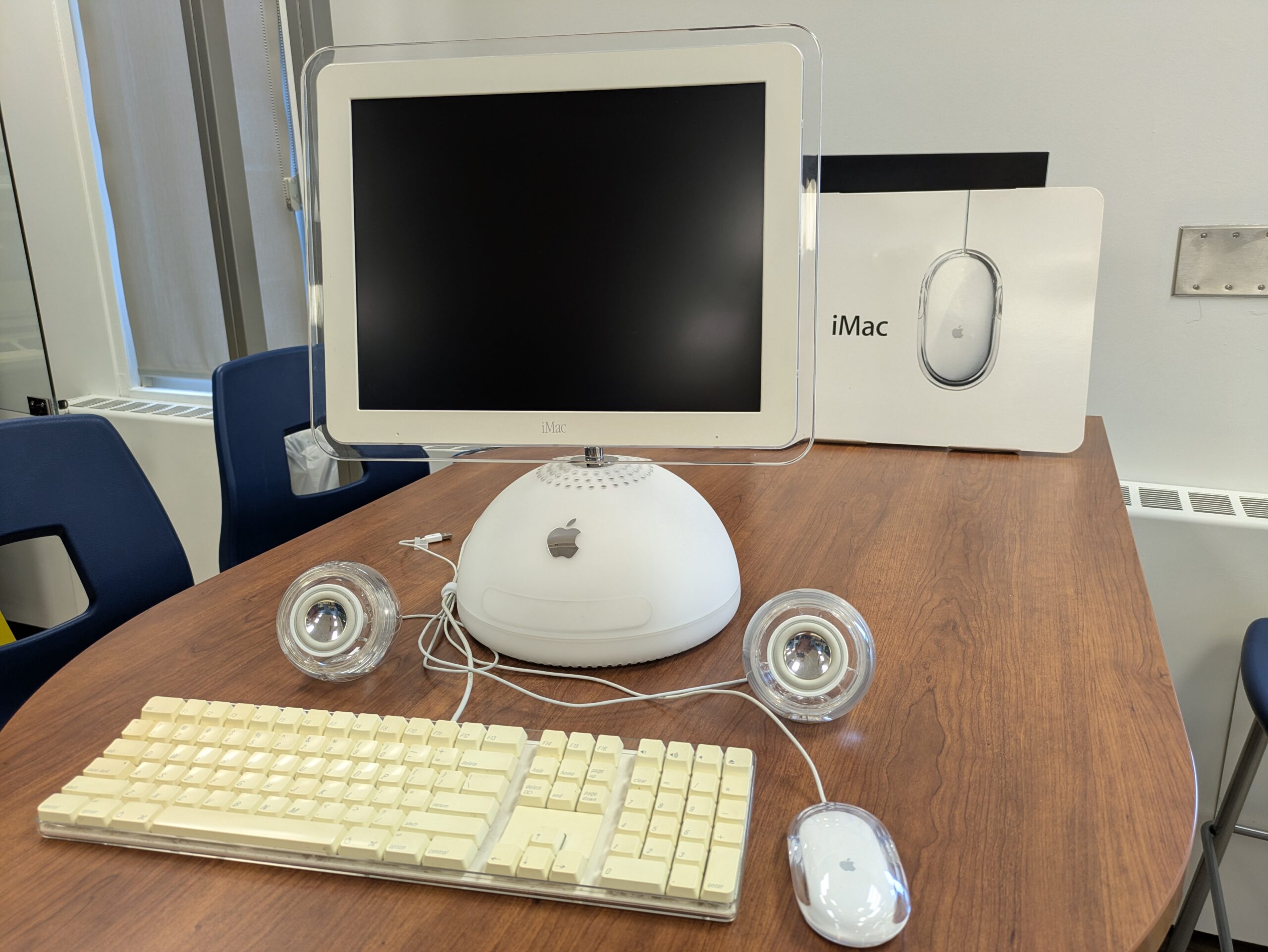
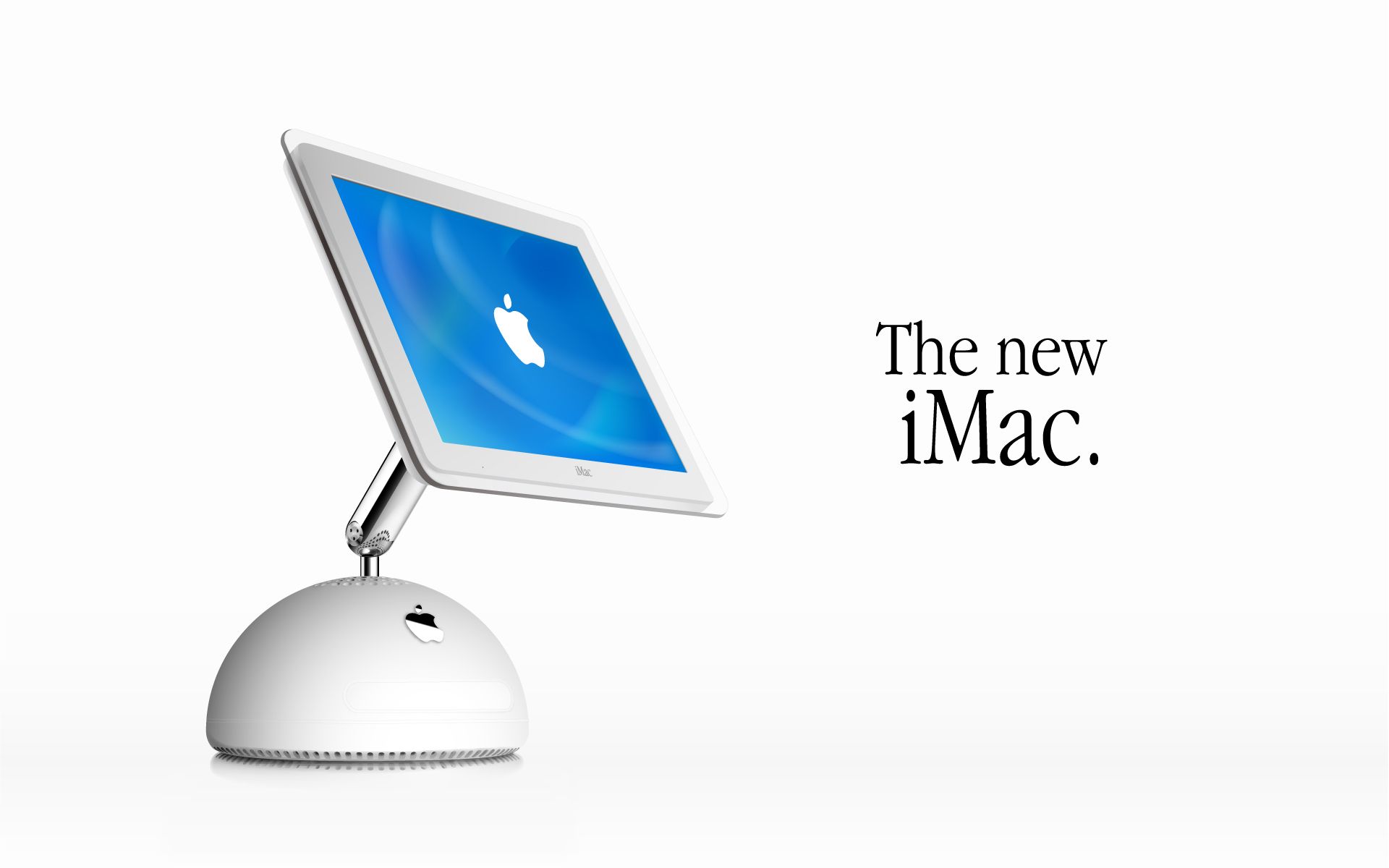
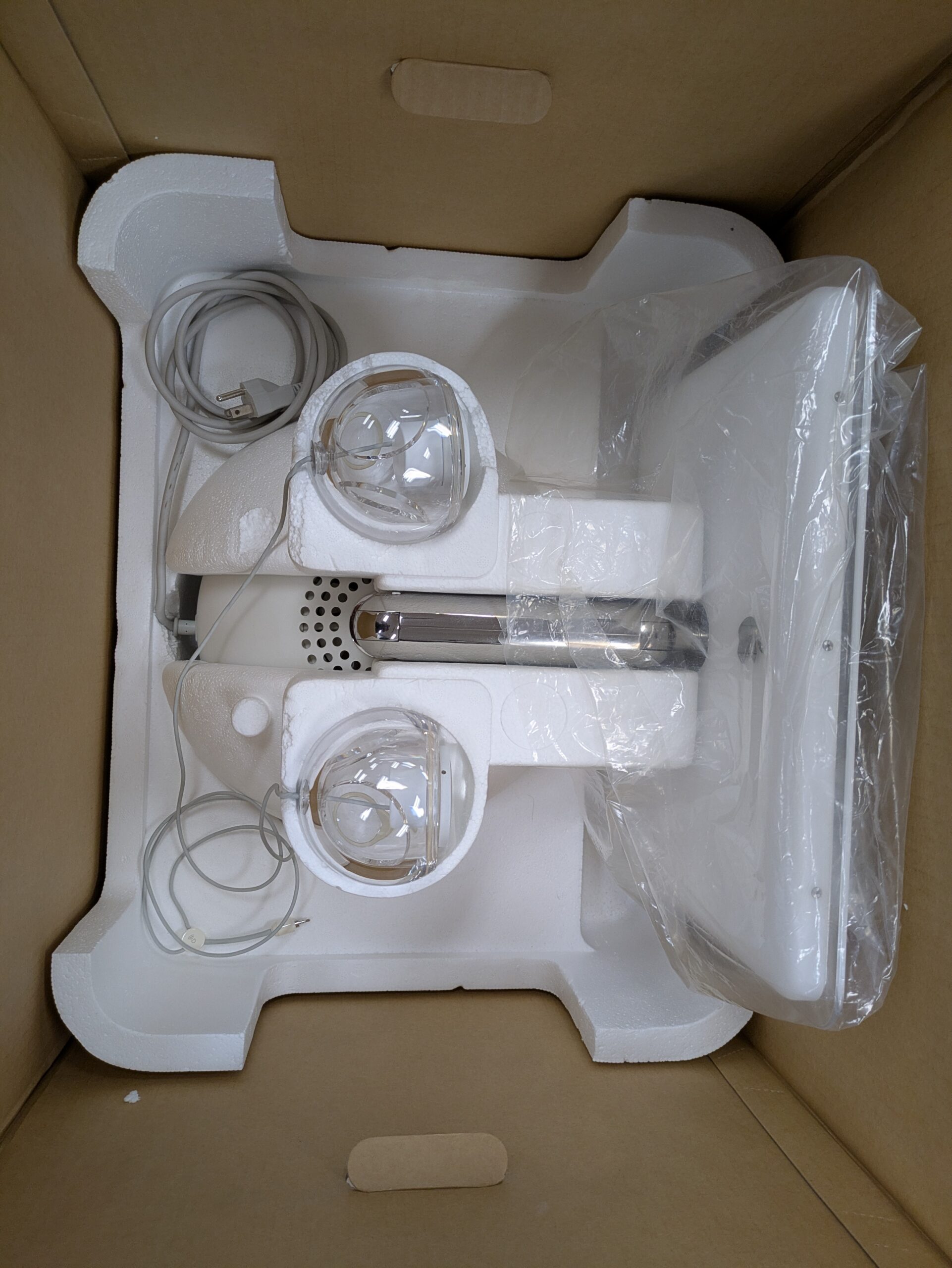
The Apple iMac G4 (2002–2004) is best remembered for its iconic “desk lamp” design, an articulated LCD arm paired with a hemispherical base, that decoupled the display from the computer for the first time in a mass-market desktop, influencing modern ergonomic and industrial design across the industry. Technologically, it marked Apple’s transition from CRTs to flat-panel LCDs and helped normalize USB, FireWire, and a clean all-in-one aesthetic in educational and creative environments. Hugely popular and widely deployed in universities and studios, the iMac G4 became a museum-grade example of how industrial design, human-computer interaction, and branding can reshape public expectations of what a computer should look like and how it should fit into everyday academic life.
Manufacturer: Apple Computer Inc.
Released: 2002
Type: All-in-one personal computer
Cost at release (base model): ~$3,350 (adjusted for inflation)
MIPS: 1,400 – 1,800
Hardware Specifications
CPU: PowerPC G4 (various speeds depending on model):
Early models: 700 MHz and 800 MHz G4 variants.
Later models: 1.0 GHz and 1.25 GHz PowerPC G4 with Velocity Engine.
Level 2 Cache: 256 KB on-chip.
System Bus: Up to ~167 MHz on later USB 2.0 models.
Memory
RAM (Standard): 128 MB to 256 MB depending on model; later USB 2.0 models shipped with 256 MB DDR SDRAM.
Max RAM: Upgradable typically up to 1 GB (some unofficial reports of 2 GB possible).
Hard Drive: 40 GB, 60 GB, or 80 GB Ultra ATA (most common 7200 rpm on USB 2.0 models).
Optical Drive Options: Combo (DVD-ROM/CD-RW) or SuperDrive (DVD-R/CD-RW).
Unique Articulated Arm: Adjustable display mounted on a ball-and-arm for flexible viewing angles (iconic design).
Graphics Processors:
NVIDIA GeForce2 MX with 32 MB VRAM on early units.
NVIDIA GeForce4 MX with 64 MB VRAM on later 1.0 GHz+ units.
Connectivity & Ports
USB: 2–3 ports (USB 1.1 on earliest; USB 2.0 on later models).
FireWire 400: 2 ports.
Ethernet: 10/100 BASE-T built-in.
Modem: Built-in 56k V.92.
Optional: AirPort (802.11b/g) and Bluetooth on later configurations.
Audio: Built-in speakers and headphone jack; audio in/out ports
Weight: Approximately 9.7 kg (21.2 lb) for 15″ models and 10.4 kg (22.8 lb) for 17″ models.
Operating System & Programming Languages
O/S:
Shipped primarily with Mac OS X 10.1 “Puma” (early 2002 models) and Mac OS X 10.2 “Jaguar” (later models).
Officially supported upgrades up to Mac OS X 10.4 “Tiger”, which is generally considered the most stable and historically representative OS for the iMac G4.
Could also dual-boot Mac OS 9.2.2 (Classic Mac OS) on many models, making it a transitional machine between “classic” and Unix-based Mac computing.
Programming Languages:
C and C++ – primary system and application development languages (via Apple Developer Tools/Xcode).
Objective-C – central to Mac OS X application development (Cocoa framework).
Java – officially supported by Apple
Python – included with Mac OS X
Perl – bundled with Mac OS X; popular for system administration and web scripting.
Ruby – available via third-party packages and later OS X releases.
AppleScript – Apple’s native automation and scripting language.
Pascal – supported historically through legacy tools and education environments.
Assembly (PowerPC) – used in low-level or performance-critical academic and research work.
Notables
Commonly called the “Sunflower iMac” or “Desk Lamp Mac” due to its articulated arm and lamp-like silhouette.
One of the first mass-market computers to fully decouple the display from the system unit, pioneering ergonomic adjustability now standard in modern monitors and all-in-ones.
Famously compared to (and inspired by) the Anglepoise desk lamp, making it a landmark example of industrial design influencing computing form factors.
Helped normalize flat-panel LCDs in consumer desktops, accelerating the industry’s move away from bulky CRT monitors.
Widely adopted in universities, design studios, and media labs, reinforcing Apple’s dominance in creative and academic computing in the early 2000s.
Bridged Classic Mac OS and Mac OS X, representing Apple’s shift to a modern Unix-based operating system.
Regularly appears in museums of modern art and design, underscoring its cross-disciplinary significance.
Apple ads emphasized motion, elegance, and human interaction, often showing the screen floating and moving effortlessly, selling design and experience, not raw specs.
Seen as the final and most expressive evolution of the iMac line before Apple pivoted to minimalist aluminum designs, making it a high point of expressive, human-centric computer design.