Compaq ProLinea 4/24s
The Compaq ProLinea 4/24s features an Intel 486SX processor running at 25 MHz, 4 MB of onboard RAM, and no built-in floating-point math coprocessor. Housed in a compact desktop case, it offered a practical, expandable platform for the DOS and Windows applications used in offices and classrooms during the early 1990’s.
Compaq ProLinea 4/24s
[Vin194]
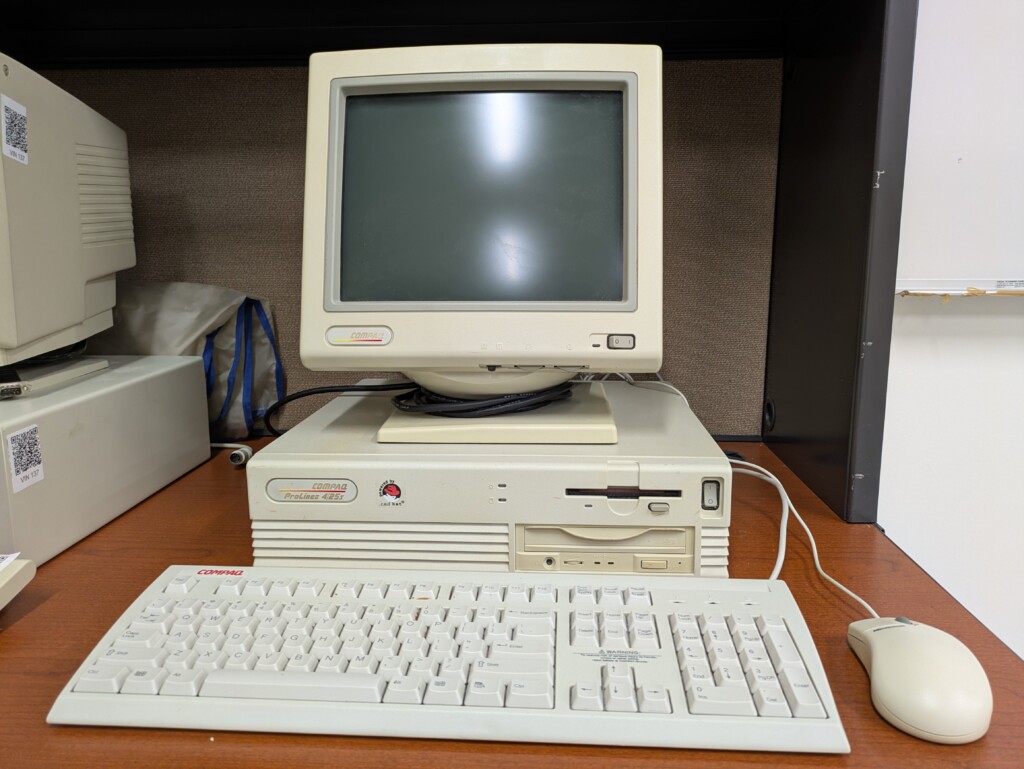
The Compaq ProLinea 4/24s represents an important turning point in early-1990’s PC history, when affordable IBM compatible computers began reshaping a market once dominated by IBM itself. Introduced in 1992, Compaq’s budget ProLinea family marked a decisive shift away from premium priced systems toward competitively priced desktops, helping ignite an industry wide price war that forced IBM and other major manufacturers to respond. With its 486-class processor and modest memory and storage by today’s standards, the 4/24s illustrates the practical computing needs of businesses, schools, and home users of the period. Although less celebrated than Compaq’s flagship Deskpro machines or the later Presario range, the ProLinea family played an important role in the company’s expansion into the mass market. This aggressive low-cost strategy helped Compaq lead the charge against IBM’s dominance of personal computing, ultimately overtaking the industry giant in 1994 to become the world’s largest PC vendor.
- Manufacturer: Compaq Computer Corporation
- Type: Desktop IBM‑PC‑compatible personal computer
- Release Date: October 1992
- Cost at release: ~$2,000 (adjusted for inflation)
- Cost with peripherals: ~$4,400 (adjusted for inflation)
- MIPS: ~20
Hardware Specifications
- CPU: Intel 486SX @ 25 MHz (no internal math coprocessor in base config)
- Memory: 4 MB onboard (70 ns SIMM), expandable (some boards up to ~32 MB)
- Graphics: Often Tseng Labs ET4000/W32 local‑bus VGA or similar integrated graphics on 486 models
- Hard Drive: Originally commonly a ~120 MB IDE hard disk in many 4/25s units
- Floppy Drive: 1.44 MB 3.5″ floppy drive (some units also supported a 5.25″)
- Expansion Slots: Typically 2–3 ISA slots + shared PCI/ISA on some configurations
- Integrated I/O: Serial, parallel, keyboard, PS/2 mouse, and VGA ports (standard PC configuration)
- Weight: Approximately ~21–24 lbs (9.5–10.9 kg) depending on configuration and drives.
Operating System & Programming Languages
- Operating System:
- Primary OS: MS‑DOS 5.0 or 6.0 (depending on the exact year/configuration).
- Graphical Environment: Windows 3.0 or 3.1 (Windows ran on top of DOS).
- Optional OS: Some installations could run OS/2 2.x or early Linux ports for PCs, but this was less common.
- Supported Languages:
- Compiled Languages:
- C / C++ (Turbo C/C++, Borland C++, Microsoft C)
- Pascal / Object Pascal (Turbo Pascal, Borland Delphi later on Windows)
- Fortran (IBM Fortran, Lahey Fortran)
- Interpreted Languages:
- BASIC (GW‑BASIC, QuickBASIC, QBasic)
- Bourne / DOS batch scripting
- Early versions of Python or Perl (if installed, mostly under DOS extenders or Windows 3.x)
- Other: Assembly language programming via MASM / TASM for low‑level development.
- Compiled Languages:
Notables
- Part of Compaq’s ProLinea line, it was among the first 486‑class PCs sold at sub‑$1,000 prices, making powerful IBM-compatible computing accessible to homes, schools, and small offices.
- Its aggressive pricing in 1992 forced competitors to cut PC prices dramatically, accelerating desktop adoption worldwide.
- Sold hundreds of thousands of units in its first year, making it one of the most popular “entry-level” 486 PCs of the era.
- Represents the democratization of desktop computing, bridging business-grade PCs and home computers.
Donated by: Dr. Arlen Michaels