Apple Macintosh Color Classic
The Macintosh Color Classic (1993) was Apple’s first compact all-in-one Macintosh with a built-in color display: a distinctive 10-inch Sony Trinitron CRT in the familiar original-Mac form factor, powered by a 16 MHz Motorola 68030. It bridged Apple’s monochrome compact Mac’s into color while offering an Apple IIe expansion card option which was an important migration path for schools invested in Apple II software.
[Vin209]
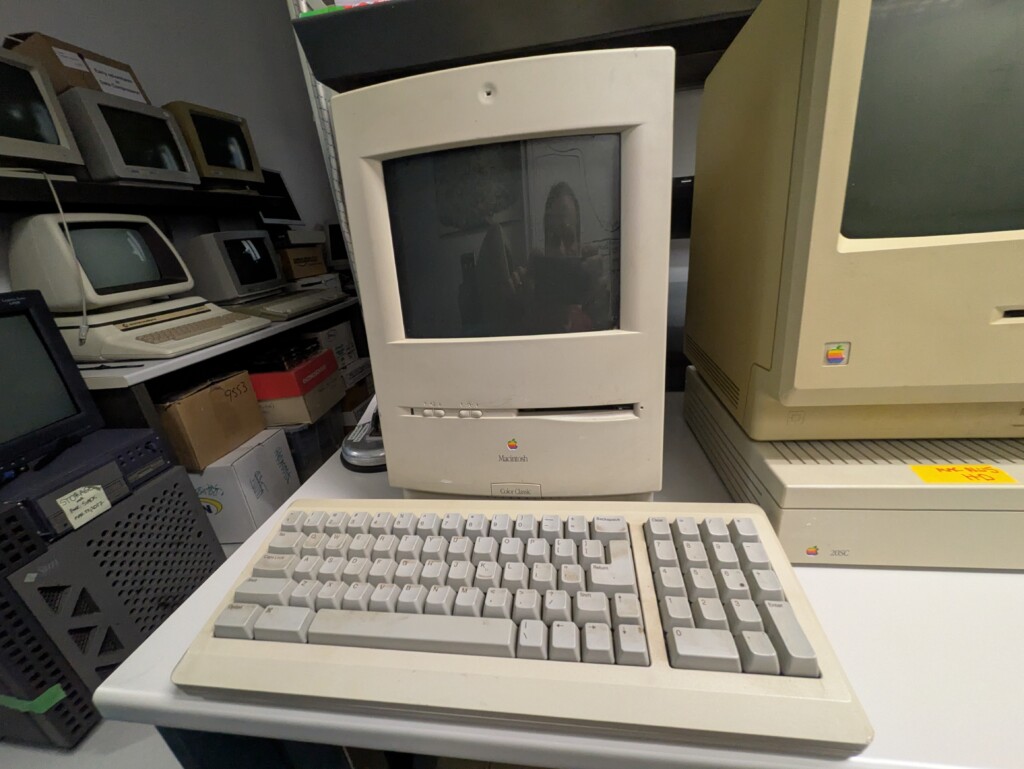
- Manufacturer: Apple Computer, Inc.
- Model: Macintosh Color Classic
- Type: Personal Computer
- Released: February 10, 1993
- List price: $3,350 (*adjusted for inflation)
- MIPS: 3
Hardware Specifications
- CPU: Motorola 68030 running at 16 MHz.
- Memory: 4 MB RAM installed on the logic board; expandable to 10 MB using 30-pin SIMMs.wikipedia+1
- Display: Built-in 10-inch color CRT. Display resolution: 512 × 384 pixels.
- Video memory: 256 KB VRAM standard; expandable to 512 KB.
- Storage: Internal SCSI hard-drive options of 40 MB, 80 MB, or 160 MB, depending on configuration.
- Floppy drive: Built-in 3.5-inch 1.44 MB SuperDrive with automatic disk insertion/ejection.
- Expansion: 16-bit Processor Direct Slot (PDS), compatible with certain LC-series expansion cards.
- Ports: Two ADB ports for keyboard/mouse, two RS-422 serial ports, and an external DB-25 SCSI port.
Operating System & Programming Languages
- Operating Systems
- Original operating system: System 7.1, shipped with the model-specific System Enabler 401.
- Supported releases: Apple lists compatibility with System 7.1, 7.1.1 Pro, 7.5, 7.5.1, 7.5.3, 7.5.5, 7.6, and Mac OS 7.6.1.
- Programming Languages:
- Pascal / Object Pascal: A central early Macintosh development language. Apple’s Macintosh Programmer’s Workshop (MPW) initially supported Pascal, while THINK Pascal and related tools were widely used.
- C: Supported through environments such as MPW C and THINK C; a very common language for classic Mac applications and utilities.
- C++: Available through MPW and third-party environments such as Symantec/THINK tools and Metrowerks CodeWarrior.
- Motorola 68000-family assembly language: The Color Classic’s 68030 could run software written in 68k assembly; MPW included 68k assembler tools. This was used for low-level programming and performance-sensitive code.
- HyperTalk: HyperCard’s English-like scripting language. It was especially suitable for interactive stacks, educational software, simple databases, and multimedia prototypes.
- AppleScript: Available in the System 7 era for automation between scriptable Macintosh applications.
- BASIC: Third-party BASIC implementations could run on it, including Microsoft BASIC, True BASIC, and other period interpreters/compilers.
- FORTRAN and Modula-2: Available through development toolchains such as MPW Fortran and Metrowerks Modula-2.
- Lisp: Available through Macintosh Lisp implementations and MPW-related tools.
- Perl: MacPerl was available for classic 68k Macs, typically with memory and system-version constraints.
- Python: Very early MacPython releases could run on System 7-era 68k Macs, although this would be far less practical than C, Pascal, BASIC, or HyperTalk on a stock Color Classic.
Notables
- The Color Classic was Apple’s first compact, all-in-one Macintosh with a built-in color display
- It was the final model in Apple’s original compact Macintosh family, descended from the 1984 Macintosh, before the larger LC 500-series all-in-one machines took over.
- Apple introduced it on February 10, 1993; it was discontinued in May 1994.
- A familiar Mac, in color: Its 10-inch Sony Trinitron CRT ran at 512 × 384 pixels which is the same resolution used by an LC II with Apple’s external 12-inch RGB display.
- Behind the nostalgic compact case, it was substantially based on the Macintosh LC II architecture: a 16 MHz Motorola 68030 constrained by a 16-bit data bus. That compromise limited its performance and expansion compared with the case’s premium appeal.
- A small screen for the era: It used a 10-inch color CRT when many desktop computers were moving toward larger external monitors. Its compact size was therefore both its defining charm and a practical limitation.
- Apple could use either “Color” or “Colour” branding because the front badge was a separate plastic insert, rather than text molded into the case.
Donated by: T. Warren Christopher