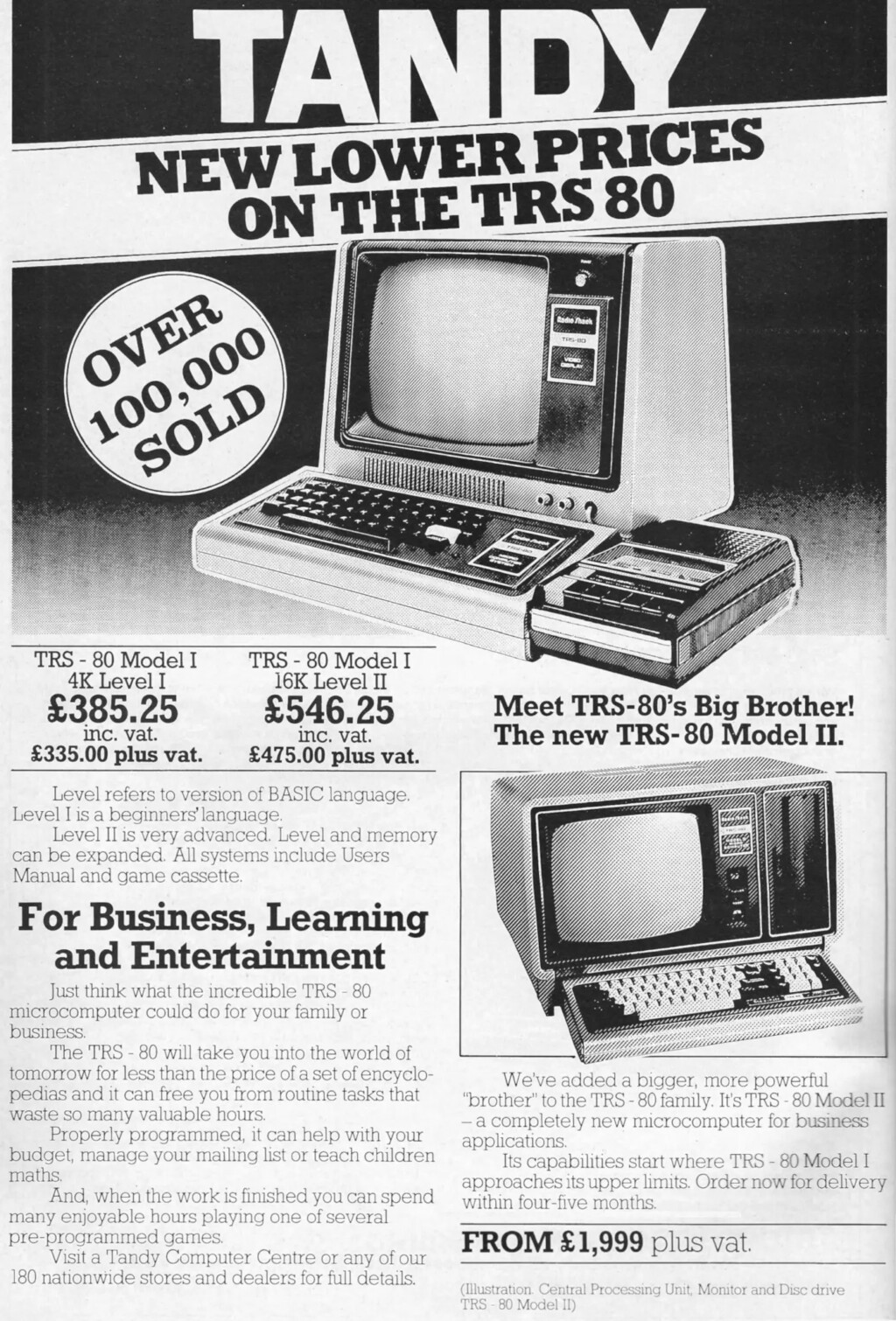
Tandy TRS-80 Model I
The Tandy/Radio Shack TRS-80 Model I, introduced in 1977 by Don French and engineer Steve Leininger, was one of the first personal computers sold as a complete, ready-to-use consumer product rather than a hobbyist kit.
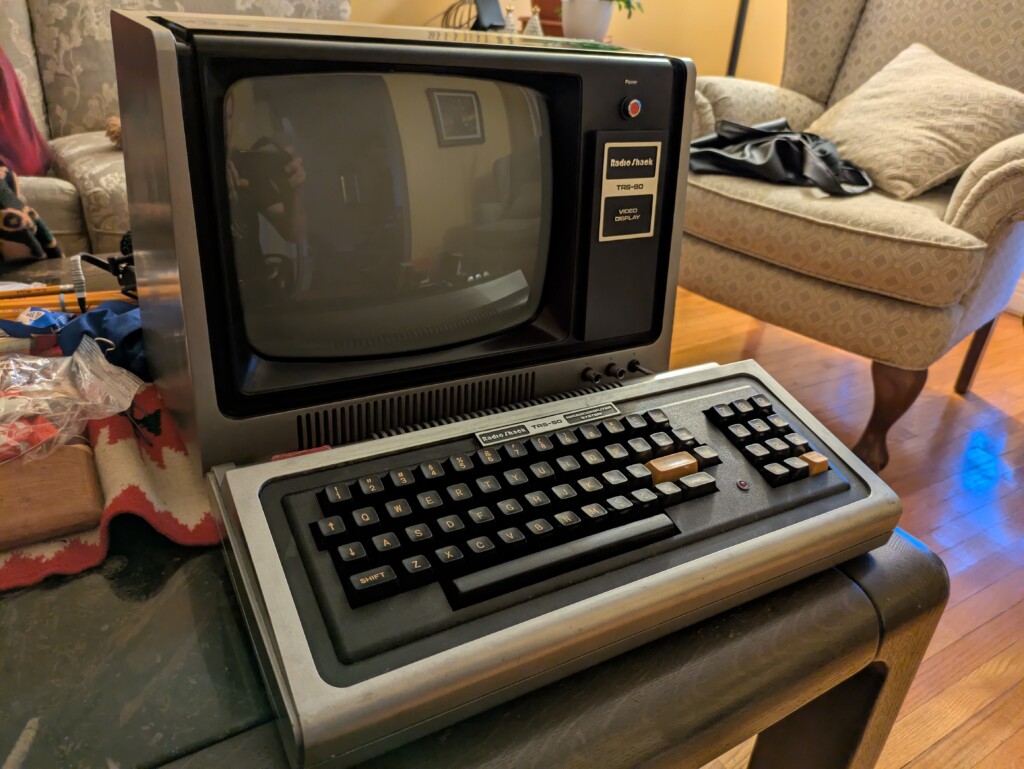
[Vin216]
The 1977 Tandy/Radio Shack TRS-80 Model I became famous as one of the “1977 Trinity” of ready-built personal computers, alongside the Apple II and Commodore PET: its 1.77 MHz Zilog Z80, built-in ROM BASIC, keyboard and monitor package, cassette storage, and later floppy-disk expansion made programming and practical home or small-business computing accessible without building a kit. It was extraordinarily popular for the era and the initial production sold out within a month, Radio Shack sold about 100,000 units in 1978, and its nationwide retail network helped make the TRS-80 the best-selling U.S. microcomputer through its production run proving that a mass market existed for personal computers and helping launch the home computing boom.
- Manufacturer: Tandy Corporation’s Radio Shack division
- Model: Model 1
- Released: 1977
- Type: Personal Computer
- Cost at release: CAD ~$3,000 adjusted for inflation ($599 USD in 1977)
- Cost with peripherals: ~$10,000 adjusted for inflation ($1,995 USD in 1977)
- MIPS: 0.3-0.5 (300-500 KIPS)
-
- CPU: Zilog Z80, 8-bit CPU, 1.77 MHz
- RAM: 4 KB RAM. Supported: 4 KB, 16 KB, or 48 KB total; the optional Expansion Interface could accommodate an additional 32 KB
- ROM: 4 KB Level I BASIC ROM originally; Level II systems used a larger BASIC ROM, commonly described as 12 KB
- Display: Separate 12-inch monochrome CRT monitor, normally displaying black characters on a light screen
- Text: 40 and 80 columns, 24 lines, white-on-black
- Graphics: Low-Resolution 40×48 (16 colors), High-Resolution 280×192 (6 colors), Double-Low-Resolution 80×48 (16 colors), Double-High-Resolution 560×192 (16 colors)
- Text display: 64 columns × 16 lines
- Character set: 64-character alphanumeric and symbol set, with block-style semigraphics
- Graphics: No true bitmap graphics mode; programmable character/semigraphics display gave an effective 128 × 48 block resolution
- Video RAM: 1 KB, memory-mapped at hexadecimal addresses 3C00–3FFF
- Keyboard: Full-travel, 53-key keyboard built into the computer chassis; keyboard matrix was memory-mapped
- Sound: No built-in sound generator or speaker in the base Model I
- Storage: Cassette capable and floppy-drive option
-
- Operating Systems
- Level I BASIC: The operating environment in the first 1977, cassette-based systems. It was a compact 4 KB BASIC interpreter in ROM, written by Model I designer Steve Leininger and derived from Li-Chen Wang’s public-domain Tiny BASIC. In practical terms, BASIC was both the user interface and programming language: turn it on and it presented a
READYprompt. - Level II BASIC: A more capable ROM BASIC, developed by Microsoft and supplied on later Model I systems. Its 12 KB ROM added stronger string handling, error reporting, and mathematical functions, making it the standard environment most collectors associate with the Model I.
- TRSDOS: Radio Shack/Tandy’s floppy-disk operating system for a Model I equipped with the Expansion Interface and disk drives.
- CP/M: An optional, third-party/disk-based operating system for sufficiently expanded Model I systems.
- Level I BASIC: The operating environment in the first 1977, cassette-based systems. It was a compact 4 KB BASIC interpreter in ROM, written by Model I designer Steve Leininger and derived from Li-Chen Wang’s public-domain Tiny BASIC. In practical terms, BASIC was both the user interface and programming language: turn it on and it presented a
- Programming Languages
- BASIC: The central language of the Model I: Level I BASIC on earliest systems; Microsoft Level II BASIC on later or upgraded machines. It was used for learning, games, utilities, hardware control, and small-business programs.
- Z80 Assembly, machine code, Fortran-80, Pascal 80, and other CP/M languages.
- Operating Systems
-
- Introduced on 3 August 3, 1977, the original TRS-80 (only later called the Model I after the Model II arrived) was Tandy/Radio Shack’s first personal computer and a member of the influential “1977 Trinity” with the Apple II and Commodore PET.
- It helped normalize buying a computer from a retail shop rather than building a kit: Radio Shack’s roughly 3,500-store network made it one of the first genuinely mass-market home computers. Early internal forecasts of only 3,000–5,000 annual sales were overwhelmed; more than 10,000 reportedly sold within its first six weeks, and lifetime sales reached about 200,000.
- The name TRS-80 means Tandy/Radio Shack, with “80” referring to the Zilog Z80 processor. Its keyboard-integrated case, 12-inch monitor, cassette storage, and ROM BASIC made it unusually approachable in 1977.
- It was famously and affectionately nicknamed the “Trash-80.” The nickname reflected its low-cost, sometimes temperamental reputation, particularly connector and expansion reliability issues.
- A key historical quirk: the optional 1978 Expansion Interface added floppy-disk control, more memory, and other connectivity, but linked to the computer through a short, unshielded cable carrying critical processor signals. Electrical noise or a poor connection could crash the system an iconic restoration and reliability issue for modern collectors.
- Its 64 × 16 character display and block “semigraphics” were limiting by later standards, yet they supported a prolific ecosystem of BASIC programs, text adventures, business software, and games.
-
Acquired via TRADE: Apple ][ GS for Tandy TRS-80 Model 1