Tandy 1000
The Tandy 1000, launched in 1984, was a landmark home computer known for its affordability, full IBM PC compatibility, and innovative features like enhanced 16-color graphics and three-voice sound, which surpassed the standard capabilities of most PCs at the time.
[vin35]
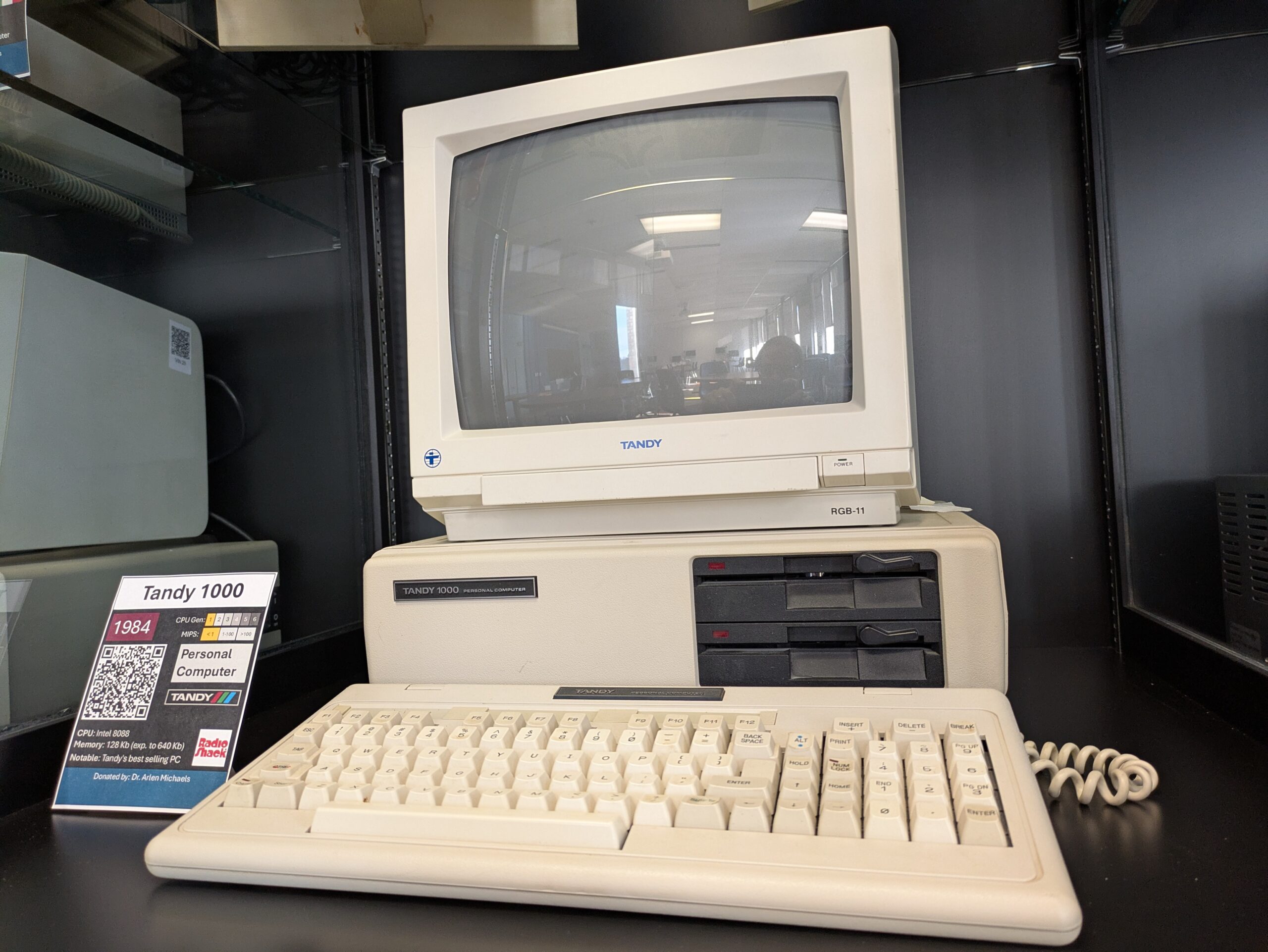
The Tandy 1000 delivered superior multimedia performance and expandability for less money than IBM’s own offerings, making it a favorite for home users and educational markets, and helping Tandy capture nearly 10% of the US home computer market by 1986. The Tandy 1000 was immensely popular, selling several million units, and was widely available in Canada through Radio Shack stores.
- Manufacturer: Tandy Corporation and sold primarily through Radio Shack stores
- Released: November 1984
- Type: Desktop computer
- Cost at release: USD $1,200 (CAD ~$4,000 adjusted for inflation)
- Cost with peripherals: USD $1,800 (CAD ~$6,200 adjusted for inflation)
- MIPS: 0.33 (330 KIPS)
Hardware Specifications
- Processor: Intel 8088 @ 4.77 MHz
- Memory: 128 KB (expandable to 640 KB) RAM
- Storage: 5.25-inch floppy disk drive (single or dual), optional hard drive in later models
- Display: Tandy Graphics Adapter (TGA), compatible with CGA, supporting 16 colors at 160×200 resolution
- Sound: Three-voice sound chip (Texas Instruments SN76496), plus PC speaker
- Expansion: Three ISA slots (8-bit)
- Ports: Parallel, serial, joystick, and keyboard ports
- Keyboard: Full-size, detachable keyboard
-
- O/S: MS-DOS (bundled), compatible with most IBM PC software
- Programming Languages:
- GW-BASIC (bundled and commonly used for learning and hobbyist programming)
- Turbo Pascal and Borland Pascal
- Turbo C, Borland C, and compatible C/C++ compilers
- Microsoft QuickBASIC and BASIC
- Assembly language (using assemblers like MASM)
- Fortran (with appropriate DOS compilers)
-
- The Tandy 1000 was nicknamed the “machine IBM was too inept, incapable, or afraid to manufacture,” highlighting its reputation as the PCjr done right.
- It offered enhanced 16-color graphics and three-voice sound, making it the best PC-compatible computer for games until VGA became standard in the 1990s.
- The Tandy 1000 was the first home PC to popularize features like the inverted-T arrow key layout and function keys grouped along the top, now standard on modern keyboards.
- It sold more units in its first month than any previous Tandy product and quickly became the company’s best-selling computer.
- Its built-in joystick port and affordable price made it a favorite for home and educational use, helping Tandy capture nearly 10% of the US home computer market and regain a significant share of the educational market from Apple.
- The Tandy 1000’s “Tandy-compatible” graphics and sound became a widely supported standard for PC games, with many titles advertising explicit support for the platform.
- DeskMate, its bundled graphical environment, predated Microsoft Windows as a home productivity suite, offering a user-friendly interface before GUIs were common.
- The series remained in production for nearly a decade, with about a dozen models released, and was widely available in Canada through Radio Shack stores, with Canadian-specific support and documentation
-
Dr. Arlen Michaels