Intel SDK-85
Intel SDK-85
[vin42]
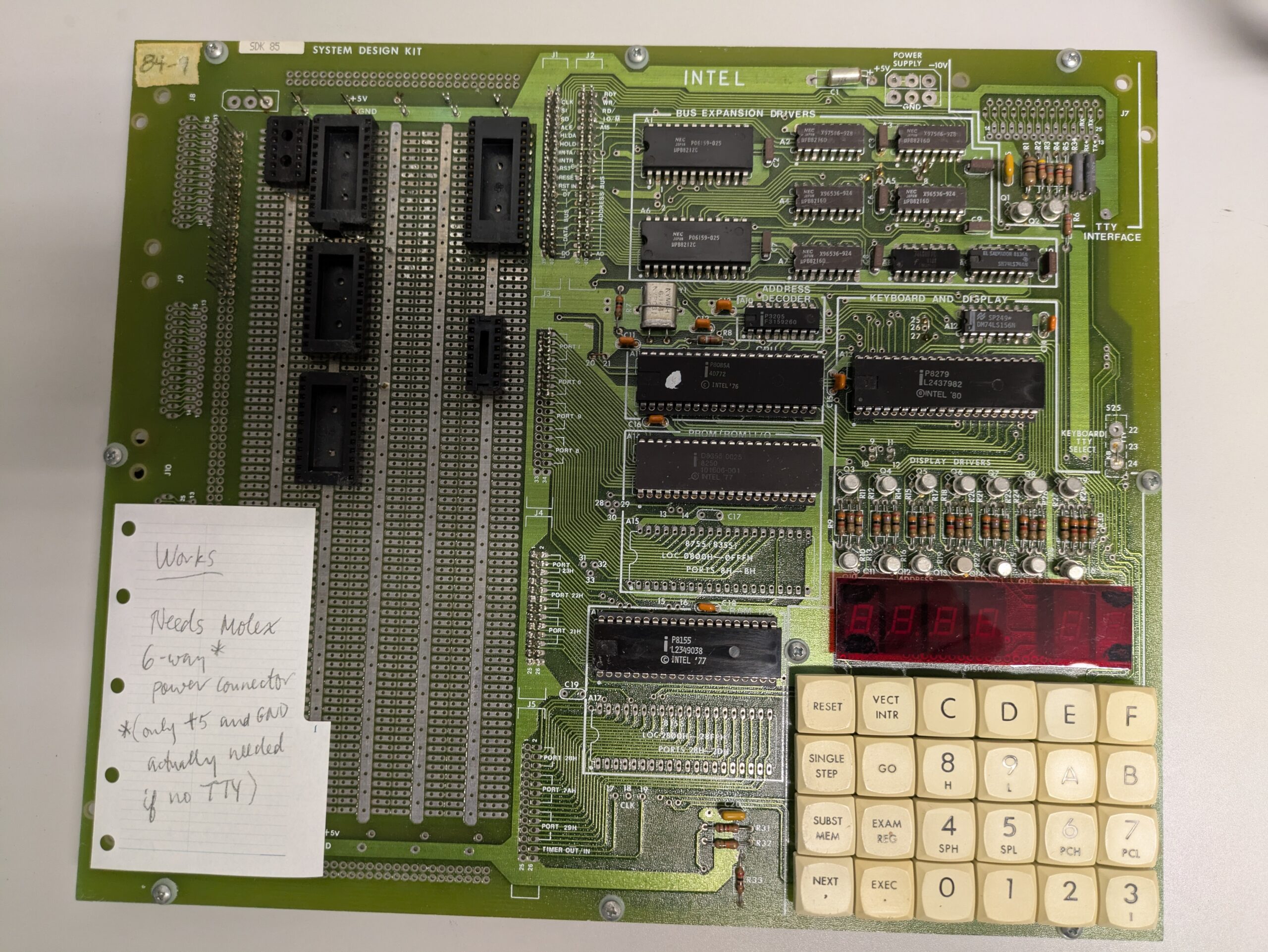
The Intel SDK-85, introduced in 1977, was a pioneering single-board computer designed to showcase and develop for the Intel 8085 microprocessor, featuring a 6-digit LED display, a 24-key hexadecimal keyboard, and expandable RAM and ROM. Its claim to fame was making microprocessor technology accessible to engineers, students, and hobbyists, serving as both a learning platform and a prototyping tool during the early microcomputer revolution
- Manufacturer: Intel
- Type: Single-board computer
- Release Date: 1977
- Cost at release: USD $250 (CAD ~$1,400 adjusted for inflation)
- MIPS: 0.77 (770 KIPS)
Hardware Specifications
- Processor: Intel 8085A running at 3 MHz with a 1.3 μs instruction cycle
- Memory:
- ROM: 2 KB expandable to 4 KB (using 8355 or 8755)
- RAM: 256 bytes expandable to 512 bytes (using 8155)
- I/O:
- 38 programmable parallel I/O lines (expandable to 76 lines)
- Serial interface through SID/SOD pins of 8085
- Display: 6-digit 7-segment LED display
- Input: 24-key hexadecimal keyboard
- Interfaces:
- TTL-compatible bus
- 20 mA current loop for teletype (110 baud)
Operating System & Programming Languages
Operating System: The Intel SDK-85 ran a built-in monitor program stored in ROM rather than a traditional operating system. This monitor provided basic system control, program entry, memory inspection, and I/O functions directly through its hexadecimal keypad or via a teletype interface
Supported Languages: The primary programming language for the SDK-85 was 8085 assembly language, as users wrote and entered machine code or assembly programs directly. Additionally, higher-level languages such as Intel PL/M could be used if cross-compiled on another system and then loaded onto the SDK-85
Notables
The Intel SDK-85 was nicknamed a “system design kit” and was notable for being a complete single-board computer aimed at education, prototyping, and development for the Intel 8085 microprocessor
It featured a rare 24-key hexadecimal keyboard and a 6-digit LED display for direct program entry-unusual for its era
The SDK-85 could interface directly with teletypes using a 20 mA current loop, rather than the more common RS-232, reflecting its roots in early computing labs and industrial environments
Despite only 256 bytes of RAM (expandable to 512 bytes), it was used to build games like Simon and for hardware experiments, showcasing the versatility of minimal hardware
The SDK-85 helped launch the era of hands-on microprocessor learning and rapid prototyping, influencing generations of engineers and hobbyists
Donated by: Arlen Michaels