Kester Dyer
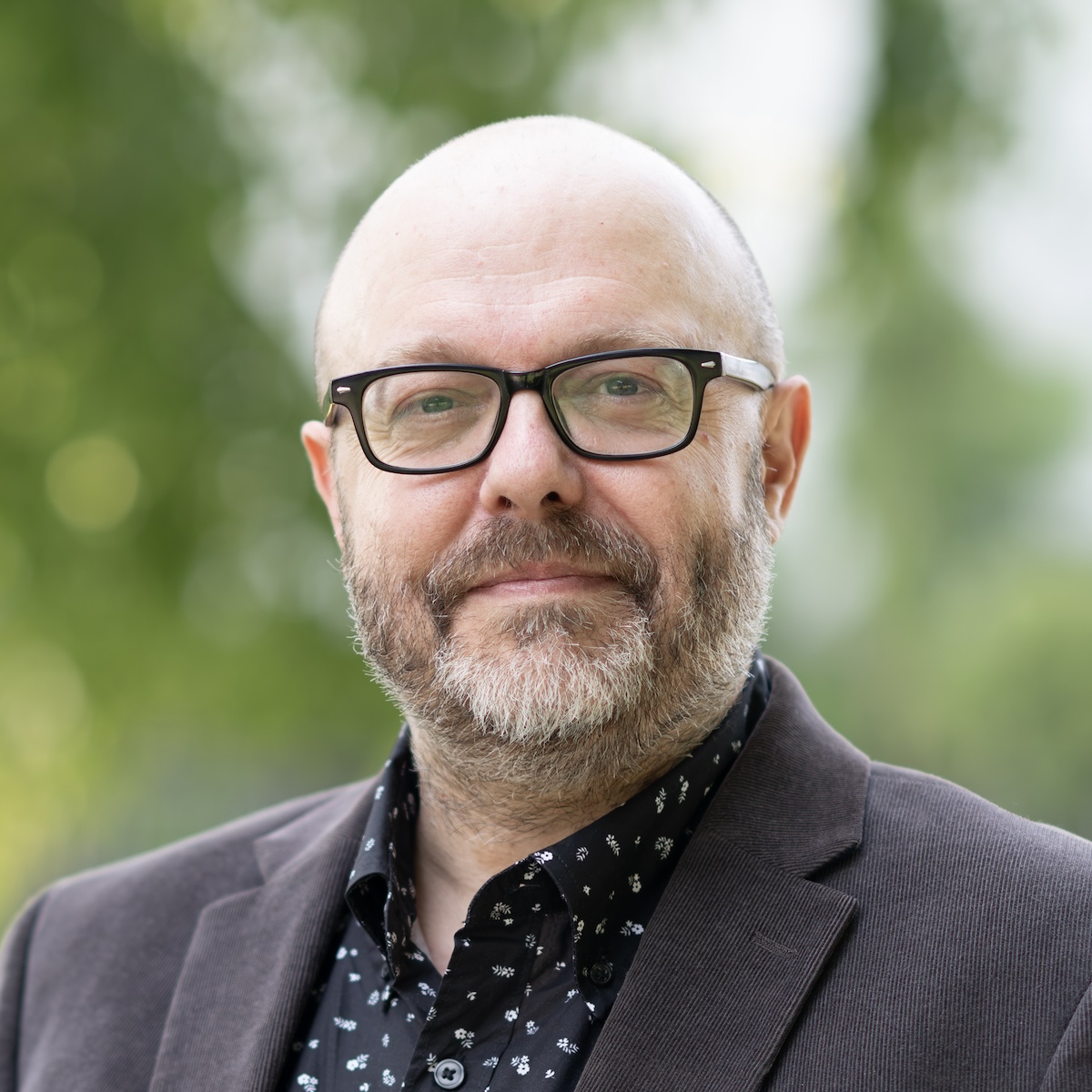
Associate Professor; Undergraduate & Practicum Supervisor
- PhD (Concordia University), MA (University College Dublin), BA (University of Portsmouth)
- Email Kester Dyer
Kester Dyer (he/him) is a settler scholar whose work focusses on Québécois, Canadian, and Indigenous film and media, ecocinema, and film genres, as well as on decolonial and research-creation approaches to film and media. Kester is interested in supervising graduate students and postdocs working in the above-mentioned areas.
Dyer’s current book project titled Otherworldly Incursions: The Supernatural in Québec Cinema is supported by a SSHRC Insight Development Grant and comprises a broad exploration of the Québec film corpus since the 1990s. This project analyzes how supernatural tropes across genres reveal key information about the Québec social imaginary’s struggle to delineate relationships between historically dominant and more marginalized groups, including Indigenous peoples and immigrants.
In parallel, a significant part of Dyer’s work revolves around research-creation. He was awarded the Film Studies Association of Canada’s Gerald Pratley Award for his research on Wapikoni Mobile, a unique transportable production initiative aimed at emerging Indigenous filmmakers. In his ensuing collaboration with Wapikoni, he co-founded (with Liz Miller, Communication Studies, Concordia University) the Circle Visions community-building project. This initiative, supported by several SSHRC grants since 2016, features an annual cross-platform media-making and film programming Summer Institute for Indigenous filmmakers. As part of this project, emerging Indigenous filmmakers from various communities have participated in workshops at both Concordia and Carleton Universities, focussing on different media platforms and techniques, including animation (sand and paper, rotoscoping), drawing on film, experimental video, podcasting, sound recording and design, documentary, underwater camerawork, projection mapping, using green screen and drones, 360-degree and VR filmmaking, and other approaches. Through these workshops, emerging Indigenous artists have developed a range of skills and generated their own short video artworks.
The two most recent production-focussed iterations of our Summer Institute in partnership with Wapikoni Mobile took place at Carleton University in August 2023 and 2024. These workshops involved 15 emerging Indigenous filmmakers, numerous staff, faculty, and student collaborators from across different departments, as well as special guests and local community collaborators such The Asinabka Indigenous Film and Media Festival and Ottawa’s Digital Arts Resource Center (DARC). It was also supported by Carleton’s Centre for Indigenous Support and Community Engagement (CISCE), Research Centre for Music, Sound, and Society in Canada (MSSC), Teaching and Learning Services Media Production (TLS), the Certificate in Journalism in Indigenous Communities (CJIIC) at Carleton, and the Carleton University Art Gallery (CUAG).
Publications
Co-authored with Michelle Smith, Pasha Partridge, Mélina Quitich-Niquay, and Liz Miller. “Decolonizing Documentary Spaces: Enacting Care-full Methods within Educational Institutions.” Journal of Environmental Media. Forthcoming.
“Nationhood, Otherness and Decoloniality: Time and Space in Québec’s Renouveau.” Journal of Cinema and Media Studies 64.5, 2025.
“A Transportable/Transnational Cinema: Wapikoni Mobile.” Teaching Migration in Literature, Film and Media. Edited by Masha Salazkina and Yumna Siddiqi. The Modern Language Association of America, 2025. 85-101.
“Angry Inuk, Listening to Science, and the Perpetuation of the Climate Crisis in Film.” Canadian Journal of Film Studies 32.2 (Fall 2023): 7-34.
“Science Fiction, National Rebirth, and Messianism in Un 32 août sur terre.” ReFocus: The Films of Denis Villeneuve. Edited by Jeri English and Marie Pascal. Edinburgh University Press, 2022. 23-40.
“Anticipating the Colonial Apocalypse: Jeff Barnaby’s Blood Quantum.” Pandemic Media: Preliminary Notes Toward an Inventory. Edited by Laliv Melamed, Vinzenz Hediger and Philipp Keidl. Meson Press, 2020.
“Landscape, Trauma, and Identity: Simon Lavoie’s Le torrent.” A Cinema of Pain: Essays on Quebec’s Nostalgic Screen. Edited by Liz Czach and André Loiselle. Wilfrid Laurier Press, 2020.
“Léolo’s Fantasized Italy: Family Romance and Accented Cinema in Québec.” Journal of Italian Cinema and Media Studies. 5.1 (Jan 2017): 47-64.
“Indigenous Cinema, Hamlet, and Québécois Melancholia.” In the Balance: Indigeneity, Performance, Globalization. Edited by Helen Gilbert, J. D. Phillipson, and Michelle H. Raheja. Liverpool University Press, 2017. 105-122.
« Le ‘refus’ dans la télésérie Mohawk Girls de Tracey Deer. » Télé en séries. Edited by J-O Allard, E. Després, S. Harel, M.-C. Lambert-Perreault. Montreal: Éditions XYZ, 2017.
Guest Editor with Fulvia Massimi and Andrée Lafontaine of “Locating the Intimate Within the Global: Xavier Dolan, Queer Nations and Québec Cinema” for Synoptique: An Online Journal of Film and Moving Image Studies 4.2 (March 2016).
« Miracles, mythes, cinéma : La vraie nature de Bernadette et The Butcher Boy. » Le Québec et l’Irlande : Culture, histoire, identité. Edited by Simon Jolivet, Linda Cardinal, Isabelle Matte. Québec City: Éditions du Septentrion, 2014. 166-196.