Chet Mitchell Award Winner: Daphne Duruoha
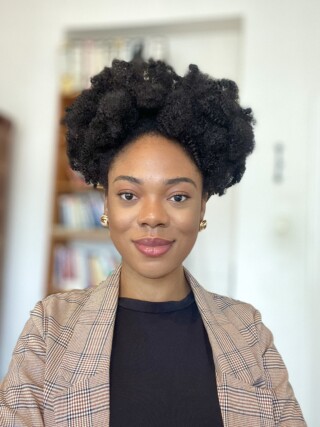
Meet Daphne Duruoha! Daphne is originally from Nigeria, but came to Carleton last fall from Berlin, Germany to pursue a Master of Arts in Legal Studies. Daphne is currently wrapping up the first year of her program and will be pursuing the Major Research Essay (MRE) stream going into the second year of her program.
Daphne is the recipient of this year’s Chet Mitchell Memorial Award in Law, which is given annually to a deserving student enrolled in the Master of Arts program in Legal Studies. Daphne was nominated by several faculty members who all had incredibly positive things to say about her academic skills, intellectual curiosity, and collegiality.
What led you to pursuing your MA in Legal Studies at Carleton?
The interdisciplinary and interpretive nature of the MA here at Carleton is what drew me in. For my undergrad, I did an LL.B. and specialized in International Law. A lot of that was helpful for familiarizing with doctrinal legal provisions and their applications, but I knew that if I wanted to truly make an impact in the legal field, I needed to understand the law differently. How it works in everyday life, how it has come to be what it is, how it is interpreted (even resisted), and how it shapes our social and material realities. So far, the MA has really delivered on that. It has strengthened my research and writing skills, and I’ve especially enjoyed the qualitative sidemof it. I love writing (creative non-fiction in particular) so learning how to translate that into academic research has been exciting. That’s not to say I’m not sometimes close to fainting in the process (haha), but it has definitely equipped me and nudged me out of my comfort zone.
Tell me more about your research, and what do you hope to gain out of it by the time you complete your degree?
My current research looks to capture marginalization from a more nuanced perspective. I’m working on developing a concept I’ve called Legal Perpetuities. To put it simply, it looks at how the law can contribute to forms of marginalization that persist across generations, and how this affects certain groups, keeping them structurally dispossessed within social systems. Theorizing in the manner that I look to approach it can be very delicate, so
while I’m consulting on the possibilities of that idea, I’m also developing research on emerging technologies, particularly artificial intelligence, and how optimism around these technologies shapes the law. By the time I complete my degree, I really hope to have stretched my intellectual capacity. How I interpret and apply law and policies, as well as how I write about it.
What advice would you give to incoming students?
If I had to give any advice, it would be not to underestimate the value of faith and consistency. I’ve had quite a long journey getting here, and sometimes I wonder how different things would have been if I wasn’t consistent with my choices and didn’t trust them with God. I’d also say, speak up. In Chimamanda Ngozi Adichie’s speech titled Never
Admire Quietly, she says to speak, speak freely, speak kindly. Because human beings are fragile and life is fleeting. I take this advice with me into academia and often encourage everyone not to be afraid to sound silly, too
knowledgeable, or even a bit awkward. We are here to explore and grow, and that only really happens when you
participate fully. Engaging in classes, sharing ideas and taking part in activities will help you make the most of your experience at Carleton (and possibly, really have fun while at it).
Are you interested in learning more about our graduate programs? You can find more details here!