- What is Experiential Learning?
- Project Types
- Eligibility
- Eligible Expenses
- Application Process
- Evaluation Criteria
- Reporting
- Appendix A
- Previous Recipients
At TLS, we recognize that the development of experiential learning opportunities requires support. The goals of the Carleton University Experiential Learning Fund (CUELF) are to help expand and enhance existing experiential learning initiatives and promote awareness of experiential learning across Carleton.
What is Experiential Learning?
The experiential learning cycle (Fig. 1) is when a learner makes meaningful connections (reflection) between their experiences (action) and conceptual understandings (theory). Learners can start anywhere in the cycle and would ideally complete more than one full cycle of reflection-theory-action.
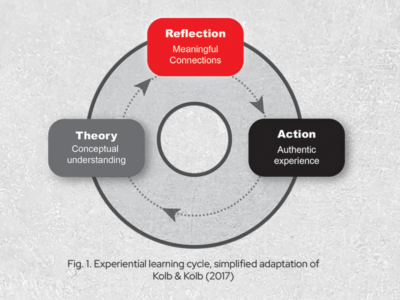
Reflection can happen in a wide variety of ways: written reflections or journals, individual or group debriefs, annotated assignment submissions, and more. Action can take place in the classroom, the community, a real or simulated workplace, or a combination of these. Theory can be related to academic content, personal or professional growth, civic impact, and more.
Learn more about Carleton’s 12 types of experiential learning activities.
Project Types
In winter 2026, CUELF funding will provide financial support of up to $2,500 for experiential learning projects within a single credit course. Program-level initiatives will not be supported in this call.
If your request is for less than $500, we recommend that you contact your department chair as a first step to inquire about the availability of departmental funds.
Eligibility
Instructors and faculty members are eligible to apply. A letter of support from your department head is not required.
Learning support staff and contract instructors are eligible to apply. A letter of support from your department head is required, as the department head will be designated as the administrator of the funds. Letters can be submitted with your CUELF application or emailed to tls@carleton.ca.
Eligible Expenses
Eligible expenses include but are not limited to hiring research assistants* (RAs), support for off-campus activities (e.g. transport, admission fees), support and honoraria for community/industry partners, event costs, purchase of equipment or technology.
Ineligible expenses include but are not limited to reimbursement or honoraria to Carleton faculty/instructors/staff, honoraria for guest speakers, memberships, conference costs (e.g. registration, travel, accommodation, food expenses).
Reach out to tls@carleton.ca or submit a support request to the TLS support portal with any questions about eligible expenses.
*Refer to the latest CUPE 4600 (Unit 1) collective agreement for current salaries, regulations and restrictions regarding RAships.
Application Process
The call for applications for winter 2026 is now closed.
To apply, you will need to submit an online application form along with any additional documents, if applicable. Please review the requirements for letters of support. Letters can be submitted via the CUELF application form or emailed to tls@carleton.ca.
We will notify applicants whether their application has been successful within four weeks of the application deadline.
Evaluation Criteria
Projects will be evaluated according to the following criteria:
- The project aligns with the CUELF goals and Carleton’s guidelines for experiential learning (see Appendix A)
- The project includes all elements of the experiential learning cycle (see Fig. 1).
- The project supports course learning outcomes with relevant activities and assessments.
- The project has the potential to support student learning over more than one term (e.g. recordings, reusable materials).
- The proposed budget is reasonable given the scope and anticipated impact of the project.
Other factors that may be taken into consideration in the adjudication process include the balancing of funds across faculties and whether TLS has previously funded the project and/or applicant.
Reach out to tls@carleton.ca or submit a support request to the TLS support portal with any questions about the application process or evaluation criteria.
Reporting
One of the aims of the fund is to build awareness and capacity around experiential learning at Carleton. To support this aspect, all CUELF recipients are expected to share back the results of their project with the Carleton teaching and learning community. For example:
- A story for the TLS newsletter
- A blog post for the TLS blog
- Participation in a future teaching and learning conference or symposium (e.g. InspirED 2024: CU Teaching Innovation Symposium)
- Participation in a workshop, panel discussion or other type of TLS event
- A new/revised resource about experiential education (e.g. for the Experiential Education website)
In your application, you will be asked to identify possible ways you can envision sharing back. We will reach out to successful applicants to discuss the details of the share-back.
Appendix A
Goals of CUELF
- Increase the number of experiential learning opportunities for Carleton students, particularly in programs that may not have many experiential learning opportunities
- Enhance and/or expand existing experiential learning opportunities
- Build awareness of experiential learning at Carleton
Carleton Guidelines for Experiential Learning Opportunities
The following Carleton guidelines have been developed in order to identify which Carleton courses include experiential learning. In order to be considered as experiential learning, course activities must satisfy the following criteria:
- The activity must meet the requirements of MTCU’s Experiential Learning Guiding Principles (see below).
- The experiential learning activity must be significant. This means that the activity is an integral part of the course but the course may also have elements that are more traditional. A portion of the student’s assessment in the course relies on engagement in the experiential learning activity.
- The experiential learning activity is intended to be a continuing element of the course. For course projects, this means that the project is designed and implemented in such a way that it can be repeated and/or shared with other faculty teaching the course. For program level projects, this means that the experiential learning activity is built into the course and is not dependent on which instructor teaches the course.
- The experiential learning activity can be categorized into one of the 12 types.
MTCU Guiding Principles for Experiential Learning Projects
To count as experiential learning, an activity must satisfy all of the following criteria:
- The student is in a workplace or simulated workplace.
- The student is exposed to authentic demands that improve their employability, interpersonal skills and transition to the workforce.
- The experience is structured with purposeful and meaningful activities.
- The student applies university or college program knowledge and/or essential employability skills.
- The experience includes student self-assessment and evaluation of the student’s performance and learning outcomes by the employer and/or university/college.
- The experience counts towards course credit or credential completion OR is formally recognized by the college or university as meeting the five criteria above.
Previous Recipients
Congratulations to all previous fund recipients.