Immersive Learning
Are you struggling to overcome logistical hurdles like site visits, or finding it hard to teach high-stakes skills or complex empathy in the classroom?
Immersive technologies, including VR, AR and XR, are here to solve those dilemmas. The Experiential Learning Hub is ready to support your project by providing the tools to place students directly inside the learning content, transforming abstract theory into powerful, embodied skill practice.
Looking for inspiration? Below you’ll find examples of how some instructors at Carleton have leveraged immersive technologies in their courses.
Manjeet Birk: Creating HOME – An Immersive Solution for Teaching Abstract Concepts
Manjeet Birk faced a key teaching challenge: presenting marginalized experiences in a way that moves beyond trauma-based narratives to explore the universal experience of belonging. To address this gap and offer a fresh perspective, she partnered with the Experiential Learning Hub to produce HOME, a 360-degree immersive media experience.
This innovative project immerses students into the often-complex relationship we have with “home,” wherever that may be. The embodied understanding achieved is difficult to create through traditional discussion. The immersive media fosters critical reflection and builds a safer classroom community where marginalized voices are given powerful presence, transforming abstract theory into immediate, shared insight.
Jennifer Drake: Bridging the Gap Between Paper Calculations and Real-World Scale
Jennifer Drake faced a significant teaching problem in her Civil Engineering course: municipal hydraulics infrastructure is often “buried, out of sight, out of mind.” This prevents students from appreciating the system’s massive scale and scope. Logistics like expense, safety hazards and distance make physical site visits impossible. Her solution was to partner with the Experiential Learning Hub to create a stormwater VR field trip.
This tool allowed students to virtually enter inaccessible spaces, such as a 40,000 cubic meter tank. The VR experience gave them a tactile understanding of structures that previously only existed as calculations on paper. It turned inaccessible infrastructure into a key part of the curriculum, making complex engineering concepts immediately impactful.
Sara Jamieson: Connecting Course Content With Living Indigenous Knowledge
The challenge of teaching students that Indigenous knowledge exists everywhere, moving beyond static textbooks, often leaves course material feeling abstract. Kahente Horn-Miller solved this by partnering with the Experiential Learning Hub to create the VR experience, Wa’ötši’gwa:to’ (she dropped in for a short while). This 360-degree cinematic tool immerses students in a replica Longhouse and guides them through foundational Haudenosaunee practices and protocols.
Sara Jamieson incorporated the VR experience into her second-year English course and the impact was profound: students reported the experience challenged the myth that Indigenous peoples are “of the past.” They made deep connections between the tangible virtual content (like cornbread making) and abstract course readings on food sovereignty and colonialism. The VR space made complex knowledge immediately accessible and relevant.
Kester Dyer: Beyond the Frame – Directing Empathy Through Immersive VR
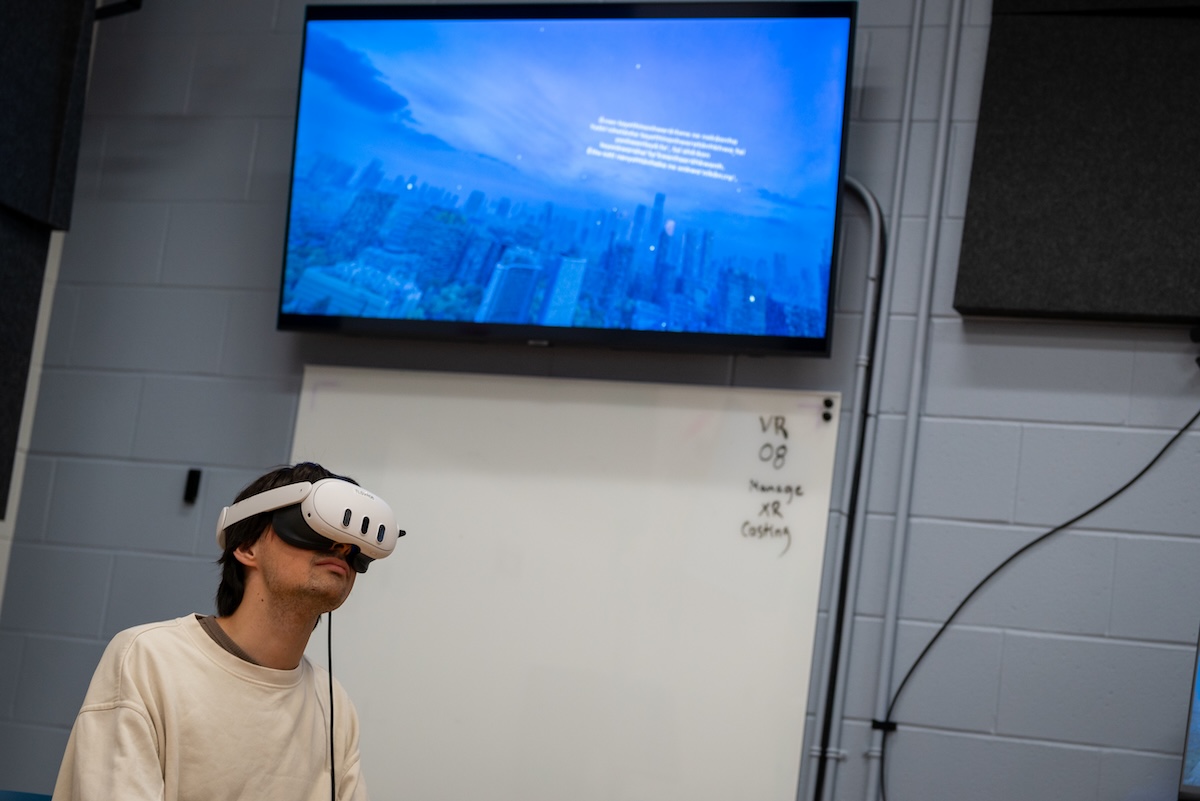
Kester Dyer faced the teaching challenge of moving students beyond passive viewing to engage critically and empathetically with marginalized narratives. As an early adopter of Experiential Learning Hub services, he regularly integrates VR titles, such as William, Biidaaban and Driving While Black into his curriculum.
These immersive titles solve the problem of distance by placing students inside culturally significant scenarios. Students are forced to confront complex themes such as systemic racism, Indigenous sovereignty and futurism in an embodied way. By leveraging the Experiential Learning Hub’s resources, Prof. Dyer transforms abstract lecture topics into powerful, personal experiences that foster critical reflection.
Derek Gransden: From Textbook to Takeoff – Copiloting Decisions in Flight Sim
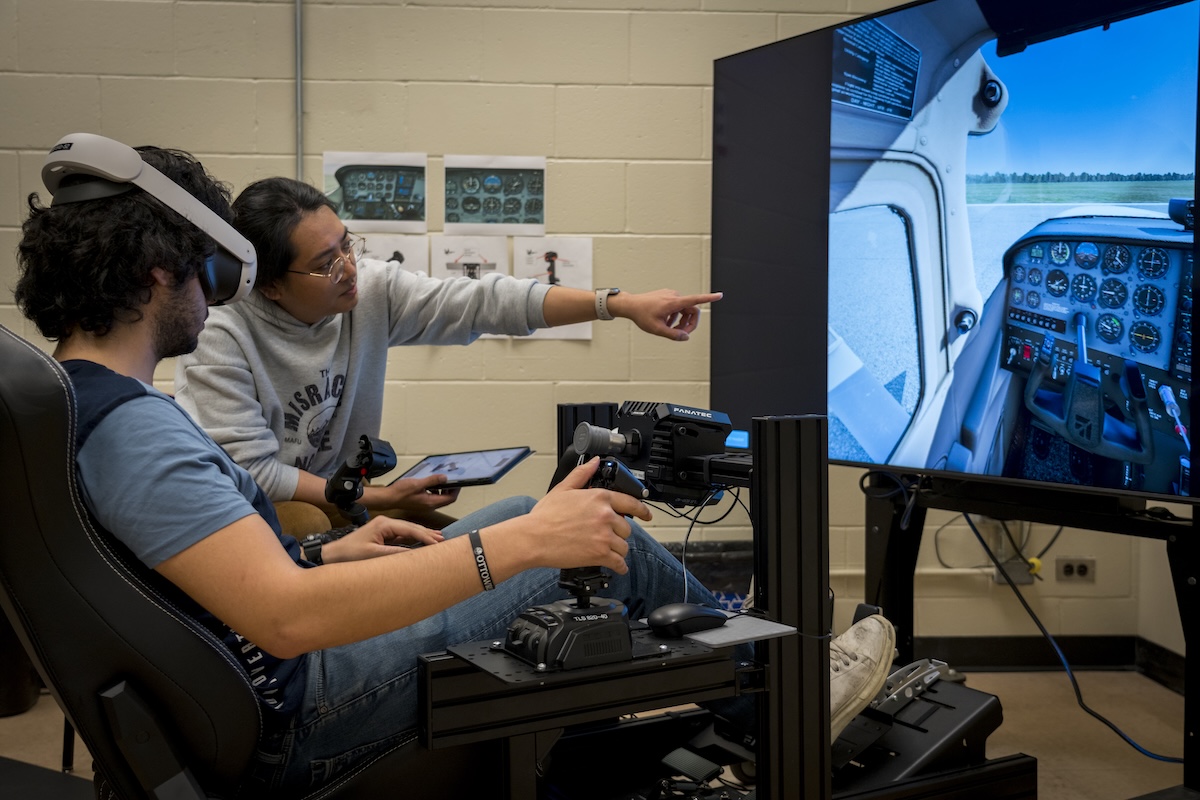
In his fourth-year aerospace engineering course, Derek Gransden faced the challenge of translating complex systems design theory into a practical, real-world context for a large class. He needed a way to create an accurate environment for students to practice core concepts, such as cockpit situational awareness, crew and resource management, and avionics.
Gransden found the solution through the Experiential Learning Hub’s custom sim rig flight simulator. Pairs of students, working as pilot and co-pilot, were tasked with performing flight manoeuvring exercises standard in a Transport Canada-approved flight test, such as taking off, performing turns and even stalling (and recovering) the aircraft. Through the sim rig, students received resume-ready skills practice that could typically only happen through expensive discovery flights.
Book a Consultation
Ready to explore the possibilities of immersive learning in your course? Book a consultation with our team!
Trouble accessing the form? Try clearing your cache or using Incognito mode in your browser.