Congrats to Team Ravens – VFS Student Design Competition Best New Entrant!
Carleton University’s Team Ravens proudly received the Best New Entrant Award in the Undergraduate Category of the 43rd Annual Vertical Flight Society (VFS) Student Design Competition. Sponsored by Leonardo Helicopters, this year’s competition challenged university teams to redesign the historic XV-15 tiltrotor aircraft using hybrid-electric propulsion. Read more about Team Ravens and their design below.
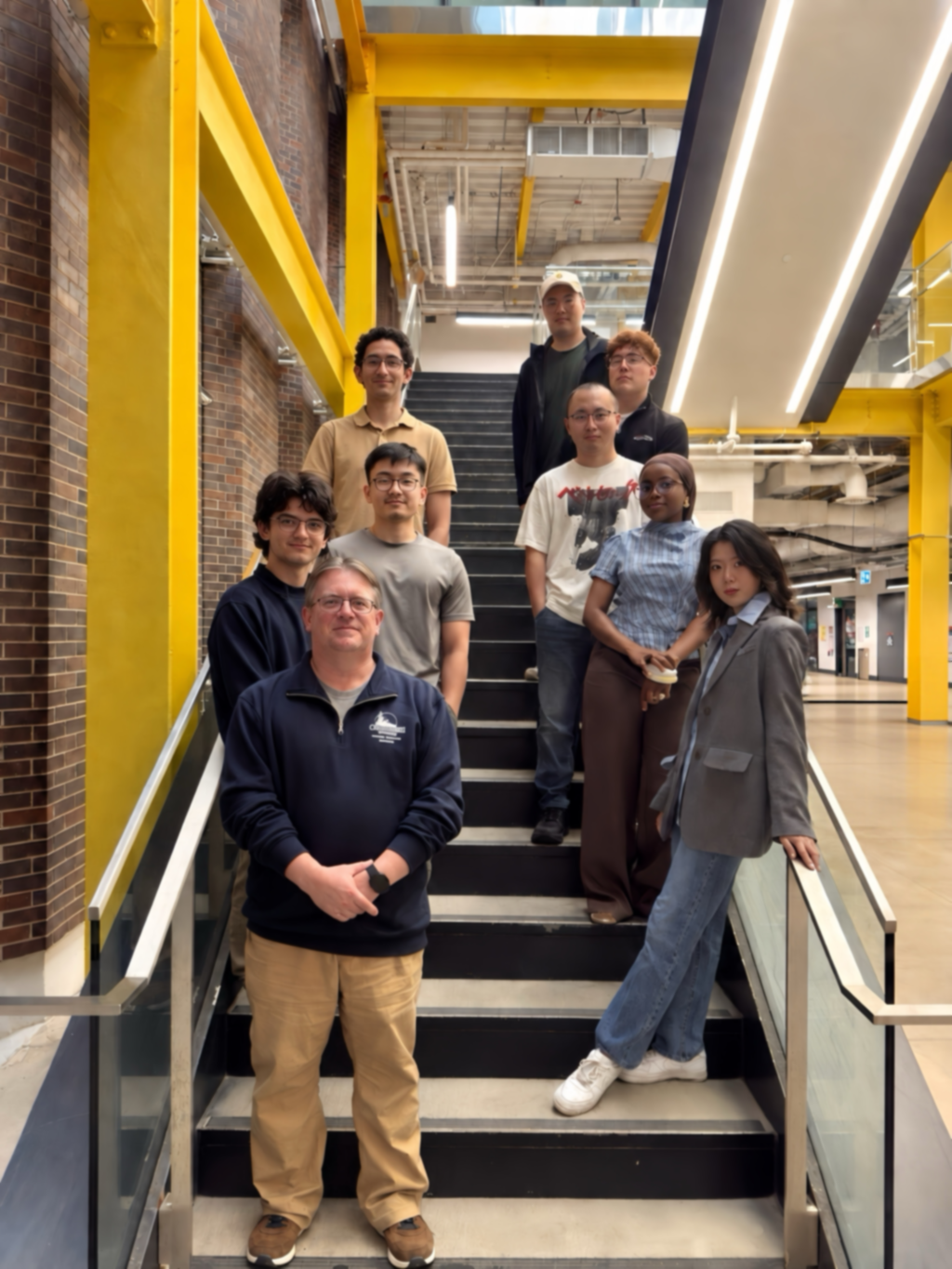
Photo credits to Team Ravens.
Written by William Chen, Team Captain:
About the team:
The name “Ravens” was chosen both to represent Carleton University and its mascot and to reflect the unique capabilities of a tiltrotor aircraft — a vehicle capable of hovering and taking off vertically like a helicopter while also transitioning into efficient, high-speed airplane flight.
Throughout the project, our team worked under the supervision of Professor Jeremy Laliberte from Carleton University’s Department of Mechanical and Aerospace Engineering. The project gave us the opportunity to apply concepts learned throughout our aerospace engineering studies to a complex, multidisciplinary aircraft design problem.
Receiving the Best New Entrant Award was especially meaningful to us as a first-time entrant in the competition and recognized the months of research, engineering analysis, trade studies and teamwork that went into our final proposal.
About the competition:
The Vertical Flight Society Student Design Competition is an international university aircraft design competition focused on advanced vertical flight technology.
For the 43rd Annual Student Design Competition, sponsored by Leonardo Helicopters, teams were challenged to develop a Hybrid Electric Tiltrotor based on the Bell/NASA XV-15 research aircraft.
The competition required a two-phase design approach. In Phase I, teams had to retain much of the original XV-15 configuration while integrating a hybrid-electric propulsion system. Phase II allowed greater design freedom to further improve aircraft performance while maintaining several important characteristics of the original aircraft.
Teams were required to evaluate not only aircraft performance, but also propulsion architecture, weight, aerodynamics, structures, reliability, manufacturability, technology readiness and overall system feasibility. Trade studies and engineering justification were an important part of the evaluation process.
About the aircraft we designed:
Our final concept retained the XV-15 as the foundation of the aircraft while introducing a parallel hybrid-electric propulsion architecture.
For Phase I, our design combined the aircraft’s conventional turboshaft propulsion system with a Proton Exchange Membrane Fuel Cell (PEMFC)-based electric power system. The hybrid architecture was developed to provide electrical power contribution while working within strict aircraft weight, geometry and mission-performance constraints.
A major part of the design process involved determining where electrification could provide the greatest benefit without adding excessive system mass. This required detailed analysis of the fuel-cell system, hydrogen storage, electric machines, power distribution, thermal management and other balance-of-plant components, together with aircraft-level performance and weight calculations.
For Phase II, the team investigated additional improvements including composite structural components, aerodynamic refinements, weight reduction and flight-control improvements. These modifications were evaluated as part of a complete aircraft-level design rather than as isolated technologies.
Throughout the project, our team developed performance models for hover, climb, cruise, descent, short takeoff and landing, one-engine-inoperative conditions, payload-range capability and the aircraft flight envelope. We also evaluated how changes to individual subsystems affected the performance and feasibility of the aircraft as a whole.
One of the most valuable lessons from the competition was that aircraft design is fundamentally a multidisciplinary process. A change to propulsion affects weight; weight affects hover power and range; structural changes influence aeroelastic behaviour; and changes in propulsion and aerodynamics can ultimately affect flight control and aircraft operation.
The project gave our team an opportunity to move beyond individual coursework and experience the iterative engineering process involved in developing and defending a complete aircraft concept.
The project gave our team an opportunity to move beyond individual coursework and experience the iterative engineering process involved in developing and defending a complete aircraft concept.
We would like to thank Professor Jeremy Laliberte for his guidance and support throughout the project, as well as everyone at Carleton University who provided advice and feedback during the design process.
We are proud to have represented Carleton University and the Department of Mechanical and Aerospace Engineering in the 43rd Annual VFS Student Design Competition, and we are honoured to have our work recognized with the Best New Entrant Award.
To view the News on VFS website, please click here.
Yuxuan (William) Chen
- Team Leader
Tanya Chang
- Phase 2 Aerodynamic Design
Yancheng (Marx) Ding
- Mechtronics Design
Timothy Qin
- MATLAB Digital Twin
Xuan Nie
- Structural Framework Design
Faraz Ali Khan
- Aerodynamics & Weight Analysis
William Kruse
- PEMFC System Evaluation
Mutihat Apelogun
- Avionics Control Analysis
Adam Drissi
- FAA Powered-Lift Provision Analysis
Louis Vu
- Auto-rotation Analysis